


Urban planning experts, policymakers and academics have warned that Nigeria’s fragmented land-use classification systems are undermining planning efficiency, revenue generation and sustainable development, calling for the urgent adoption of a single, standardised and digitally encoded framework to support spatial data integration and smart-city ambitions.
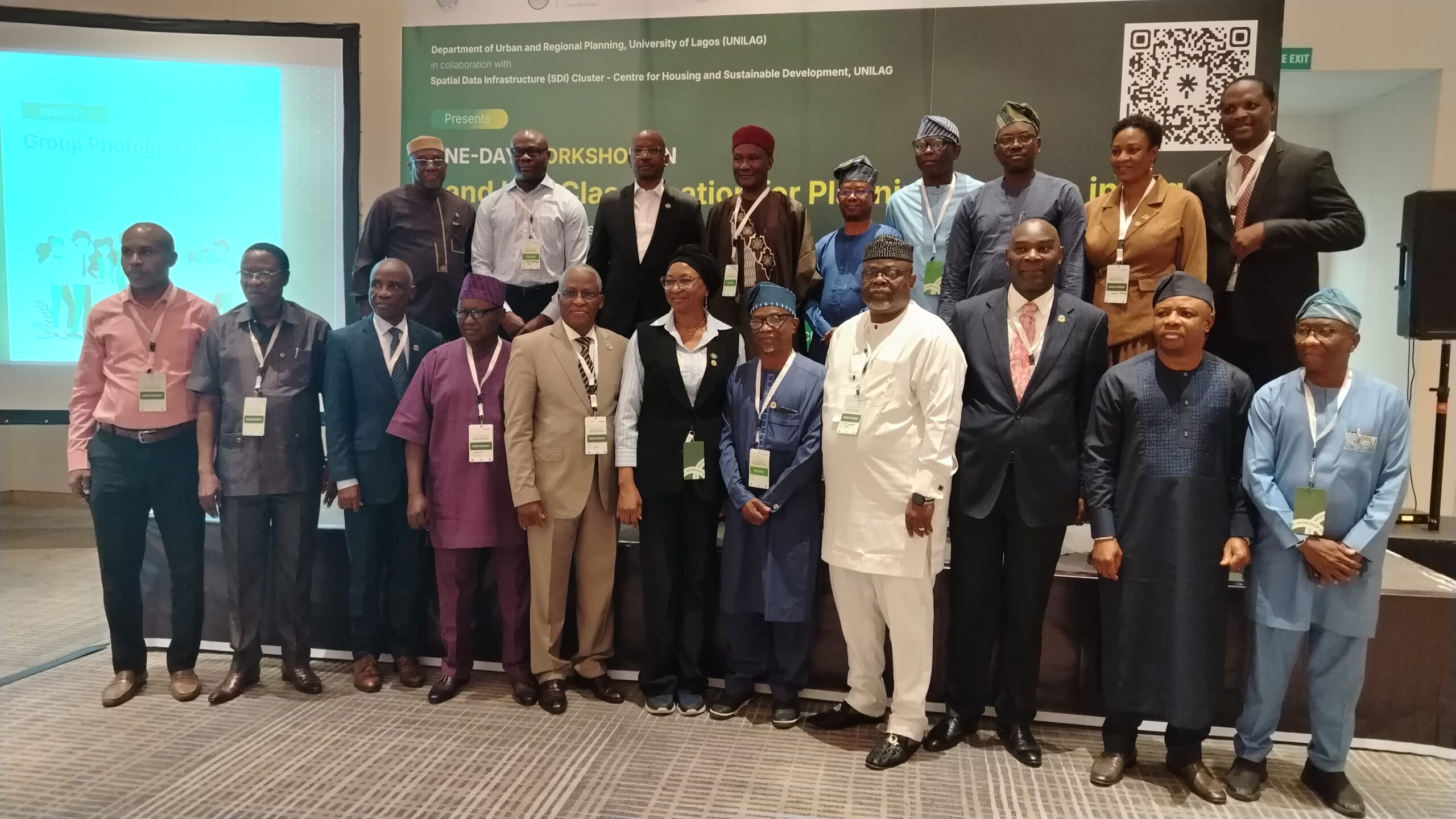
The call was made at a one-day national workshop on land-use classification for planning practice in Nigeria, organised by the Department of Urban and Regional Planning, University of Lagos (UNILAG), in collaboration with the Spatial Data Infrastructure (SDI) Cluster of the Centre for Housing and Sustainable Development, UNILAG.
The workshop, held at the Marriott Hotel, Ikeja GRA, Lagos, brought together professionals from government, academia and the private sector.
Participants said a unified, digitally encoded land-use classification system is critical to addressing Nigeria’s planning challenges, improving governance efficiency and advancing sustainable development at local, state and national levels.
Fragmentation as a development challenge
The workshop facilitator, Muyiwa Agunbiade, a professor and SDI-Cluster Lead at UNILAG, said the absence of a common land-use language has resulted in multiple, inconsistent classifications across ministries, departments and agencies (MDAs), as well as local governments, undermining planning and revenue systems nationwide.
“The fragmented nature of existing datasets hampers effective coordination, planning and implementation. Land use classification provides the building blocks for spatial data infrastructure. By developing efficient land-use classification, we can improve data integration, quality, accessibility, and analytical capabilities. With this, we can collectively improve revenue and make Nigerian cities smart,” Mr Agunbiade said.
According to him, a standardised classification system would improve data integration, accessibility and analytical capacity, while strengthening zoning logic, protecting community character and reducing duplication of mapping efforts.
He said, “It matters for the preservation of community character. It strengthens zoning logic to protect established neighbourhoods, supports orderly densification and regeneration aligned with state policy, and establishes a shared data foundation across all MDAs and LGAs.
“It reduces manual reconciliation across agencies, eliminates duplication of mapping efforts and conflicting datasets, and enables cross-validation between approved land use, actual land use and tax records.”
Mr Agunbiade added that land-use data underpins planning approvals, infrastructure delivery, taxation, environmental management and investment decisions, warning that without standardisation, states would struggle to achieve e-planning or smart-city goals.
“Without a standardised classification, no state government can fully achieve e-planning or smart-city ambitions. The government can also significantly generate revenue if there is a proper cadastral system,” he said.
He noted that in Lagos, a unified digital land-use classification could unlock substantial fiscal benefits without raising tax rates.
“A unified system can conservatively unlock between N40 – N60 billion annually for Lagos State alone by fixing misclassification, closing revenue leakages, improving approvals, capturing land value and reducing waste, without raising tax rates,” he said.
Standardisation, governance and sustainability
In his keynote address, the Vice-Chancellor of Ahmadu Bello University, Zaria, Adamu Ahmed, a professor, said land-use classification must go beyond revenue considerations to support sustainable development.
The vice chancellor who was represented by the Permanent Secretary, Ministry of Land and Survey, Niger State, Abdul Hussein, also emphasised that land classification must also become digitised.
he said: “We need to work as professionals collaboratively. It is important to look at how to standardise GIS to work towards a common goal, the Spatial Data Infrastructure. We must go beyond revenue. The ability to achieve sustainable development through SDI is beyond revenue. Sustainable development cannot be achieved if we cannot work together.”
Earlier, in his welcome address, Mr Agunbiade likened the lack of land-use standards in Nigeria to speaking without an alphabet.
“Planning professionals across Nigeria are, in effect, speaking without a shared alphabet. We use terms such as residential, commercial or mixed-use, institutional or industrial, yet we often mean different things when we use them. Without clearly defined classes and subclasses, meaningful communication becomes difficult and sometimes impossible,” he said.
He clarified that land-use classification and zoning are often confused, with serious implications for enforcement and planning credibility.
“Land-use classification is descriptive; it tells us what is happening on the land. Zoning is regulatory; it prescribes what is permitted or prohibited. Without consistent classification, zoning becomes subjective, enforcement becomes difficult, and planning decisions lose credibility,” he added.
Warnings against policy inertia
In a goodwill message, the Director of the Centre for Housing and Sustainable Development, UNILAG, Timothy Nubi, a professor, warned against repeated discussions without implementation.
“Ten years ago, the same issues were discussed at a workshop, and a decade later, we are still here. I hope that in another ten years, we will not be having the same conversation,” he said.
Mr Nubi linked weak land governance to future pressures from population growth, climate change and environmental degradation, noting that Lagos could approach a population of 50 million within 25 years if foundational planning issues are not addressed.
Participants also drew lessons from international examples, including Australia’s hierarchical land-use classification systems, highlighting how standardisation supports monitoring, environmental protection and long-term planning.
Lagos government backs reform
Opening the workshop, Lagos State Governor, Babajide Sanwo-Olu, said inconsistent land-use classification remains a major barrier to effective governance and development control.
Represented by the Surveyor General of Lagos State, Ayokunnu Adesina, the governor noted that Lagos’ fast-growing population has increased pressure on land, making accurate land-use understanding and classification critical.
“If ten town planners are asked to classify a hotel today, we are likely to get ten different answers. This lack of consistency creates confusion, weakens coordination among government agencies, and slows down effective decision-making. When we do not speak the same planning language, progress becomes difficult,” he said.
Mr Sanwo-Olu described the proposed 208-subclass land-use classification system as a practical response to long-standing challenges, rather than a purely technical exercise.
“It is heartwarming for me to learn that the Department of Urban and Regional Planning of this great institution has brought forward a bold proposal for a standardised and harmonised land-use classification system for Nigeria, made up of 208 clearly defined subclasses.
“This is not just a technical exercise. It is a practical solution to real problems that allows planners, policymakers, investors and institutions to work with the same data, definitions and understanding,” he said.