



By Quadri Adejumo
It was just after the first-period lesson at the Community Junior Secondary School in Adegbayi, Ibadan, Oyo State’s capital, when the principal’s sharp eyes caught the faint glow of a phone under a desk. A 15-year-old Junior Secondary School 3 (JSS 3) female student was engrossed in TikTok, a social media and short-form online video platform owned by a Chinese Internet company.
The teenager’s eyes were fixed on the screen as she frantically tried to hide it when the teacher approached. Upon entering the classroom, Adeoye Faramade, the principal, confiscated the phone.
“You should see me after school,” she said firmly. According to Mrs Faramade, the student’s face burned with embarrassment as she realised her parents would likely be informed.
“As I was engaging the students caught using TikTok, others were busy gisting about viral videos they had seen online the night before,” the principal told our correspondent.
Digital devices meant to aid learning have become portals to distraction, risky behaviour, and online exploitation. Recently, there has been a concerning trend of female secondary school students sharing videos on social media that showcase indecent dancing and other irregularities. These online activities often attract unwanted attention that raises worries about online safety, cyberbullying, and the potential long-term impact on these young individuals’ reputations.
“We have a policy that forbids the use of mobile phones in school because of students who watch explicit videos and hardly concentrate on their learning,” Mrs Faramade added. “When caught, we seize the phones, involve parents, and have them destroy the phone themselves. But this hardly works. They return to school weeks later with a new set of gadgets. It is difficult to control.”

Hungry for overnight fame
At Urban Day Grammar School, situated in the Olaogun area of Ibadan, Adepoju Shakirat, the principal, told our correspondent that many of her female students are increasingly obsessed with becoming celebrities. She said platforms like TikTok, Instagram, and YouTube have created a culture of instant gratification, where likes, followers, and viral moments are the ultimate currency.
“The prospect of overnight fame is too enticing to resist for many of our students from JSS 2 to SS3. They have seen a lot of celebrities who do not graduate but make waves, leading them to prioritise their social media presence over their education,” she said.
Mrs Shakirat added that some students use their phones to access pornography, while others rely on the internet for quick assignment answers, bypassing critical thinking.

Speaking with this newspaper, the Information and Communication Technology (ICT) teacher of the school, Adeniran Saheed, added that “many of them are being asked out for a date by people who are much older than them, often leading to poor academic performance. Rather than reading their books to pass, the pressure to maintain a perfect online image takes a toll on their mental health, leading to anxiety.”
Also, a teacher who simply identified himself as Mr. Alabi at Oba Akinyele Memorial School, Basorun, says many female students slip into isolated corners to absorb content they struggle to understand and cannot manage.
“Across schools, we have distracted classrooms, deteriorating grades, rising absenteeism, and a growing emotional burden on girls who feel compelled to meet the expectations and trends dictated by social media,” he said.
“When we seize these phones, we ask them to bring their parents, and we interrogate them to know if they bought the phones for the children. And some say, yes, because they want to monitor them. But, the sad aspect is that these children misuse these phones,” he added.

Experts warn that this trend is particularly worrying in Nigeria, where the education system is already struggling with inadequate resources and infrastructure. According to Tunde Aremu, a Policy, Research and Influencing Manager at Plan International Nigeria, the use of mobile phones by students is both a gateway and a trap.
“A clear observation we have seen over the years is how the small glow of a mobile phone can brighten a girl’s world and bruise it at the same time,” he told this reporter. “In Nigeria, as elsewhere, the phone in a girl’s hand carries both promise and peril. Nigeria urgently needs a coordinated approach that treats girls’ digital access as both an educational necessity and a priority for protection.”
What data says
According to a 2020 report by Plan International, digital spaces often expose girls to pressure, harassment, and emotional strain. Girls reported anxiety, reduced confidence, and withdrawal from school activities. The report draws its conclusion from survey responses from 14,000 girls in 31 countries.
Also, a 2025 Gatefield report shows that women and girls account for 58 per cent of online harm cases, and another report finds nine out of 10 Nigerian children face at least one form of cyber risk, with 97 per cent experiencing sexual exploitation online and 89 per cent receiving unsolicited sexual content or requests.
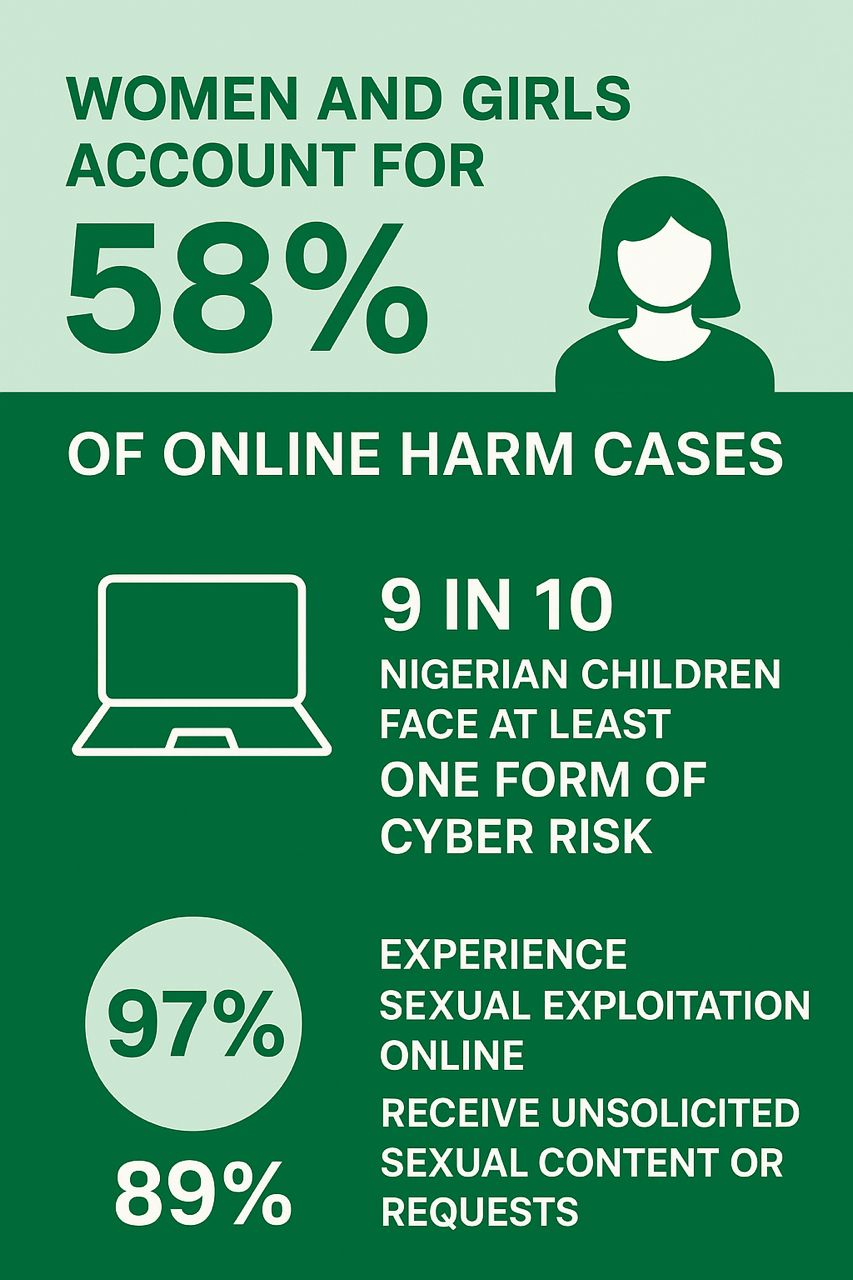
These figures highlight the disturbing risks young Nigerians encounter in digital spaces. For Oyo State’s schoolgirls, this global trend is evident in the testimonies of their teachers.
In a 2015 research by Adesola Olumide, Patricia Adams, and Olukemi K Amodu, 653 adolescents interviewed owned a personal mobile phone, and about half of them had internet access, while 40 per cent were reportedly visiting social media every day. Many of the respondents were said to have been exposed to harmful interactions on social media.
Impact on academics
While mobile devices provide access to learning materials, past questions, and online tutorials, their largely unregulated use has increasingly been linked to declining study discipline, poor concentration, and examination malpractice.
Speaking after the release of the 2025 West African Senior School Certificate Examination (WASSCE) result, Head of the Nigeria National Office of WAEC, Amos Dangut, said only 38.32 per cent of candidates who sat for the exam obtained at least five credits including English and Mathematics.
He added that mobile phones played a significant role in examination malpractice, which directly affected WAEC results across the country. In fact, WAEC identified mobile phones as one of the most frequently recovered prohibited items in examination halls nationwide.
“…192,089 results, representing 9.75 per cent of candidates, are currently withheld for offences ranging from the use of mobile phones in exam halls,” he said.
In some cases, centres in Oyo State have had portions of their results withheld, reducing the number of candidates counted as successful in official WAEC statistics. This contributes to the persistent gap between enrolment numbers and the proportion of students who eventually secure five credits, including English and Mathematics.
While the National Examination Council (NECO) recorded 501 cases of malpractices relating to mobile phone use in 2024, the examination body recorded 126 cases in 2025. Though the council recorded a significant decline in exam malpractice cases, it needs to increase surveillance and awareness campaigns against use of phones in examination centres..
Overwhelmed parent
Rukayat Ayilara, 54, a mother of two secondary-school children and a trader who leaves home early and returns late, said she often left a mobile phone with the children, but after some months, she noticed certain behaviours in her daughters that she could not have imagined in her own youth.
“My teenage daughters now call and chat with their boyfriends, and speak about visiting boys during and after school. It is really overwhelming,” she said.
For Mrs. Ayilara and many parents like her, the challenge is compounded by long work hours and a lack of tools to supervise her children’s online activities.
Reacting to this, Halimat Azeez, a child-development specialist and founder of MyChildWay, said: “Early signs of behavioural or moral challenges often go unnoticed. Parents need personal guidance to support children’s digital, emotional, and moral growth.”
Authorities actions and inactions
In April 2025, the Oyo State House of Assembly passed a resolution banning mobile phone use during school hours in all secondary schools, citing declining discipline and academic performance. Yet, enforcement is uneven.
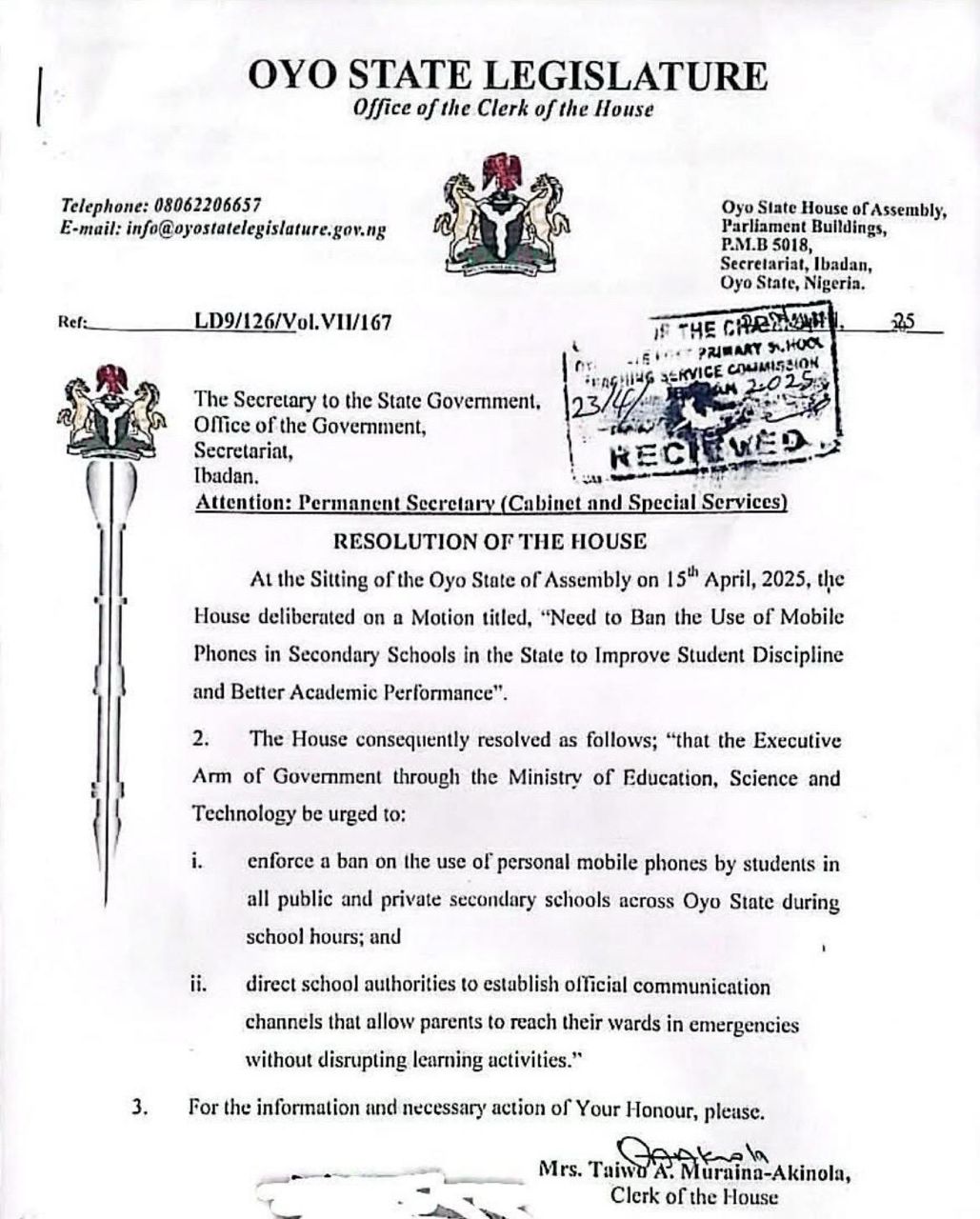
Many principals reported seizing phones and sometimes destroying them, but without a coordinated system, compliance varies widely, leaving students to navigate digital risks largely on their own.
This reporter visited the office of the Director of Basic Education at the Oyo State Ministry of Education, Science and Technology repeatedly in November, but found the office locked. Similarly, repeated calls and messages sent to Nureni Adeniran, Chairman, Oyo State Universal Basic Education Board (SUBEB) went unanswered.

Beyond behaviour and academics, doctors warn of physical consequences. Olamide Adebisi, an Optometrist at Welfare Eye Clinic in Ibadan, said; “school-age children report symptoms of eye strain because they spend long hours on phones. When eyes are tired, concentration drops, affecting lessons and assignments.”
From threat to empowerment
While concerns about indecency and online exploitation dominate discourse, experts stress an empowering approach, explaining that girls are not the problem; they are agents of change when provided with education, guidance, and safe access.
Vincent Okpechi, founder of Hisell, a Nigerian platform built to give young people safe, guided digital pathways to learn and grow, argued for structured learning rather than avoidance.
“Authorities should introduce ‘guided digital literacy’ from JSS 1, covering digital safety, privacy, and cyberbullying. Supervised digital learning allows girls to benefit from technology without waiting until they are harmed,” he said.
Without a unified framework linking policy, schools, families, and platforms, the students remain exposed to emotional, academic, and moral harms, highlighting the urgent need for coordinated protection and digital literacy programmes. Experts also call for integrating digital safety into the national curriculum, a state-wide reporting system for online harms, parental-control education in communities, and regulation compelling platforms to protect minors.
“The Federal Ministry of Education, sub-national ministries, and SUBEB, in coordination with the Nigerian Educational Research and Development Council (NERDC), should embed digital safety, responsible phone use, and online rights into the curriculum as core literacy,” Mr Aremu of Plan International added.
This report was facilitated by DevReporting in partnership with Education As a Vaccine (EVA) and supported by the Malala Fund.

