


Our Reporters
By midday at Oja Oba Market in Osogbo, the sun hangs heavy, and the narrow aisle where hair accessories are sold is unusually quiet. Plastic mannequins wear neatly arranged wigs. Hairbands and beads hang in careful rows, untouched. Behind the stall, 32-year-old Monsurat Alao watches customers pause, ask for prices, negotiate, and walk away.
“Customers come, ask for the price of everything and leave,” she said. “They always say the money is not complete.”
In previous Decembers, Ms Alao barely had time to sit. Mothers bought hairpieces for their daughters’ end-of-year parties. By mid-month, she would already be restocking. This year, she spends more time waiting than selling.
“What I used to buy for ₦10,000 is now almost ₦25,000,” she said, gesturing to synthetic wigs, beads and imported accessories.
“If I increase the price too much, they will walk away. If I don’t, I will run at a loss.”
Across Nigeria, scenes like this are playing out as December, traditionally the busiest month for informal businesses, arrives under the weight of inflation, insecurity and shrinking disposable income. DevReporting reports the mood across major thriving businesses in Nigeria.
Rising food costs squeeze festive plans
For many households, the cost of food has become the defining factor for Christmas planning. At a small restaurant along Osogbo-Gbongan Road of Osun State, a caterer, Afolake Ojo, said customers still want Christmas meals, but rising food prices have made it difficult to meet expectations without running at a loss.
“Rice, vegetable oil, chicken, tomatoes and pepper have doubled. Customers still want quality food, but they don’t want to pay the new price,” she said.
According to Mrs Ojo, a bag of rice that used to cost ₦32,000 in previous years, currently sells for between ₦55,000 and ₦60,000. A litre of vegetable oil rose from ₦900 to ₦2,100.
“If I cook with the old budget, I will run at a loss. If I increase the price, they will say I am too expensive,” she said.
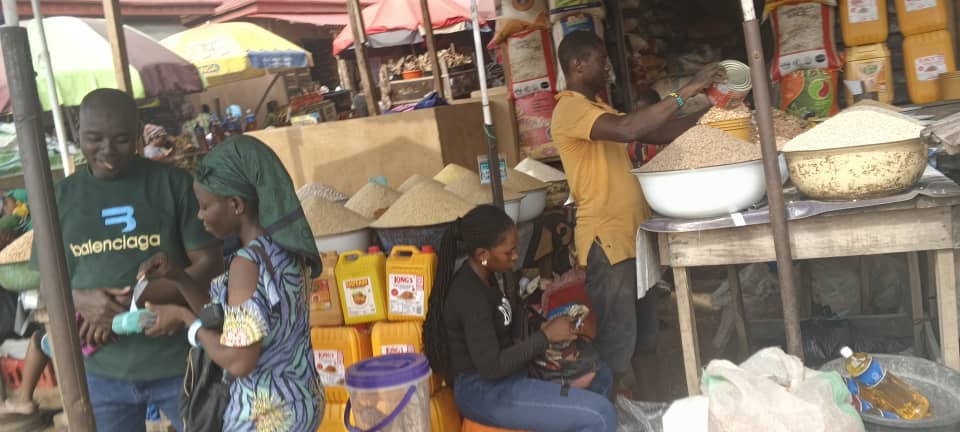
At Mile 12 Market in Lagos, a rice seller, Chibuzor Godwin, said people still buy rice because it is essential for Christmas meals, but the volume has reduced compared to three to five years ago.
Similarly, a 29-year-old party supply merchant who specialises in disposable plates, balloons, napkins, banners, and party packs at Igbonna Market, Rukayat Ajibola, said most customers now buy in smaller quantities.
“Before, organisers would buy 200 packs, 300 packs. Now most people buy only 50. Some even buy 20,” she said.
Markets dull, spending seems delayed
Beyond food, traders across Lagos say the usual build-up to Christmas has been delayed. An electronics dealer, Nnadi Victory, owner of Baron Enterprises, at the Bariga Market, said Christmas seasons of previous years showed early signs of increased spending, but this year has been different.
“Five to 10 years ago, by the end of November, you would already notice changes,” he said.
Mr Victory noted that although sales usually rise between 20 and 31 December due to demands for gift items, the current state of insecurity is affecting the mood of the season. He explained that fears of kidnapping and unsafe road travel have dampened festive excitement.
He described this year’s prospects as “50/50,” adding that while bulk purchases usually come toward the end of the month, customers seem to be making plans, with no major bookings yet.
Meanwhile, at the gift card and baby items section of Sabo market at Yaba in Lagos, a manager, identified simply as Betty, reported a noticeable increase in sales ahead of Christmas. She explained that many customers now prefer buying gift cards instead of physical gifts.
“Since last week, I’ve been going home around 10 p.m. Yesterday, I left after 9 p.m. Normally, I close by 6 p.m., so the difference is clear,” she said.
Ms Betty also disclosed that a company and a church made bulk purchases earlier in the day, with orders worth over ₦300,000.
Essentials outperform luxuries
While many small traders struggle, supermarkets are recording higher traffic. At The Mart Supermarket in Lagos, a supervisor, Eniola Shomorin, described December as a period that is both profitable and physically demanding for staff.
“People can’t do without eating and drinking,” Ms Shomorin explained, noting spikes in purchases of food, water, drinks, and even ice cream.
She confirmed that the price of oil and rice has increased, but that some suppliers are offering discounts to clear excess stock. The supermarket also repackages certain items into gift-friendly bundles to meet festive gifting trends.
December, Ms Shumorin emphasised, is “always choking.” Staff often work without breaks, with operations intensifying up to the new year.
Similarly, perfume sellers record higher festive sales. For Lagos-based online perfume retailer, Aderonke Oni, December is one of the most profitable times of the year, with sales boosted by discount offers, gifts, and free delivery promotions.
“It’s the season of gifting… I reduced the price so my customers can feel the impact,” she said, acknowledging that this reduces profit margins but strengthens customer loyalty.
Ms Oni also highlighted a purchasing trend among Nigerian buyers: a preference for duplicate (dupe) perfumes over original designer fragrances due to affordability.
According to her, brands such as Kayali, which are expensive and less common locally, are often substituted with cheaper “dupes” like Kali. The same trend exists with other popular fragrances, where original variants exist but are cost-prohibitive.
She stated, however, that the festive period has brought a new challenge: significant delays in supply, shortages of fast-selling items, and stockouts of popular scents, like Opulent Wood.
“I ordered things on Monday… Today is Wednesday, and I’ve not gotten my goods,” she said, attributing the delays to high nationwide demand, suppliers juggling multiple customers, and businesses preparing for holiday closures.
Festive rush drives creative small businesses
For photographers and make-up artists, December remains a peak period, though the gains are uneven.
Lekan Owojori, who has run Lekan Owojori Photography for four years, said photography attracts steady work throughout the year, but it peaks in December due to graduations and end-of-year activities. He noted that related sectors such as make-up artistry and fashion benefit from the boom as clients prepare for photoshoots.
On her part, a make-up artist and owner of Liz Artistry, Omisakin Elizabeth, said business this December appears slower, stressing that this time last year she was fully booked. She believes reduced purchasing power may be affecting clients’ spending.
Other make-up artists, like Teniola Adewunmi of Beats By Tee, said demand remains high, but time constraints force difficult choices.
Adjusting expectations, redefining celebrations
Back in the Ayetoro area of Osogbo, a 41-year-old event decorator, Sunday Owoeye, who was seen arranging artificial flowers in his small store, said, “Before, a client would call me and say, ‘Give me the full package’ for decoration. Now they tell me to remove the stage backdrop, remove canopy drapes and use fewer flowers.”
With Christmas approaching, fireworks (also known locally as bangers) usually dominate the market. However, many sellers are struggling with two major obstacles: low patronage and partial restrictions by local authorities.
At Old Garage, in Osogbo, a fireworks vendor, Chibuzor Nweke, said, “People used to buy from late November. But now I have sold only two cartons in two weeks.”
“Police warn people every year, so parents buy fewer fireworks for their children. Then the economy is hard. Instead of spending ₦5,000 on fireworks, they use the money to buy garri,” he said.
To stay afloat, some business owners told DevReporting that they are offering installmental payments, “mini packages”, discounted packages, and labour-only services.
Expert warns of deeper economic strain
A development economist at Osun State University, Rafiu Adeogun, said reduced festive spending reflects broader economic pressure.
“When disposable income falls, the first things people cut are leisure and celebrations. This affects small businesses, especially those in the events and hospitality sector,” he noted.
At Oja Oba Market, Ms Alao continues to wait behind her neatly arranged stall, hoping the final days before Christmas would bring change.
This December, Nigeria’s festive economy has not disappeared. It has simply learned to move more carefully, one smaller purchase, one reduced plan, and one tighter budget at a time.
Contributors to this report are Sodiq Mojibola, Ibrahim Awotunde, Aminat Miskilu, Olabisi Sulaimon, Maryam Bakare, and Adedoyin Oguntade.

