




Nigeria’s real estate sector has overtaken crude oil and natural gas in contributing to the economy for the first time since independence, yet millions of Nigerians remain unable to afford housing, the Founding Director of Centre for Housing and Sustainable Development (CHSD), University of Lagos (UNILAG), Timothy Nubi, a professor, has said.
This contradiction shaped discussions at the Urban Action Forum, organised by the CHSD in collaboration with the African Cities Research Consortium (ACRC), held on Wednesday at the Arthur Mbanefo Digital Research Centre, UNILAG.
Themed “A Roadmap for a Sustainable Urban Regeneration in Africa,” the event brought together academics, former government officials, urban planners and civil society practitioners to confront what speakers described as decades of failed housing policy, misguided demolition practices and a system that often displaces people without resettlement.
Mr Nubi opened the technical session with data which shows that real estate now contributes 10.8 per cent to nominal gross domestic product (GDP), placing it ahead of oil and natural gas in Nigeria’s economic ranking. The sector’s contribution rose from 5.4 per cent in the first quarter of 2024 to an estimated 5.5 to 6.0 per cent by 2025.
In the first quarter of 2025 alone, real estate injected N16.42 trillion into the economy, an 80 per cent rise from the N9.12 trillion recorded in the final quarter of 2024.
Housing boom masks deepening deficit
When the National Bureau of Statistics (NBS) completed its GDP rebasing exercise in 2025, using 2019 as the new base year, it changed the picture of Nigeria’s economy in ways housing experts had long argued were overdue.
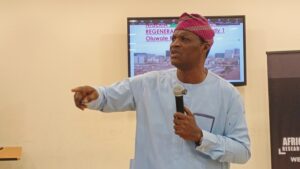
According to Mr Nubi, the new data demands a fundamental shift in how the government approaches housing, not as a marginal social service, but as a central driver of economic growth.
“Real estate accounts for about half of global wealth,” Mr Nubi said, comparing Nigeria with more advanced economies. In countries such as the United Kingdom and the United States, the sector contributes between 18 and 20 per cent of GDP.
“The total value of all US public companies is $40 trillion. The US residential real estate market is $43.5 trillion, making housing the biggest asset class in the country. Nigeria’s contribution languished below one per cent for decades, not because the sector was genuinely small, but because the rebasing methodology had not captured its true weight.
“Across Africa, the real estate market is now valued at over $100 billion and is projected to grow at a compound annual growth rate of between five and seven per cent over the next decade. Despite this expansion, Nigeria’s housing challenges continue to worsen.”
The deficit that keeps growing
According to Mr Nubi, the economic weight of real estate makes the state of Nigeria’s housing crisis all the more indefensible. He noted that Nigeria’s housing deficit has risen from about 5 million units decades ago to between 17 million and 22 million units today. “Instead of the problem reducing, it keeps increasing,” he said.
He further illustrated the crisis with a stark example: a two-bedroom apartment near the UNILAG campus in Akoka currently rents for about N3.5 million per year, roughly seven months of a professor’s salary.
“No professor will conveniently afford to pay N3.5 million for accommodation per annum,” he said.
The professor attributed the persistent deficit to decades of policy failure. From the National Council on Housing in 1971 and the Federal Housing Authority (FHA) in 1972, to more recent interventions such as the Nigeria Mortgage Refinance Company (NMRC) in 2013, and the Family Homes Fund (FHF) in 2017; adding that successive administrations produced frameworks without solutions.
“Over the years, the government has demonstrated its commitment through various housing policies and the establishment of a number of housing agencies, but the existing housing situation in Nigeria seems not to reflect any link between the comprehension of these problems and the solutions proposed in these policies,” Mr Nubi said.
Slums expand as demolition outpaces planning
At the forum, experts submit that informal settlements in Nigerian cities are growing bigger and expanding, instead of reducing.
A 1995 report by SNC-Lavalin identified 45 blighted communities in Lagos. Those communities have since grown to over 145. Makoko alone, the floating settlement on Lagos lagoon, is estimated to house about 100,000 residents.
In Abuja, rapid population growth has outpaced planning, leading to the emergence of settlements such as Gishiri, Daki Biu, Kuchingoro, Garki Village and Mpape. In Kano, about 70 per cent of residents live in informal areas, while in Kaduna, the Rigasa community has grown into one of the largest informal settlements in West Africa.
Experts at the forum argued that government actions, particularly forced evictions without resettlement, have accelerated this trend.
The former Lagos State commissioner for physical planning and urban development, Toyin Ayinde, said displacement policies often ignore what happens to affected residents. “When we evict people, we don’t care where they go. That is why slums keep increasing,” he said.
He cited the Iddo Jankara regeneration project as an example of both what is possible and how progress can be reversed. Initial plans included community engagement, resettlement options and phased redevelopment. However, a change in administration stalled the project.
Mr Ayinde argued that successful urban regeneration must be built on three pillars: value, culture and process. Without a clear commitment to housing as a national priority, he said, progress will remain limited.
Demolition must come last, not first
The General Manager of the Lagos State Urban and Regional Planning Agency (LASURA), Animashaun Oladimeji, echoed similar concerns, warning that authorities often reverse the proper sequence of urban regeneration.
According to him, government agencies routinely skip the steps that make urban regeneration work and move directly to the one step that should only come at the end.
“Urban regeneration has a procedure and a process. We do not follow these, and that is why we are having some of the problems we are having now. In urban regeneration, the last action should be demolition. So it is as if one is putting the cart before the horse,” Mr Oladimeji said.
He drew a clear line between urban renewal, which involves targeted improvements such as road works without necessarily displacing residents, and urban regeneration, which involves a more comprehensive restart that may require relocation but must be preceded by extensive community engagement, enumeration, valuation and agreed resettlement planning.
Even the most technically sound regeneration plan, he warned, will fail without genuine political alignment. “If you have a good urban planner and the plan is not in tandem with the government, just know that what you are trying to achieve will not be achievable,” he added.
System failures, not residents, drive informal settlements
Beyond policy gaps, experts also challenged the tendency to blame residents of informal settlements for their living conditions.
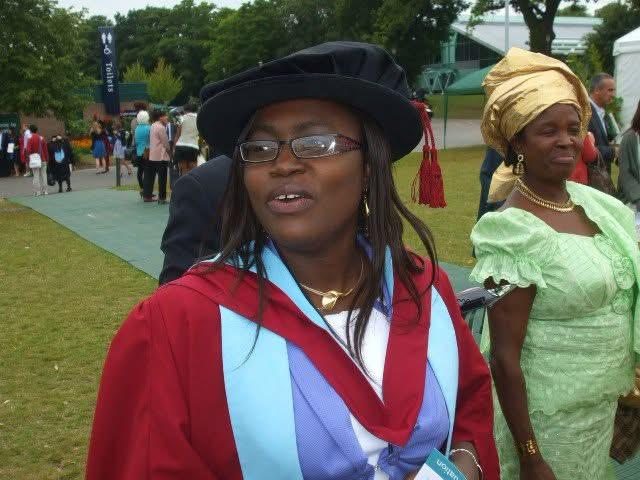
Lagos City Manager at ACRC, Temilade Sesan, a development sociologist, challenged what she described as a tendency in housing discourse to frame residents of informal settlements as the authors of their own conditions.
Drawing on the consortium’s city-as-systems framework, she argued that housing cannot be separated from education, employment and infrastructure.
“People do not choose informal settlements. They end up there because systems such as education, employment and infrastructure have failed,” she said.
Mrs Sesan further argued that housing cannot be addressed in isolation, as it is closely linked to income levels, public services and urban planning systems.
What Kenya did differently
A participant from Kenya drew attention to the Mukuru settlement in Nairobi, which was designated as a special planning area. Rather than treating Mukuru as an illegal zone requiring clearance, planners worked alongside community organisations and non-governmental organisations (NGOs) to provide targeted infrastructure and upgrade housing conditions without mass eviction.
“When we see these areas not just as areas that should not be, we have areas that should be there, but they are special planning areas. So we give special planning effort to them in how we provide infrastructure, in how we improve the housing, without necessarily evicting anyone,” the participant said.
The slum that could pay for its own regeneration
Mr Nubi presented findings from an enumeration exercise conducted at the Ilasan community in Lagos that challenged the default assumption that informal settlements have no economic value worth working with.
The survey identified 875 plots within the settlement, each averaging 648 square metres. At current market rates, a standard 300-square-metre plot in that corridor is valued at N55 million. A full-sized 648-square-metre plot is worth N110 million. The combined land value across the settlement amounts to N96.25 billion, , suggesting that regeneration could be financed through structured development rather than displacement.
“The value of the land offers many opportunities and hope for regeneration,” Mr Nubi noted.
He proposed a three-level methodology for turning that value into a practical regeneration framework. At the city scale, he said, the priority is to map and define slum boundaries and characteristics, while at the neighbourhood level, the work involves capturing population density, infrastructure conditions and service networks.
Mr Nubi added that at the building level, the task is to calculate structural worth and adjust for market value, giving planners the financial data needed to credibly structure compensation, resettlement and phased development.
