

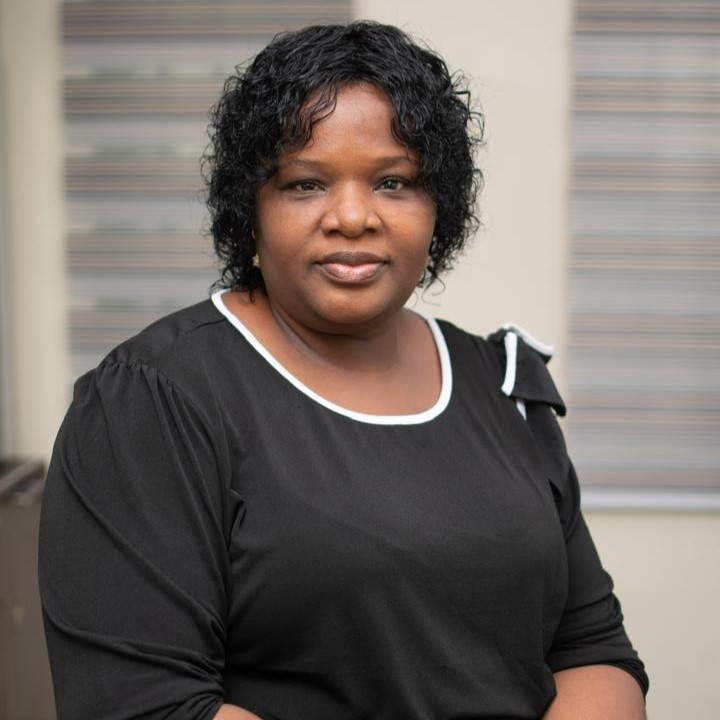

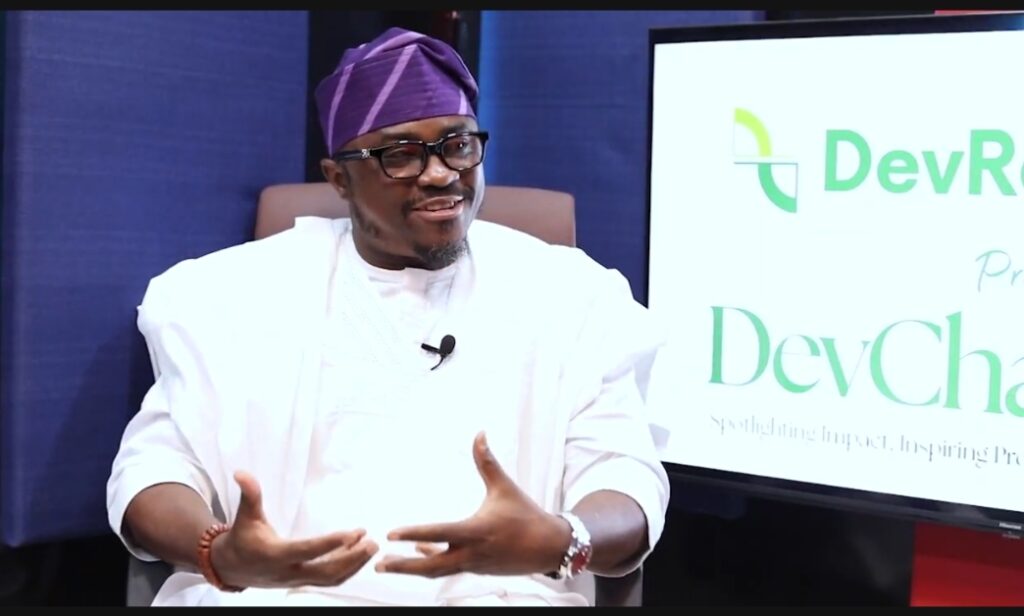
Olalekan Fabilola is the creator and host of ‘Masoyinbo’, a popular Yoruba cultural game show that blends language, history and entertainment. Through the programme, he has carved a distinct space for indigenous knowledge in Nigeria’s contemporary media landscape, reaching audiences across generations. In this interview with DevReporting, Mr Fabilola speaks on the idea behind Masoyinbo, the power of indigenous language, and why culture remains a critical tool for development. Excerpt
DR: Anywhere you appear today, many people recognise you by the programme you currently host, ‘Masoyinbo’. So, who is Masoyinbo?
Masoyinbo: I am having mixed feelings about whether to speak Yoruba or English because I am used to speaking Yoruba all the time, so I am still trying to get into the character of speaking English. My name is Olalekan Fabilola, from Oba Ile in Ondo State. I was born in Oba Ile, and I did my primary education in Oba Ile. Then, I went to the Christ School, Ondo Boys High School, and then to Covenant University to study Computer Science, and I am where I am doing Yoruba today.
DR: From Computer Science to Yoruba? What led to that? How did you marry the two?
Masoyinbo: Yes, you know our forebears have a saying that ‘Ohun ti a waye waye laaye’ everyone of us came to this world to ‘ye’ something. You know ‘ye’ is to lay something. So, like ‘adiye ye eyin’, and ‘ye’ also means to understand. For example, ‘sò ye e’ (do you understand)?
By that, are you able to have what I am saying delivered to you? So, ‘ye’ is also to bring forth. ‘Ti adiye ba ye eyin nisiyin tabi to ba pa omo’ (when a chicken lays an egg). So, every one of us in this world ‘wa aye’. ‘aye’ means ‘world’ in Yoruba. So, every one of us came here to bring forth something. To ‘ye’ something in ‘aye’ (to bring forth something in the world). So, knowing what you came to this world to lay has a very deep understanding as to how you then live your life. So, you know irrespective of where you studied, what you study, you already know the end point that this is what I came to this world to bring forth. I know that I came to this world to ‘ye’ Yoruba – to teach Yoruba, to impart Yoruba knowledge to people, and irrespective of the road to that destination. I’ve always known that I’ll be a Yoruba teacher.
DR: …what informed that decision? At what stage did you make that decision and how did you come about it?
Masoyinbo: Identifying the problem early will make you understand what you actually came to this world to bring forth or to lay, and the word for place in Yoruba is ‘ibi’, the word for problem is ‘ibi’. ‘Ibi’ is place, and the word for placenta is ‘ibi’. It is not a coincidence. Our forebears already know. I used to tell people that Yoruba language is a language that has the capacity to shape the world. It is the language that has speaking, religion, philosophy, and everything that you need.
How then is it a mistake that our forebears came to that knowing?
At one point, we were in the womb and we ate from ‘ibi’ – the placenta. What happened to us while we were in the womb is what we came into this world to replicate. So, we ate from ‘Ibi’ in the womb, and when the woman gives birth, they cut the ‘ibi’ from the baby and give it to the ‘baba’, in the days of our forebears, the ‘baba’ would then go and bury the ‘ibi’. Then, we have the saying, ‘ibi ki bi ti omo yi ba de o, Eledumare yaa ya ibi’, meaning (Wherever this child goes, may God protect him/her from evil). So, where you were born is also ‘ibi’ because ‘ibi’ is the world. So, you have to be cut off from one ‘ibi’ to land in another ‘ibi’. That’s why we say anywhere we are can become a calamity. For example, people will be driving on their own and someone will just ram into them. That car was in a place, but it became a calamity. So, ‘ibi’ is everywhere.
So, now that you come to this world, they ask you what problem you can solve? you begin to look for another ‘ibi’, that is ‘problem ‘, again, in order to eat.
DR: At what stage did you know that this is the ‘ibi’ that you want to address?
Masoyinbo: As early as I could remember, because my father was a high chief in Oba Ile, so, during that period I was born. I saw my father settle cases, I saw people come to the house, I saw the way he was, and I knew that those events, those activities, shaped my life too. I like the way this culture was being portrayed, the respect, the way the elders talked; talk last; don’t talk too much; idioms; proverbs, and all, and it wasn’t this Yoruba that we speak in Oba. That is another area of interest. I started speaking English this way when I got to Covenant University in 2004. I went to Christ School, Ado Ekiti. I met people who spoke my Oba dialect because Ondo and Ekiti are more or less the same. You could hear Oba in everything I spoke then. But, when God says this is what you will become, it will just be like magic. I’d always known I wanted to do this, but I cannot pinpoint it to 10 or 15 years. I’ve always known that I have an interest in language, and interest in culture, when I see people on television. You know those days on Ondo State Radiovision Corporation (OSRC), they used to have programmes like ‘ijoko ojogbon’ and ‘Ogbon Ori’. I noticed that I was more inclined to those programmes than anything else.
DR: Is it true that, at the beginning, you weren’t very fluent in English?
Masoyinbo: Yes. I don’t speak English but there’s no way you will have a good command of Yoruba that you won’t be able to speak English.
DR: At what stage did you learn the Oyo dialect? Because the dialect that we speak, that is written, is ‘Oyo’ dialect, but you grew up speaking Oba, and you spoke a dialect that is known to Ondo and Ekiti. People ask if you grew up in Oyo. So, at what stage did you learn the Oyo dialect?
Masoyinbo: We are not speaking Oyo dialect. I don’t subscribe to dialects. We have languages, and language is just like culture; it’s not static, it is dynamic. I agree that Oyo metamorphosed to the general Yoruba that we speak now, but when you go to Oyo, the way they speak is still crude. In Chemistry, there’s what we call crude. In fractional distillation from a crude, you can have diesel, bitumen, etc. So Oyo is like the crude from which we have some extraction. For example when you use words like ‘oga’, which is boss, it’s actually ‘o ga ju mi lo’ meaning ‘you are higher than me’. So, that’s Oyo. Harmonised Yoruba will say ‘o ma lo’ (you will go), Oyo will say ‘o ma lo’ or ‘se o ma lo (will you go?)’, Oyo will say ‘so ma lo’, so, there’s a difference between the tones.
So, some of the words we speak as vocabulary emanate from Oyo. What I’m trying to say is that we are not speaking Oyo now, but we are speaking Yoruba, which comprises different languages.
DR: When you got to Covenant University was when you started speaking English. What were the circumstances at that time?
Masoyinbo: In my first week at Covenant University, I saw the way things were, and I said I wanted to do comedy, so I went to tell the chaperone that I wanted to do comedy, and there were written lines. He said that’s a new, fresh air because nobody was doing comedy, and you know I couldn’t speak English very well. I attempted to infuse Yoruba into the comedy. People who went to Covenant University around 2004, will know what I am saying. I got up on stage that day, and my opening line was “ki came I came to this school” that is ‘wiwa ti mo wa si Ile eko yi‘, they didn’t even allow me to finish that line, they just booed me. You know the school was filled with people of affluence, the rich people. They booed me, and the booing was so much that they even drew my ear that “what pushed you, you are just an 100 level guy”, and they booed me to my room. That was the Omega semester, which is the second semester. They booed me, my room became a Mecca, and people were rushing to see who the guy that messed up was. ‘Awon omo butty yen’ “those children of the rich”. My roommates even vacated the room for me because nobody wanted to identify with a failure. There were four of us in a room, but one of my roommates, Lambert Okoroafor, just said “all these people that are doing these things to you, it’s because they cannot climb the stage. Do you know the confidence it takes to climb a stage? You are now here, being moody.”
I didn’t cry, but I was just covering my face. That statement changed me, I said “before I leave this school, all of you will become my friends”. So, for like a week, I was going to class alone, nobody sat with me. Even my cousin in the same school didn’t talk to me. I’m tempted to mention his name, but I won’t. We talk and joke about it every time.
Then, I said to myself, what do I really want to do? So, I tell people that Covenant University is not a school for academic performance alone, it is for discovery. If you go to CU and you don’t discover yourself, I don’t know. It is a fertile ground for discovery. Much of what I do now, I can say that the university shaped me into doing them. It taught me how to write my vision statement. I had my vision statement when I was in 100 level, 2004. I still have it now. So, when I read some of them, I know this is what I am doing.
We used to have spiritual emphasis. Papa (Bishop Oyedepo) himself will come to teach us. In 200 level, we had an international conference which was attended by Dr. Myles Munroe. We needed to do a film, a stage play but you know, I was an outcast because nobody wanted me to join their group. So, I went to the Covenant University Theatre group to tell the Theatre Director that in Yoruba land, the stage play they wanted to do should have an ‘akoda’ – someone that eulogises and chant panegyrics of the king. It tells where I am coming from. Then he said to me reluctantly, go and try it. You know I created the role for myself, so there won’t be an audition. So, I appeared twice, in the middle and at the end, and guess what, Dr Myles Munroe liked it, talked about it; Papa liked it and also talked about it. Then the chaplain told me that every Sunday, I must hail the king and say the name of God before the chaplain will come.
DR: If you did the chanting in Yoruba language, how did Dr Myles Munroe understand?
Masoyinbo: Yes, I did it in Yoruba. You see, it goes beyond language. Language is artistic. In China, they don’t understand Micheal Jackson, but they dance to his songs. So, it’s the spirit that you carry with what you’re saying that makes people understand it. People watch Masoyinbo but they don’t speak Yoruba. Hausa people send me videos of them watching Masoyinbo from the North, and they don’t speak Yoruba.
DR: So, was that the breakthrough?
Masoyinbo: Yes, every Sunday, whether they like me or not, they had to see me right from 200 level but by the time I got to 300 level, it became too much because I was doing first and second service every Sunday. So, I went to ask if I could get people to join me, and they said “no problem”. They announced, and 57 people joined the group. Some people who actually know how to sing, when I chant, they sing. Some learn the chant when I do it. I didn’t join the theatre group, but I was acting. Before I left Covenant University, I was one of the stars.
DR: When you were in CU, you developed a keyboard. Could you tell us about that?
Masoyinbo: They gave us an assignment, and I used key basics to do my Yoruba assignment because I wanted to type in Yoruba, and there was no Yoruba keyboard then, so I used the basic language to do it. Not that I am a genius, but in the Yoruba language, God has blessed me. I used that to do it, and I showed Dr. Sikiru, and he was wowed. He later became the Vice Chancellor, and he changed my life, too.
DR: At what stage did you think of Masoyinbo?
Masoyinbo: Masoyinbo was actually created in 2007. I was still in Covenant University, 400 level, when I got the idea of Masoyinbo, and in 2008, when I graduated, I already knew that was what I was going to do, so I was already pushing it by 2008. The first copyright for Masoyinbo was done in 2010. That time, we went to Ali Baba, who is my mentor. He took me to different places. He said, “This idea is nonsense. What are you doing?”
DR: How did you meet him?
Masoyinbo: That was on BBN. He mistakenly dropped his pin on his bio, and I messaged him, but he didn’t reply. I was constantly checking him up online, and anytime I see him online, I send messages without greeting first. I already had the messages typed on my phone, so I just copied and pasted. Eventually, he asked me to come see him at his office. So, I went to the office, and then he bought into the idea of Masoyinbo.
That time it wasn’t Masoyinbo, it was Babela. Babela, because I am a Christian. I am a product of droplets because people pour into me. The name ‘Babela’ was coined from the word Babel. I just added ‘a’ to it, because we wanted a name that would just be for that show. So, it was in me that I thought of it. Then, Bayo Komolafe, now a professor, and I used to meet to talk about it, and then we came up with that name. He was the one who designed it.
DR: So, was Babela designed to bring people to the stage to just talk?
Masoyinbo: Babela is Masoyinbo, it is the name that changed. Masoyinbo is catchy. We don’t need to explain it. I had to coin a name from the word ‘Babela’, like ‘Bii abela’ (like a candle), so language is like a candle. But with Masoyinbo, nobody asked for the meaning; it just resonates.
DR: When you got to Ali Baba, did he try to assist you…
Masoyinbo: He tried, he assisted in many ways but it just couldn’t fly at that time. So I went back to class, and I started teaching Yoruba online.
DR: Since you graduated, was that the only thing that you’ve been doing?
Masoyinbo: Yes, I have never done anything else.
DR: You abandoned computer science?
Masoyinbo: No, I didn’t abandon it. I designed the website that I use. I didn’t abandon it. I write books. Abandonment means that I don’t use it, but if you come to my studio, you will see a lot of things that speak about computer science that I studied. But I have been teaching and educating people about Yoruba. Going to school and spending money to make sure that people imbibe the culture.
DR: So, at what stage did the breakthrough for Masoyinbo happen?
Masoyinbo: We started shooting Masoyinbo in 2024, it is just a year.
DR: So, what happened between 2010 when you had the first patent and 2024? Did you just keep it somewhere?
Masoyinbo: Yes, I was just looking at it. I didn’t even water it because it’s already watered. Just like bitumen. It’s already there. When we started showing Masoyinbo, I was teaching 20 hours a day, online. From 2020 to 2023, I did not leave my hometown. For two weeks, I will not leave my house. I was teaching back-to-back, at least 20 hours every day. The only place I went to then was the church. People will be building houses in my street, and I will be wondering when the construction started.
DR: How rewarding do you think that was, even in terms of materials?
Masoyinbo: I don’t measure my worth by material, but I am comfortable. I can buy anything I need. Not my want, but anything I need. I can buy them. So, when I started teaching for that long, I was doing Masoyinbo with my student online. Whenever we were in class, I would raise bills of maybe a hundred naira and say, “if you get this right, I will do this, and if you do this, you will lose the money, and so…” I was doing it with them, and then I just called my assistant and sat him down. We tried it. I had Omowale and students who travelled from abroad to stay with me to learn Yoruba. I had a Mexican who has now relocated to Oba Ile and bought a house. So, I used my iPhone and sat them down, testing the show with them. Then I put it on my Twitter, and people reposted it. I then told my assistant that we needed to get cameras. We bought cameras and we started. Then we put it online in April last year.
DR: At what stage did you get support and sponsorship that made you feel that people had bought into it?
Masoyinbo: The thing is that I was never really looking for sponsorship. I just wanted to do what I was doing. I had a friend with whom we went to Covenant university together; he manages my life and all. He was the one who said okay, because people kept sending me adverts and things they wanted to put out, and I said okay, if you can do it. Interestingly, people who told me that this was not going to fly now want to relate and even support in ways.
DR: What lesson has this taught you?
Masoyinbo: ‘Nkan ta waye, wa ye la a ye’ (what you have come to this world to bring forth is what you bring forth), even if Eledumare tells you to sell groundnut, just be selling it. Our generation is so fixated on taking shortcuts to our destination. There is no shortcut to wherever we are going in life, so just keep doing it.
DR: You have hosted several celebrities on your show. How do you manage to keep the conversations both entertaining and educational?
Masoyinbo: The thing is. I am teaching Yoruba in class, but if I tell you to come to class to learn the Yoruba language, you will say that you have been speaking the Yoruba language since childhood, but in actual fact, you cannot speak Yoruba without code-mixing. So, Masoyinbo is a Yoruba class; the way I do it in my class is just replicated on the show. So, it’s an attempt to teach the work in Yoruba.
DR: So, have you relocated from Oba Ile to where you shoot now?
Masoyinbo: No. I am still in Oba Ile.
DR: So we can have something like ‘From Oba Ile to the world’?
Masoyinbo: Yes, I got that idea from Kenneth Hagin, our father of the faith. He didn’t leave Tulsa, Oklahoma, so I will not leave Oba Ile. The interesting thing is, I live in Oba Ile and I could teach in London, in Houston, in New York, and at three different hours. It’s humbling for me that I can travel around the world without leaving Oba Ile.
DR: So, how has technology helped to advance the language?
Masoyinbo: Sure, of course, without technology, how would I teach? I have to go to class. Without technology, how would you know about Masoyinbo? So, technology has done a lot. The dream is to marry culture with technology.
DR: Computer science and Yoruba now came together. Now you have added media…
Masoyinbo: Yes, both Computer Science and Yoruba came together. I am a Yoruba teacher. So, many people tend to say, ‘Oh, I am a celebrity,’ but I say that I am not a celebrity; I am a Yoruba teacher. They try to imply that I am into media, but I say that I am just a Yoruba teacher. But I am using those tools to reach my students.
DR: In the next couple of years, where do you want to see Masoyinbo?
Masoyinbo: The next thing is to go from city to city, country to country. Everybody in this world is in a ministry. Some, their ministry is to preach Jesus; for some, theirs is to preach Islam; for me, my ministry is to preach Yoruba. So, I will preach the word through Masoyinbo.
DR: Now, Africans are seeking change to the way the African map is currently designed. We believe that it is one thing to redesign the map, and it is another thing to actually do things from the African perspective. It is not just about the shape of the map, it is about the culture and tradition. So, beyond teaching the language for people to speak, what other ways do you think that we can promote Africa?
Masoyinbo: The thing is, I tell my students and I tell people that I am not teaching them to speak Yoruba. Yorubas say (in Yoruba) all languages are good for hearing, but no one finds it easy to understand Yoruba. Because inherent Yoruba words are what you need to know or do. So, if you say some Yoruba words like baba, iya, orun, ile, aye etc all those words are not just mere words; they carry the meaning to which you should relate with them. They are deeper. There’s nothing like arbitrariness in Yoruba. So, Yoruba is a mystery, we call it ‘aditu’, and you know that even the word ‘aditu’, ‘di’ is to tie, ‘tu’ is to loosen. So, when you say ‘aditu’, it is something that is difficult to loosen, but it can be unraveled.
DR: You seem to have demystified language and teaching. Before you can teach, they said in Nigeria you must have a Teachers Registration Council of Nigeria (TRCN’s) certificate. It’s about paper qualification. What do you see? Does it take anything away from your competence? Does it take or add any value? Have you gained any particular certification to be a Yoruba teacher?
Masoyinbo: Right. So, Yoruba teaching for me is ‘imisi’ (inspiration). It’s talent. It’s ‘ebun’ (gift). The people who designed the curriculum of a place, the person who established an organisation, gave orientation for people; they didn’t do orientation for the person in the company. Right. What I’m trying to say is that there are doctors, but in the field of medicine, there are talented doctors. You say, this person has talent. The only talent that I have is Yoruba. You know, King Saheed Osupa said, ‘Orin ni aye mi, me le sai korin, mi o mo ata ta de bi kin le ma tata, mi o mo igi la debi kin le ma lagi, ele lo meji ko di aro, mi o ni ona mi ju kin ko rin lo.’ In translation, that means music is my life, or songs are my life. I cannot help but sing it. I don’t know how to sell pepper, so I can’t sell pepper. I can’t sell wood. What you use to make a tie doesn’t have two more useful qualities than to make tie. So, he now said, I don’t have any other way other than to sing.
So, for me, I don’t have any other thing. I cannot sing. I cannot do any other thing than to teach Yoruba.
DR: Now, let the Nigerian public learn from you. How best do you think Yoruba can be taught in schools?
Masoyinbo: I would say that Yoruba will be taught well if we make Yoruba fashionable. By going into the meaning of the words that you teach, and loving what you teach. You know, most of our teachers, people that study Yoruba, they say, Medicine ‘ni mo fe shey o, wan kan fumi ni Yoruba.’ You go to university to learn what you don’t like. So, you graduate and you don’t know what to do. You go to the bank, and they say they don’t want you. They go to this and that. Okay, there is this school that needs a teacher. So, you are not creative in how you teach. It’s an alternative. So, we need teachers who are called to teach. The moment you have that, you can then have that spirit. You know, you have teachers that love what they are doing when they get to class. Not for money, not for anything. You know, even if we don’t pay them, they are still in class. They want to do it. So, the best way to teach Yoruba is for the teacher to know that he/she wants to teach Yoruba. Identify the real teachers who want to teach. I’m a Yoruba teacher.
So, people call me ‘Oluko Yoruba bi oba ilu kan’ (A Yoruba teacher like the king of a town). So, if I go out now as a Yoruba teacher, and you go out as an accountant or this thing. You will not push me aside. And I go out with that mentality every day. When I leave my house, someone has to tell me, ‘Lekan i bo lowa’, we have to see the president now. I won’t have to say, let me go back home to change my clothes. That can never happen because I am already well dressed at all times and I will be leaving there to go to the place.
So, when you are in school, when you say, I’m studying medicine. The way you carry it will determine how much people will want to study medicine. You know, I’m doing medicine and surgery. But if you ask what are you studying, Yoruba? Yoruba education.
The dream is that, at one point, and it’s already happening, people tell me, “I want to be like you. I want to be a Yoruba teacher”. Soon, your son, your daughter. You ask your son or your daughter what they want to become, and they say, I want to be a Yoruba teacher, and you say, that’s a good one, because you have become a model. 20 years ago, 30 years ago, if you tell your father that you wish to become an actor, that’s trouble. So, you cannot. People will not. Parents will not fathom. You say you want to become a Yoruba teacher, or you say you want to become a footballer. Footballer, 20 years ago?
DR: So, in the next couple of years, will people become stronger?
Masoyinbo: That’s why you should teach your children. Let them speak your language. So, they don’t say, my parents did not teach me. Teach them now. It will get to a point, in no distant time, that if you want to become somebody, politically, you debate in Yoruba.
DR: So, will you advocate, as some people are advocating, that the language of our immediate environment, like Yoruba, like Swahili, like Hausa, should be the medium of communication in governments, in assemblies, in public offices?
Masoyinbo: Of course. But Yoruba has a saying that, little by little, water washes away the rock. Because we are moving. See, the houses of assembly are now doing Wednesday Yoruba, Thursday Yoruba only in most of the states now. Great. As time goes on, we’ll move to two days, three to four days. It may take years but we’ll get there.
So, it’s a gradual process. Soon, we will start advocating to our fathers, our governors, if they want to address us, please address us in Yoruba. Igbo and Hausa too should be advocating for that, because we are in a cultural revolution now. Every generation has what they are bringing to the table, and that is why this generation is called ‘Iran’. Vision is called ‘Iran’. Insight is called ‘Iran’. Revelation is called ‘Iran, and ‘Iran’ is like to spread.
So, this generation is bringing something that is going to span a long time. The Cultural Revolution is going to span a very long time. We will grow old. Ninety, a hundred will pass. We’ll still be there. So, the earlier you key into every aspect of it. People are now using ‘Adire’, using beads, using cowries, ‘eyo owo’, and, you know, these Gen Zs now want to know. They are asking questions. ‘Why do you say I should not go back to my village?’ They are now killing people there again. They want to know. ‘You are saying ‘ifa’ is wrong. Why? Tell me.’ You are saying this is this. They are asking questions. We are just getting there.
DR: On Masoyinbo, how many people have won the grand prize?
Masoyinbo: Nobody!! Nobody has won the grand prize, but someone has won the car.
The grand prize is N1million. It is even more than that but N1million is the tag. So, I have my brother on tag. I put N1 million. I have another brother, who put in N2million. So, the total money, for the person that won one million will be like, plus the car will be going to like N16 million or more, with lithium batteries, inverters, and so on. I just don’t want to mention it out loud, but I have mentioned it. It’s going to be a lot for the person that wins.
DR: But nobody has been able to win the grand prize?
Masoyinbo: Yes, I hope so.
DR: So, what is the difference between the person who won the car and the one who will win the grand prize?
Masoyinbo: Alright, so when we realised that for months, nobody has won the car, we then organised Masoyinbo live in Lagos. We then said the person that wins the highest money on that show, on that day, will go home with the car. The person that went home with the car won just N40,000.
DR: But was it the highest?
Masoyinbo: It was the highest. That was the LASU graduate, she studied Yoruba.
DR: Are you happy about that?
Masoyinbo: I’m very, very happy. She’s come to work with us now.
DR: Coming to work with you now? Don’t you think people will say it’s because she studied Yoruba?
Masoyinbo: Yes. Let them go and study Yoruba too.
DR: Masoyinbo, how do people participate?
Masoyinbo: You follow a link. We have a number on the screen, and you then send a message to the number. Then the number sends you a link that you follow. When you follow the link, you fill the form. After filling the form, you’ll be waiting, then we will call you. So, there are two ways to actually appear on the show. Either you follow the link or I call you to come.
DR: You use your discretion, discretionary power? As the spirit directs you?
Masoyinbo: Yeah, maybe like most of the celebrities that come on Masoyinbo, I invite them. Maybe we meet at a function and say they want to come, things like that, or I call them.
DR: So how often do you record?
Masoyinbo: I record once a month.
DR: How many people do you record per month?
Masoyinbo: We record between 16 to 20 per month.
DR: If someone is applying today, what’s the number you think he/she is going to queue behind?
Masoyinbo: Maybe 70,000 plus.
DR: Is that the bank from which you select people to participate?
Masoyinbo: What we do is that we print some of the names from the bank, I mean from the pool. So, when people come on the show, they pick and then we call the person to come so that it’s fair to people.
DR: But for people who are in the diaspora and they want to participate, how do you factor them in?
Masoyinbo: Most of them call me and I ask them, when are you coming? You’re coming this time. I will get you on. If I see that the person can actually speak Yoruba.
DR: So, are you considering deploying technology to capture people in diaspora who may want to participate and not necessarily come down to Nigeria?
Masoyinbo: Now, if we are doing it via Zoom or Teams, it’s not about the money for most people, but people will not want to lose. You know. I can’t come on Masoyinbo to lose. So most people, or some people are ten times richer. N1 million is nothing to them, but they don’t want to lose. So, when you see footballers like Ronaldo crying because of losing just a single game, they can buy the team, but they don’t want to lose. So, if you are doing it online, in that space, you can just position someone at a corner to check answers from ChatGPT or other apps. Not because of the money, though, but because they don’t want to lose. So, due to that, we are taking it to those cities like South Africa, Egypt, Kenya, UK and so on. You know, going around preaching the gospel of Yoruba.