



The incumbent Head of the National Office of the West African Examinations Council in Nigeria (WAEC-HNO), Amos Dangut, will, in October, assume office as the registrar of the examination body at its headquarters in Accra, Ghana.
DevReporting gathered that his successor-designate, Suleman Kum, the immediate past Senior Deputy Registrar and Director of Test Administration, has since resumed as a senior deputy registrar in Mr Dangut’s office to understudy him for a smooth transition, as is WAEC tradition.
However, Mr Dangut’s elevation is coming amidst the growing concerns over the recent release of the 2026 West African Senior School Certificate Examination (WASSCE) results,
Many schools and parents have questioned the unexpectedly poor performance of candidates who sat the examination, especially those who opted for the computer-based testing (CBT) mode.
This is as the results of blind candidates have yet to be released one month after the examination body’s official announcement of the results. This development has been described as an injustice by a public commentator, Adebukola Adebayo, whose opinion on the matter has gone viral on media platforms.
Mr Adebayo wrote: “Blind students sit their WAEC exams at the same time as their sighted colleagues– no reason will be acceptable for the delay in the release of WAEC results of blind candidates. This situation is considered unjust, discriminatory, unfair, and unkind to blind students who put in so much to go through secondary education despite all the inclusivity and accessibility challenges they are confronted with.
“Delay in the release of WAEC of blind students is an abuse of their rights to equal educational opportunity enjoyed by their sighted counterparts.”
But while the examination body has denied committing any error in the process leading to this year’s results, it has failed to provide reasons for the delay in releasing the blind candidates’ results.
The examination body’s Acting Head of Public Affairs, Moyosola Adesina, promised to give an update on the matter to DevReporting but has yet to do so many days after.
More controversy
Adding to the intrigue of the controversy, an official of WAEC, Olanrewaju Fadehan, has also publicly accused the leadership of the examination body of compromise, noting that the sudden change in the schedule for the release of the results earlier in August was a key indicator that something was wrong.
Mr Fadehan, who is currently on interdiction by the examination body for speaking out, also accused WAEC management of corrupt practices, listing issues including the supply of calculators and identification cards, among other charges, as conduit pipes for corruption.
“What was brought for Anambra State at the beginning of the exam was 13,000 calculators for 65,000 candidates,” he alleged.
WAEC has faced many challenges and controversies in its more than 70 years of existence. But the past two years have put its reputation under unusual pressure.
2025 results crisis triggered questions over WAEC’s processes
In 2025, the examination body recalled the WASSCE results for school candidates following a public outcry over what stakeholders described as unjustifiably poor performance by the candidates.
The results, initially released on 4 August, showed that only 38.32 per cent of the 1,969,313 candidates who sat the examination obtained credit passes in five subjects, including English Language and Mathematics.
In a statement issued at the time by the spokeswoman, Mrs Adesina, WAEC said it had identified glitches in the processes that led to the compilation of the results earlier released and had shut down the result-checking portal.
According to the Council, the affected subjects were those it had “serialised” including: Mathematics, English Language, Biology and Economics.
The controversy over the results also came against the backdrop of an earlier disruption during the conduct of the examination in May, when candidates at some centres were kept until late at night before completing their papers.
DevReporting had reported that the disruption followed the compromise of the English Language paper. Sources told the newspaper that the paper had been leaked online, prompting WAEC to cancel it at the last minute. It then made arrangements for a replacement.
The disruption left candidates at some centres writing their examinations late into the night while parents waited anxiously.
WAEC, however, attributed the delay to intensified efforts to prevent examination-material leakage, as well as logistical hurdles, security concerns and sociocultural factors. The Council said the measures were intended to protect the integrity of the examination but acknowledged that they affected the timely and smooth conduct of the English Language paper.
Later on 8 August, WAEC released revised results showing that 1,239,884 candidates, representing 62.96 per cent of the 1,969,313 candidates who sat the examination, obtained credits in at least five subjects, including English Language and Mathematics, a sharp increase from the previously announced 38.32 per cent.
While apologising for the error, Mr Dangut described the episode as a trying time for the WAEC management.
2026: Fresh questions over CBT and candidates’ performance
A year later, the examination body is again under scrutiny over the performance recorded in the 2026 WASSCE. On 5 August, WAEC released the results of the 2026 WASSCE for school candidates, with 1.2 million, representing 61.54 per cent of the 1,950,726 candidates who sat the examination, obtaining credits in at least five subjects, including English Language and Mathematics. This represents a 1.42 percentage-point decline from the revised performance recorded in the 2025 examination.
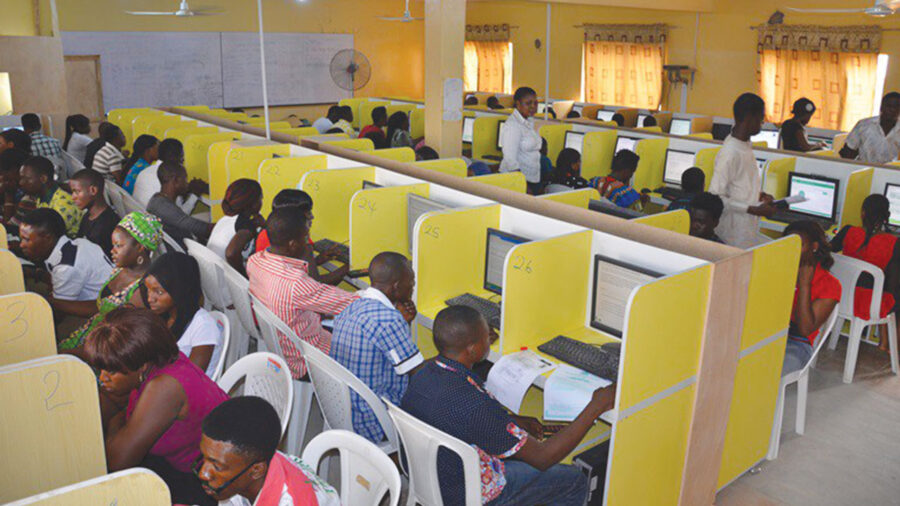
The 2026 examination marked the second edition of the Computer-Based WASSCE for school candidates. While most centres continued to use the traditional paper-and-pen format, a total of 45 schools out of the 24,000 that participated in the examination opted for CBT.
Some school administrators, education advocates, parents and candidates have questioned whether the CBT format may have contributed to the poor performance of some candidates.
Vanguard Academy, Ijebu-Ode, Ogun State, said it recorded WASSCE pass rates of between 89 and 93.3 per cent for five consecutive years. But after switching from paper-and-pen to CBT this year, the school’s pass rate dropped sharply to 65.3 per cent.
The decline has raised concerns among the school and some parents, particularly because 58 of the school’s 64 candidates who sat the Unified Tertiary Matriculation Examination (UTME) earlier this year scored between 200 and 347.
With the tertiary admission process already underway, some of the affected candidates may now have limited options in choosing their preferred courses if their WASSCE grades do not meet the required subject combinations.
Sharp drop in WASSCE pass rate
The principal of Vanguard Academy, Kunle Alabi, said the school used the CBT format for WASSCE for the first time this year and was surprised by the results.
According to him, the school recorded an 89 per cent pass rate in 2021, 91.6 per cent in 2022, 93.3 per cent in 2023, 89.1 per cent in 2024 and 90 per cent in 2025. All the examinations during those years were conducted using the paper-and-pen format.
This year, however, after the school opted for CBT, its pass rate dropped to 65.3 per cent, he said.
Mr Alabi said Biology, Chemistry, Mathematics, Physics, Economics, Accounting and Commerce were among the subjects most affected; saying, the subjects recorded the widest gaps between the school’s previous pass rates and the results obtained by this year’s CBT candidates.
The principal also said the results were particularly difficult for the school to reconcile with the students’ performance in the UTME earlier in the year.
Of the 64 candidates from Vanguard Academy who registered for the UTME, 58 scored between 200 and 347, according to Mr Alabi. He added that the UTME results showed that the candidates were academically prepared.
Mr Alabi said Vanguard Academy decided to opt for CBT this year because the school believed the format would make the examination more credible and reduce human interference, having observed its use for external candidates and understood that WAEC had been using the format for two years.
Parents question unexpected grades
Some parents of affected candidates have also questioned results they consider inconsistent with their children’s previous academic performance.
A parent and a public office holder in Akwa Ibom who pleaded anonymity said his child obtained A’s and B’s in eight of nine subjects but got an ‘E’ in the remaining subject, which he described as a compulsory subject.
“You look at a child that has nine subjects, has A’s and B’s in eight, and then suddenly has an E in one. An important subject for that matter, then something is fundamentally wrong,” the parent said.
According to him, the school wrote to WAEC concerning the result but had not received a response. He said he also sent a follow-up email through the school but had yet to receive a response.
Another parent, Morufah Omotayo, a medical doctor, said her child also performed well in the UTME but received a poor WASSCE result.
“My child aced his UTME examinations, but surprisingly failed this CBT exam,” Mrs Omotayo said, noting that she and the school jointly wrote to WAEC over the result but neither she nor the school had received a response.
Responding to the concerns surrounding the 2026 WASSCE results, WAEC insisted that the results were produced through the same rigorous, transparent and quality-assured processes that have guided its operations for decades.
While welcoming constructive scrutiny, WAEC maintained that every candidate’s script undergoes a multi-tiered system of marking, moderation and auditing, guided by standardised marking schemes and overseen by vetted subject experts. It said the processes were designed to ensure objective and fair scoring.
“The WASSCE for School Candidates, 2026, was conducted strictly in line with WAEC’s established standard operational procedures and in keeping with relevant educational policies in cooperation with the Federal Ministry of Education,” says a statement signed by WAEC’s spokesperson.
Results raise admission concerns
The concerns extend beyond the grades themselves, as the release of the results coincides with the ongoing admission process into tertiary institutions.
For candidates seeking admission into competitive courses, poor grades in key subjects can affect their eligibility for some programmes, even where they have performed well in the UTME.
This means that candidates whose WASSCE results are being questioned may have to make admission decisions while waiting for the examination body to respond to their complaints.
For parents, the concern is not simply about the grades themselves but the potential consequences if the results are ultimately used to determine their children’s admission eligibility.
Professor urges JAMB to intervene
An educationist and professor at a Nigerian university, who craved anonymity, said the concerns over the WASSCE results have become more urgent as some universities begin closing their admission portals.
According to the professor, many universities require candidates to upload their WASSCE results as part of the admission process, leaving affected students with little time to seek clarification or wait for other examination results such as the Senior Secondary School Certificate Examination (SSCE) conducted by the National Examination Council (NECO).
“There is a massive complaint across the country,” the professor said, adding that some universities were already closing their portals after candidates had uploaded their WASSCE results.
He called on the Joint Admissions and Matriculation Board (JAMB) to appeal to universities to keep their admission portals open until the release of results by NECO.
He also appealed to JAMB to prevail on universities not to close their admission portals or, alternatively, to extend the deadlines for the submission of examination results to allow candidates to receive and submit their NECO results. “I think that will help to assuage a lot of frayed nerves and families that are angry and cold,”he said.

