


By Mariam Alabi
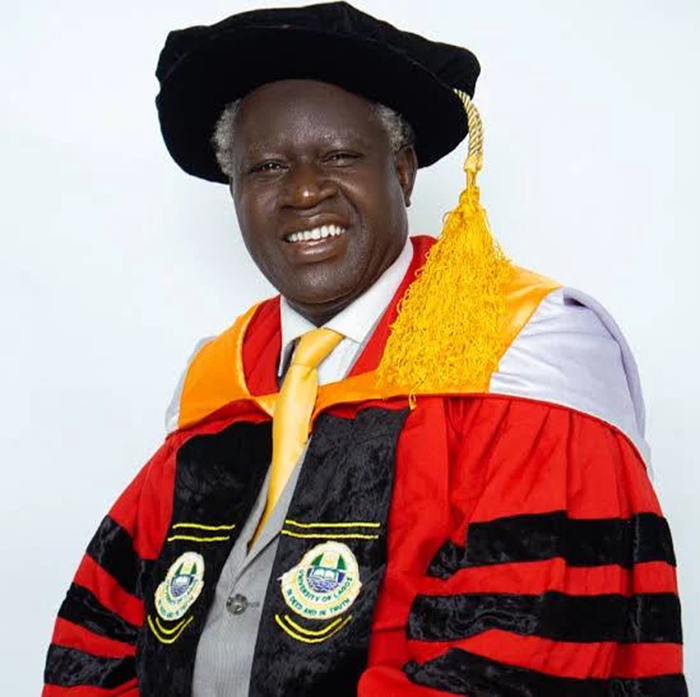
Africa must move beyond the accumulation of wealth and natural resources to building the productive, technological and institutional capacity required to translate those resources into development, Adelaja Odukoya, a professor of comparative political economy at the University of Lagos has said.
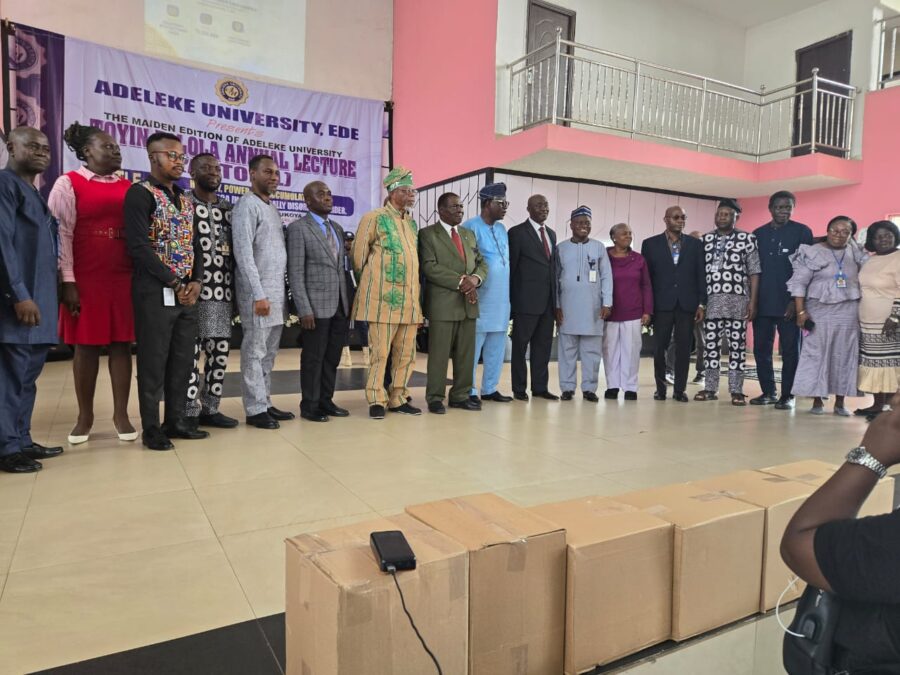
Mr Odukoya made the argument in a lecture titled “History, Power and Accumulation: Reimagining Africa in the Globally Disorderly Order,” and delivered at the maiden edition of Adeleke University Toyin Falola Annual Lecture (AUTOFAL).
Presenting his lecture, he examined the relationship between Africa’s history, knowledge, political power and economic transformation; arguing that accumulation should not be celebrated simply because wealth is being generated, but that the more important question is what each cycle of accumulation makes possible for the next.
According to him, Africa’s long-standing dependence on the export of primary commodities has limited its ability to convert its considerable resource endowments into sustained industrial and technological development.
He distinguished between primary-product accumulation, centred on commodities such as oil, minerals and agricultural products, and productive-capital accumulation, which expands manufacturing, technological knowledge, skilled labour, domestic firms and industrial linkages.
“Accumulation is not development,” he argued, noting that economic activity, investment and capital formation do not automatically translate into productive transformation. He further warned that Africa’s growing strategic importance in the global economy could reproduce old patterns of exploitation if the continent fails to build the capacity to determine how its resources are used.
The professor noted that critical minerals, energy resources, agricultural resources and Africa’s expanding markets are attracting renewed interest from global powers amid geopolitical rivalry, technological competition and changing supply chains. While this presents opportunities for African countries, he said strategic relevance should not be confused with strategic autonomy, as resource ownership alone does not guarantee control over higher-value stages of production.
Mr Odukoya further identified the fragmentation of African economies as a major obstacle to the continent’s developmental ambitions, arguing that African countries remain politically and economically divided even as production and capital increasingly operate across national borders.
He said initiatives such as the African Continental Free Trade Area (AfCFTA) would have limited developmental impact if they merely expanded trade without integrating production. According to him, Africa needs infrastructure, energy systems, finance, research networks, technology and industrial capacity that connect its economies and enable the continent to build regional value chains and greater collective bargaining power.
He also stressed the importance of universities and knowledge production in Africa’s development, arguing that education should not be reduced to producing employable individuals while ignoring the structural conditions that prevent their capabilities from being fully utilised.
Universities, he said, must remain connected to society and productive needs while retaining the intellectual independence to interrogate the structures of power and accumulation. He linked this argument to the scholarship of historian Toyin Falola, a professor, whose work, he said, demonstrates the importance of African intellectual agency and the need for Africans to produce knowledge about their own historical and contemporary conditions.
Mr Odukoya urged Africans to use the continent’s history, resources, human capital, universities and markets as foundations for building developmental agency rather than waiting for a more favourable global order.
Read the full lecture below:
HISTORY, POWER AND ACCUMULATION: REIMAGINING AFRICA IN THE GLOBALLY DISORDERLY ORDER
Professor Adelaja Odutola Odukoya, fspsp
Department of Political Science
University of Lagos, Akoka, Lagos, Nigeria
Tel: 08024047242
Email:aodukoya@unilag.edu.ng
Introduction: From History and Knowledge to Power and Accumulation
Beyond Africa’s glorious historical achievements, which resonate in great civilizational imprints, its historical trajectory has also been marked by imperialist domination, unequal incorporation and the development of underdevelopment. Africa’s contemporary conditions, however, cannot be explained solely through its history. The other fundamental concern is what historical experience has produced in the organisation of power, knowledge and accumulation. Not the least is the question of what possibilities remain to change those conditions.
Notwithstanding the damage colonialism inflicted on Africa, Africans have never lacked historical consciousness and knowledge. Africa’s accumulated historical knowledge has been transmitted through the ages by the means of oral traditions, praise poetry, mores, material culture, ritual, socio-political institutions and, not the least, collective memories. No meaningful conversation about Africa’s future is therefore possible without giving primacy to history. For a lecture concerned with reimagining the future of Africa through the lenses of power and accumulation, history matters for more than chronology. It matters because historical processes have shaped the institutions, social forces, political authorities and economic relations through which contemporary Africa is organised. Their consequences remain visible and enduring.
It is in the intellectual repositioning of African historiography with regard to the identity and development of Africans that Professor Toyin Falola’s scholarship has achieved global prominence. Professor Falola has consistently demonstrated that historical experience, indigenous knowledge and African intellectual agency constitute the essence of African historical identity, rather than making Africans mere objects of history. A significant thrust of Professor Falola’s treatment of African knowledge systems is his engagement with indigenous knowledge and oral traditions. These function as sources of historical understanding requiring no validation from outside (Falola, 2022a, 2022b).
Professor Falola’s rigorous scholarly interrogation with power, especially his exposition of African perspectives on power, demonstrates that power is a sacred thrust. This flows from the understanding that historical knowledge is power and that power also gives life to history, just as history shapes power. There is therefore an organic nexus between history, knowledge and power. This interface throws up fundamental questions that go beyond academic preoccupation: Who has the authority to define Africa? Whose interpretation of African experience is authoritative? Which knowledge systems are treated as legitimate, and which are assigned a subordinate position?
One benefit of knowledge is that it helps establish the categories through which societies gain self-understanding and apprehend possibilities in their progression towards development. However, though knowledge may be perceived as brilliant, like a knife, it lacks the power to cut itself. To this end, knowledge qua knowledge is incapable of changing material conditions. Herein is the heuristic value of political economy.
Colonial narratives and associated imperialist hegemonic historiography sought to obscure the authenticity of Africa’s past and distort its contemporary historical trajectory. Africa owes historians such as Professor Toyin Falola considerable intellectual debt for illuminating how Africa came to be what it is today. The knowledge produced within Professor Falola’s scholarly tradition provides the means to interrogate received histories. It also enlarges the capacity of contemporary African societies to alter the possibilities of the futures built upon them. This raises a more complex set of questions about the underlying mechanics through which historical relations become material and political relations:
How do historical relations become economic structures?
How do economic structures become relations of power?
How does power organise accumulation?
And what happens when accumulation expands without producing the productive transformation associated with development?
In this lecture, accumulation is used in a broader sense than the mere expansion of capital or the increase of wealth. Rather, it is the process through which resources, productive capacities, institutions, knowledge, political authority and social power are organised, appropriated and reproduced over time. What a society accumulates is therefore more than money or physical assets. Society also accumulates technological capabilities, skills, infrastructure, organisational capacities and the institutional means through which these can be converted into further productive possibilities.
Against this background, accumulation is also a question of power. It entails decisions about what is produced, what is extracted, who controls the surplus, where investment goes, whose knowledge counts, and whose labour bears the cost. It also concerns how the resulting surplus is reproduced and deployed for the development of society. For this reason, the economic and the political therefore cannot be separated.
This broader understanding is important because accumulation can take different directions. A society may accumulate wealth from the extraction and export of primary commodities without developing the productive capabilities required to transform that wealth into sustained industrial and technological capacity. It may experience expanding financial and commercial activity while productive capacity remains weak. It may also accumulate institutions and formal democratic procedures without a corresponding expansion of popular capacity to influence the direction of development. Accumulation, in other words, can expand while development remains limited.
The question that runs through this lecture is therefore not whether Africa accumulates. Africa has accumulated and continues to accumulate. The more fundamental question is what Africa accumulates, who controls the process, how the resulting surplus is reproduced, and what one round of accumulation makes possible for the next.
My work on Nigerian and African political economy has been primarily concerned with these problematic questions. My doctoral thesis, A Discourse on Accumulation and the Contradictions of Capitalist Development in Nigeria, interrogated the relationship between state, social classes, foreign and transnational capital accumulation, including forms of primitive and compradorized accumulation within Nigeria’s postcolonial political economy (Odukoya, 2011). What came out from the study is that the focus should never be accumulation qua accumulation. It made clear that accumulation is not development. The problem concerns what accumulation produces in terms of social and productive outcomes.
The import of this lies in the fact that there is no linear relationship between accumulation-induced wealth increase and the expansion of productive capacity. Accumulation can generate exports without technological transformation. It can also produce private fortunes alongside deteriorating public institutions. Investment can be generated without creating an internally articulated productive economy. It is for these reasons that the distinction between primary-product accumulation and productive-capital accumulation remains fundamental. The problem arises when deliberate effort is not made to unpack accumulation, given the implications of its different forms for developmental outcomes.
First, primary-product accumulation refers to accumulation that is dominantly organised around the extraction and production of primary commodities. This includes oil, minerals and agricultural products. This sort of accumulation has a low coefficient for development. While revenue, foreign exchange, infrastructural finance and raw materials for industrialisation can be generated through primary production, it encounters developmental limitations when extraction and export are the terminal point of accumulation.
When there is an expansion in productive capacities such that, over time, the economy flourishes through manufacturing, innovation and the reproduction of productive capabilities, productive-capital accumulation is taking place. It is underscored by outputs such as machinery, technological knowledge, skilled labour, domestic firms, industrial linkages and institutions capable of supporting further production.
The difference between these two forms of accumulation can be expressed through a simple question: is accumulation an endpoint, or is it a means within a wider developmental process? Put differently, to what extent does a particular form of accumulation possess the capacity to generate further accumulation? This question extends the accumulation framework. It draws attention not simply to the volume of accumulation, but to its capacity for reproduction and expansion. It also brings the role of the state into sharper analytical focus.
Often overlooked is the fact that state power provides the overarching mechanism through which accumulation is organised, facilitated, regulated and protected. It is this constitutive relationship between state power and the imperatives of capital accumulation that provides the basis for what I refer to as the State-Capital Model of Accumulation.
The State–Capital Model of Accumulation (Odukoya, 2011) underscores the fact that power is a desideratum for accumulation. Capital does not accumulate in a political vacuum. Even market imperatives operate within the ambit and protection of the state. Property rights are secured by the legal might of the state. An enforceable contract has failed the moment it was consummated if the state guarantee is missing. Infrastructure requires public authority and investment. Concessions require state approval. Labour is regulated through state institutions, while finance operates within legal and political arrangements. The state is therefore integral to the organisation of accumulation.
The postcolonial state is Janus-faced and amphibious in terms of power. As the experience of African states demonstrates, a state that has difficulty providing electricity, education, healthcare or social protection may still demonstrate considerable capacity in protecting property, allocating concessions, facilitating investment or securing particular accumulation interests. This gives rise to the problem of selective state capacity.
The problem is often reflective of a situation whereby a state may possess considerable capacity while deploying it unevenly across social and economic priorities, having class implications. This is what I call the Accumulation-Protective State, that is, a state whose institutions preserve, regulate and reproduce dominant accumulation relations even where those relations do not produce broad developmental transformation.
At the empirical level, we confront this contradiction wherein the state embraces policies that promote investment without engendering technological transfer; promotes entrepreneurship without creating sufficient productive employment; expands primary-product exports while leaving processing capacity undeveloped; constructs infrastructure without organic linkage with domestic production. From the forgoing, the importance of state intervention lies in the direction it takes and the consequences it produces.
Another important part of the issue is that foreign capital has acquired a fetish status. External capital operates through domestic institutions and political relationships. Domestic actors can derive substantial benefits from forms of accumulation that remain externally dependent. The distinction between internal and external accumulation is consequently insufficient on its own. Dependency is reproduced through the interaction between domestic and international forces. The relevant question is not simply who owns capital, but what form of accumulation the relationship between state and capital produces.
The world is changing, so too is the world’s perception of Africa and its strategic position in the global order. The Africa that in the past few decades was deemed almost irrelevant and a burden to human civilisation has assumed new strategic importance for global accumulation. This importance is closely tied to its critical minerals, energy resources, agricultural resources, markets and geographical position. These are attracting renewed international attention. In what has been described as the second scramble, the acquisitive gaze of competing geopolitical powers is making Africa increasingly valuable because of its resources. Historical lessons commend to Africa a caution: being of increased value to others may not translate into increased power for the continent in the Globally Disorderly Order within which contemporary accumulation takes place.
The Globally Disorderly Order and Africa’s Changing Position
Today’s international system is experiencing remarkable reconfiguration. Geopolitical rivalry, wars and sanctions, technological competition, energy insecurity and contestations over strategic supply chains have produced what has been described as circulation capitalism. This development has disrupted the post-Cold War illusion of a relatively stable liberal internationalism. It is a paradox that an entrenched order still exists despite this global disorder.
The existence of considerable global institutional continuity has ensured that the world has not simply become chaotic. Interstate trade continues. Despite the serious challenge of dedollarisation, global financial systems remain integrated. The operations of international organisations remain effective, while production networks continue beyond national boundaries. The change in question is the political stability of the hierarchy within which these relationships operate. Above all, the order within this Globally Disorderly Order is far from settled. The terms of that order are increasingly contested.
For Africa, there is more than a passing challenge in reordering its strategic positioning within this context. This flows from the new strategic significance Africa’s resources have acquired as a result of changes in energy systems, industrial technology, digital infrastructure and global supply chains. Critical minerals are now the locomotive of global capitalism. By providence, substantial shares of several minerals increasingly important to contemporary industrial and technological production are available in Africa (African Union, 2025). Again, relying on Africa’s historical trajectory, the strategic value of these resources provokes an old concern in a new form: Will Africa export the resources while other economies capture the higher-value stages of production? Or can resource endowments become a foundation for productive transformation? This concern matters in a fundamental way beyond mere academic exercise.
The global paradox has been that a country can possess cobalt without producing batteries. It is also not given that a country exporting lithium will necessarily develop the technologies associated with battery production. Nigeria and other African oil-producing nations have exported crude oil without developing a fully integrated petroleum industry. Exporting agricultural commodities has resulted in the importation of processed food and agricultural inputs. Thus, resource ownership tells us only part of the story. What is germane and at the core of development transformation is how value is created, retained and extended through production.
My analysis in a recent presentation on the politics of accumulation, resource control and the Dangote Refinery Initiative approaches this question by interrogating the nexus between domestic capital, resource control and industrialisation. The presentation argued that, though the Dangote Refinery represents an important attempt to extend domestic accumulation beyond crude-oil extraction towards refining and industrial production, it also raises fundamental questions regarding market concentration, state–capital relations, technology and the continuing influence of international capital. This concern cannot be over-emphasised.
Geopolitical rivalries over the continent’s strategic and critical minerals are intensifying, alongside economic and strategic relationships between China, India, the Gulf states, Europe, the United States and other key actors with Africa. There is a looming danger that the multipolar system may create more choices without the indispensable capabilities required to maximise those choices. A state may choose among several investors and still lack the technology to determine the terms of production.
In a similar vein, the number of export markets open to a state does not free it from heavy dependency on primary commodities. The influx of foreign direct investment from geopolitical partners in no way terminates technological dependency. The more consequential issue is not which choice to make between the United States and China, or Iran and Israel. It is what Africa needs to do to make its relationships with all external powers negotiable from a position of strength. This underscores not Africa’s geopolitical alignment, but its productive capability and its capacity to propel its developmental aspirations.
There is a sense within which nations are now focusing their concern on the industrial-security complex. In this wise, industrial policy in major capitalist economies is now accorded renewed primacy. To this end, the United States, European states, China and other major economies are increasingly treating production, technology, energy and strategic supply chains as matters of national security and geopolitical power. It will therefore be suicidal for Africa to approach the global economy without connecting its market operations with its strategic state and developmental imperatives.
The choice facing Africa in this regard is complex. Any wrong step could result in the ongoing new scramble for the continent’s resources reproducing the old pattern of extraction under a new technological lexicon. On the positive side, it could also create an opportunity for African states to insist on value addition, technology transfer, domestic production and regional value chains. Either way, the outcome will depend on political capacity. This is why strategic relevance should not be confused with strategic autonomy.
My worry is that, if as a people we fail to do the right thing now that we have the unique opportunity again, there is a high probability that Africa’s resources may become more strategically important, yet Africa will still lack the capacity to determine the terms on which those resources are exchanged in the global market.
The primacy of accumulation is what marks the two different outcomes confronting Africa. These matters of a political nature are not solely determined at the global level; the fragmentation of African political economies also has much to do with it. Where what Africa requires is organic unity, African states hold tenaciously to an anachronistic historic colonial separatist cartography while they pursue the illusion of continental unity.
Ghettorisation and the Political Economy of African Fragmentation
The reality of accumulation on the continent produces an interesting paradox. African states are rigidly territorial and national, while much of the capital seeking African resources and markets is de-territorialised in the sense of being transnational. The implication reinforces the historical problematic of unequal relations, exemplified in an enduring problem of scale. Capital moves across the continent’s borders, while African states negotiate timidly and separately. The result is a collective developmental catastrophe.
Part of the development complications on the continent has been that Africa seeks to promote development with economic policy that is mostly nationally bound. This is in contrast with production chains that, more than before, are increasingly transnational. Reducing the question of African integration to a question of the removal of trade barriers is seriously mistaken. I use the concept of ghettorisation to describe part of this condition.
Ghettorisation has an external and internal dimension. Externally, the historical incorporation of African economies into global capitalism through primary commodities, external capital, foreign technology and externally oriented trade represents the external dimension. Internally, ghettorisation is seen in the consolidation of colonial territorial fragmentation through national political jurisdictions within which access to resources, public contracts, concessions and external capital could be organised. Colonial boundaries therefore matter, but the contemporary problem transcends the issue of colonial boundaries alone.
What we are witnessing now in Africa is that fragmentation has been domesticated across national boundaries by vested domestic interests to the exclusion of other African state elites. National political and economic elites operating within national accumulation spaces have strong vested interests in preserving the colonial territorial and institutional divisions through which their accumulation is made possible. The state has consequently become a means of production. Control of state power provides privileged access to contracts, licences, concessions, land, finance and external investment for domestic elites.
The national state is therefore both a political institution and an arena of accumulation, reinforcing the elites’ determination to tighten their hold over it. This generates a fundamental tension for Pan-Africanism, producing a disconnection between its precepts and the practices of the elites who control national accumulation. The popular agenda of continental unity is consequently undermined by the vigorous defence of economic positions that reproduce continental fragmentation. The gains from this fragmentation accrue to particular national and class interests rather than to Africa’s regional integration.
Africa’s protection of national accumulation, despite being at variance with the objectives of regional integration, reflects the concern that deeper integration would alter bargaining relationships in ways less favourable to domestic elites. Firms that have hitherto been protected from competition would be exposed to wider competitive pressures. The discretionary power associated with national concessions enjoyed by firms would also be curtailed. The ability of governments to negotiate preferential benefits from foreign capital would change, as would the rents available for distribution. Integration is therefore not merely technical, it has far-reaching political economy consequences.
Kwame Nkrumah’s position that political unity must be linked to economic organisation as the basis of African unity encapsulates this concern. For Nkrumah, African unity would remain an illusion if separated from questions of industrialisation, planning and the collective use of African resources (Nkrumah, 1963). Regrettably, Africa’s leadership has largely ignored this insight, with the result that the continent remains fragmented even as production is increasingly organised across national borders. This fragmentation is reflected in the differentiated resource endowments and productive capacities of African states.
One country may possess the minerals, while another has the facilities required to process them. A third may possess energy resources, while the infrastructure for their utilisation is located elsewhere. The country with the largest market may be different from all of these, while specialised technical capabilities may reside in yet another country. What emerges, therefore, is a situation in which resources that are organically complementary and domicile in Africa do not automatically constitute a continental production system. Their geographical proximity does not overcome the political and institutional fragmentation of production.
An important effort to address the problem of fragmentation and promote regional integration is the African Continental Free Trade Area (AfCFTA). The AfCFTA provides an institutional basis for deeper economic integration, including the development of regional value chains and industrial diversification (African Union, 2018). It is a grand delusion to think that the existence of a continental trade framework by itself generates developmental power. AfCFTA’s developmental significance depends on the nature of the integration that ultimately emerges.
A larger continental market can simply become a larger market for imported products, while the integration of trade does not necessarily produce the integration of production. Production integration requires the deliberate organisation of infrastructure, energy, finance, research, technology and industrial capacity across national borders. Without such coordination, AfCFTA, risks expanding the scale of exchange without fundamentally transforming the fragmented structure of African production.
The foregoing issues underscore the often-ignored historical difference between African and European integration. European integration developed among economies that had already acquired substantial industrial and technological capabilities, established productive linkages and significant cross-border commerce rooted in capitalist development. African integration, by contrast, is taking place under conditions in which productive capacity remains uneven, fragmented and incomplete.
The challenge, therefore, is not simply to reproduce the institutional architecture of European integration, but to construct the productive and material foundations upon which meaningful continental integration can rest. The task before Africa is consequently twofold: to integrate its markets and, more fundamentally, to construct the continental productive capacity necessary to sustain that integration.
Continental integration is thus not merely an institutional or trade-policy question; it is fundamentally a political economy question. It requires moving beyond a condition in which markets are formally integrated while the productive structures that would make such integration transformative remain fragmented. In other words, as things are presently, Africa confronts the problem of integration without being integrated.
It is important to state unequivocally that continental integration will redistribute rents, affect national elites, alter relationships with foreign capital and challenge protected industries. It will also require states to surrender some forms of discretionary control in exchange for greater collective bargaining power at the continental level.
The politics of integration is therefore inseparable from the politics of the state. To expect national states to surrender their economic privileges voluntarily, without confronting and reorganising the political interests embedded within them, simply because integration is economically rational would amount to wishful thinking. This explains the resilience of the logic of ghettorisation in Africa’s political economy of integration.
To be clear, Africa can be deeply integrated into global capitalism while remaining weakly integrated within itself. It can export resources to the world while continuing to depend on the outside world for much of what it requires for its own reproduction. This helps explain why African states compete among themselves for foreign investment, while foreign capital negotiates across the continent from a structurally powerful global position. The result is a continent of sovereign states without corresponding collective economic power.
I am not, by this argument, advocating the abolition of Africa’s national sovereignties. On the contrary, I call unequivocally for the development of continental productive and economic capacity through which national sovereignty can acquire greater collective substance and material power. Thus, the central task for Africa should therefore be to engender productive integration.
This requires infrastructure that connects African production, energy systems that support industry, financial mechanisms capable of financing long-term investment, research networks that deepen technological learning, and markets large enough to sustain African industrial firms. The challenge is political. These conditions cannot be created independently of the state. Since fragmentation has become embedded in the organisation of accumulation of the African state, the state itself must be interrogated as one of the institutions through which that accumulation is reproduced.
The Accumulation-Protective State and State-Capital Relations
Various conceptions of the state exist, ranging from the elemental and functional to the philosophical. The state is also commonly discussed in terms of whether it is interventionist or non-interventionist, large or small, developmental or predatory. These classifications are useful up to a point, but their analytical utility becomes limited when detached from the material context in which the state operates. The more important question is what the state does within a particular accumulation regime and whose accumulation its interventions enable or protect.
Given that there are no stateless people, the question was never simply whether the state was present. The more important question was what the state was present to do. The Accumulation-Protective State explains what the state does in relation to accumulation in the African context. The concept refers to a state whose institutions protect and regulate prevailing forms of accumulation while presenting such interventions through the language of reform, investment, growth and development. This moves the analysis beyond the familiar leadership-deficit thesis as an explanation of Africa’s development crisis.
It would be wrong to suggest that leadership is irrelevant to Africa’s development. Leadership matters, but it operates within institutional and class relations that constrain and shape the possibilities of policy change. A succession of governments may alter policies while leaving the basic organisation of accumulation largely intact. The persistence of an accumulation regime that constrains development despite changes in leadership therefore requires explanation beyond the qualities or failures of individual political leaders.
The selectivity of state capacity is particularly important to our analysis. A state may experience considerable difficulty providing electricity, education, healthcare or social protection while demonstrating substantial capacity in protecting property, allocating concessions, facilitating investment or securing particular accumulation interests. In this context, what appears as general state weakness may conceal considerable state capacity deployed unevenly across social and economic priorities. The issue, therefore, is not simply whether the state has capacity, but where that capacity is directed and whose interests it serves.
This contradiction can be observed in practice. The state promotes investment without creating conditions for technological transfer. It encourages entrepreneurship without generating sufficient productive employment. It expands primary-product exports while leaving processing capacity undeveloped. It constructs infrastructure without establishing strong linkages with domestic production. The significance of state intervention lies not merely in its volume. Its direction and consequences cannot be overemphasised.
The developmental significance of accumulation therefore lies in what it produces beyond the expansion of capital itself. Economic activity, investment and capital formation do not, in themselves, constitute development. The central question is what each round of accumulation leaves behind, that is, does it expand productive capacity, deepen technological capabilities and domestic linkages, generate productive employment, and increase the capacity to produce more sophisticated goods and services? More fundamentally, does it create capabilities that make subsequent accumulation more productive, less dependent and increasingly domestically articulated?
My position is that accumulation is not synonymous with development. As previously conceptualised, accumulation refers to the expansion of capital and the generation and reinvestment of surplus. Development refers to the transformation and expansion of the productive, technological, institutional and human capabilities of an economy. It is therefore possible for accumulation to occur without development. This happens when surplus expands without being converted into capabilities that deepen and diversify production. As we have seen in Africa, a country may experience substantial economic activity, attract investment and generate private wealth while remaining dependent on imported technology, foreign finance and primary-product exports, thus luxuriating with underdevelopment.
Underdevelopment refers to a historically constituted structural condition produced through the unequal incorporation of economies into global capitalism, characterised by persistent dependence, weak productive capabilities and limited control over the conditions of accumulation. Maldevelopment, by contrast, refers to a mode of accumulation in which the expansion of capital reproduces rather than transforms the structural conditions of underdevelopment.
The state is central because it mediates accumulation, shapes the appropriation and deployment of surplus, and can protect prevailing forms of accumulation even when they constrain productive transformation. Maldevelopment therefore captures the reproduction of dependency through accumulation itself: capital expands, but productive capacity, technological capability and domestic economic articulation remain structurally weak.
The distinction, therefore, is between accumulation that terminates prematurely in the extraction and export of primary commodities and accumulation that converts surplus into expanding and increasingly complex productive capabilities. The political economy implication is that the former can reproduce external dependence when surplus is not translated into domestic productive transformation, whereas the latter strengthens domestic accumulation, technological capability and greater control over the development process.
This places a major developmental responsibility on the state. A state concerned with development cannot simply maximise extraction without regard to its productive consequences. Policy must therefore be intentional, with accumulation organically aligned to the productive outcomes it is expected to generate. Attention must focus on several questions. What level of domestic processing is required and achievable? What productive linkages can be created? What technologies and skills are required, and how will they be developed? What infrastructure is needed to support related industries? Above all, how will the surplus realised from primary-product accumulation be reinvested to expand productive capacity and capability?
The issue is especially important in resource-rich economies, where Dutch disease and rentierism can reinforce one another. Dutch disease operates through a resource boom that generates large foreign-exchange inflows. This increases demand for the domestic currency and causes real exchange-rate appreciation. Domestically produced tradable goods then become relatively more expensive in international markets, while imports become relatively cheaper. Manufacturing and agriculture consequently lose competitiveness. At the same time, higher returns generated by the resource and non-tradable sectors can draw capital and labour away from other productive activities. The result can be a shift towards resource extraction and non-tradable activities at the expense of productive diversification.
Rentierism adds a political economy dimension to this process when the state becomes substantially dependent on externally derived resource rents rather than broad-based domestic production and taxation. The state–capital relationship then becomes important. The state determines the legal, fiscal, regulatory and infrastructural conditions through which resource rents are generated and appropriated. The same condition allows capital access to those rents and opportunities. The state can use resource revenues to build productive capacity, impose conditions on capital and direct investment towards diversification. Alternatively, it can facilitate the concentration and distribution of rents without transforming the productive base.
Where the latter prevails, resource rents become a principal basis of accumulation, while the productive structure remains dependent on external markets, technology and finance. The problem, therefore, is not resource abundance itself, but the way state power and capital are organised around the appropriation and deployment of resource surplus. Oil revenues can finance industrialisation, mineral revenues can support technological development, while agricultural exports can provide resources for agro-industrial investment.
However, none of these outcomes occurs automatically. Their developmental significance depends on how the surplus is appropriated, organised and deployed. Thus, extraction in itself is not the problem. The problem arises when resource accumulation remains disconnected from the successive productive transformations capable of deepening domestic productive capability. This foregrounds the fact that the development chain should be understood as cumulative.
Processing should generate manufacturing. Manufacturing should support research and development. Research should deepen indigenous technological capability. The resulting productive system should create skilled employment and leave surplus available for further productive investment. Where this chain is established, primary-product accumulation can contribute to productive transformation. Where it is broken, resource wealth can reinforce peripheralised accumulation.
Infrastructure has to be examined within the same framework. A railway designed primarily to move minerals from a mine to a port may facilitate extraction without substantially transforming the domestic productive structure. Another railway may connect agricultural zones, industrial centres, workers, markets and cities. It can therefore contribute to internal economic articulation. The physical infrastructure may look similar, but the accumulation structures it supports are not. Infrastructure is therefore not developmental simply because it is infrastructure. Its significance depends on the economic relationships it makes possible.
An application of this to financial capital is quite illuminating. Capital can circulate without producing substantial new productive capacity. Financial transactions may expand rapidly while manufacturing remains weak. Real estate can absorb large quantities of capital without resolving industrial underinvestment. This is not a contention that services or finance lacks developmental benefits. Both of them are indispensable to modern economies. The problem is the expansion of circulation without a corresponding strengthening of the productive base. This is a case of unproductive accumulation.
This brings the politics of capital attraction into sharper focus. A state that asks only whether capital is willing to invest leaves the direction of accumulation largely to capital. A state serious about development must also ask what capital is expected to produce. The emphasis consequently shifts from the politics of capital attraction towards the politics of capital discipline.
Capital discipline should not be understood as hostility to investors. Capital should be welcomed where it expands productive capabilities and regulated where it reproduces extraction, technological dependence or concentrated accumulation. This requires a state with sufficient autonomy to negotiate with capital.
Autonomy alone, however, is not enough. A state may be autonomous from particular firms while remaining insulated from society. It may pursue developmental goals from above while reproducing authoritarian forms of power. The state must therefore be strong enough to discipline capital and sufficiently accountable to society for that discipline to serve broader developmental purposes.
While the East Asian experience is relevant for Africa, its mechanical transplantation is impossible. Johnson’s analysis of Japan and Amsden’s account of South Korea demonstrate the importance of state intervention in directing investment, protecting selected industries and, crucially, disciplining capital in ways connected to productive performance (Johnson, 1982; Amsden, 1989). The lesson is not that Africa should reproduce Japanese, Korean or Taiwanese institutions. Rather, without a state capable of shaping the direction of accumulation and imposing conditions on capital connected to productive performance, there will be no development.
To this end, the useful political economy question is what an investment contributes to the transformation of accumulation. Does it deepen domestic productive linkages? Does it generate technological and engineering capabilities? Does it stimulate related industries and research? Does it retain and reproduce productive capacity within the Nigerian economy? What role does the state play in creating the conditions under which these outcomes become possible?
These considerations ensure that we avoid a simplistic distinction between foreign and domestic capital. The nationality of capital matters politically, but it does not by itself determine the developmental character of accumulation. Domestic capital can reproduce dependent and concentrated accumulation, just as foreign capital can contribute to productive transformation under appropriate institutional conditions. What matters ultimately is the form of accumulation produced, the capabilities created, the linkages established and the distribution of the resulting surplus.
The central issue is therefore neither state versus market nor foreign versus domestic capital, but the organisation of accumulation. A state that merely protects an existing accumulation structure may facilitate economic activity without producing structural transformation. A state capable of disciplining capital, directing investment, building productive infrastructure, developing technological capabilities and ensuring that surplus is reinvested into productive capacity can begin to alter the terms of accumulation.
One recalls in this respect the South Korean experience of deliberate policy intervention in the market through subsidies, tariffs and price controls directed towards industries considered strategic for national development. This was accompanied by the principle of reciprocal subsidy, under which state support was not treated as a freebie but was tied to performance standards, including the fulfilment of export commitments.
This brings the crisis of governance in Africa to the centre of the development equation. Earlier development efforts often treated the state primarily as an instrument of policy implementation, with insufficient attention to the institutional conditions under which it exercises power. However, the issue cannot be reduced to administrative effectiveness or institutional reform.
Be that as it may, if the state organises accumulation, who has the power to influence the state? If the state possesses substantial capacity to protect accumulation but limited capacity to secure social reproduction, whose interests does that capacity serve? And if political participation does not provide meaningful influence over the direction of accumulation, what, then, is the nature of democracy within the state? These questions lead directly to the vexed issue of democracy and empowerment.
Democracy as Disempowerment
If the state is central to the organisation of accumulation, the question of democracy cannot be separated from the question of who has the capacity to influence the state. The issue should go beyond merely whether citizens participate in elections, to whether participation gives them meaningful influence over the social and economic processes that shape their lives.
Nigeria’s post-1999 democratic experience presents a difficult paradox. No doubt, electoral competition has become established, constitutional government has continued, political parties compete for office and governments change through elections. Regrettably, the consolidation of electoral institutions has not produced a corresponding expansion of popular control over the economic and social processes that shape everyday life. It is this condition, in which democratic institutional continuity coexists with an erosion of popular capacity to influence the organisation and distribution of social resources, that I describe as democracy as disempowerment.
My position does not deny the significance of elections. Elections remain an important mechanism through which citizens choose governments and hold political incumbent to account. The issue is what electoral democracy can achieve when the political economy within which it operates remains deeply unequal and accumulation continues to be heavily mediated through state power. This lies at the core of the elusive search by the average Nigerian for the proverbial “dividends of democracy” since the return to civil rule on 29 May 1999.
Democracy is often assessed through institutional indicators such as elections, constitutions, party competition and alternation in office. These indicators tell us something about the operation of political institutions. They do not, by themselves, capture the extent of popular influence over the material conditions of social life. A citizen may possess the right to vote while exercising little influence over the conditions under which employment is created, education is financed, land is allocated, resources are extracted or public wealth is distributed. Political citizenship can therefore exist alongside limited material agency.
It is this contradiction that gives democracy as disempowerment its political economy content. Formal political rights may coexist with limited capacity to influence the structures through which material opportunities are produced and distributed. The problem is not the absence of participation rather it is the limited conversion of participation into substantive influence that is our focus here.
Joseph’s (1987) analysis of prebendal politics demonstrates how public office can become embedded in networks of patronage through which access to state resources is organised. Ekeh’s (1975) distinction between the primordial and civic publics provides a further historical and social context for understanding how relationships to state resources can complicate the meaning of public accountability. Ake (1996), in turn, draws attention to the ways in which political institutions operate within wider economic structures. The possibilities of democracy are therefore shaped by the social and economic relations within which institutions are embedded. Taken together, these perspectives point to the need to approach the Nigerian problem through the relationship between democratic institutions and accumulation.
Where economic opportunity remains heavily dependent on access to state resources, political competition becomes inseparable from struggles over accumulation. Politics is therefore not simply political. It is often clothed in economic garbs and interests. Political office acquires economic value, helping to explain why electoral competition can become intensely contested without necessarily producing structural change. Parties compete and governments change, yet the underlying mechanisms through which accumulation is organised remain remarkably resilient. The resulting condition can be described as an Order of Organised Inversion: democratic institutions exist and political alternation occurs, but the capacity of these institutions to produce substantive popular power remains constrained (Odukoya, 2026).
The contradiction can be seen in the divergence between political participation and everyday economic experience where citizens vote, yet many remain jobless. They possess constitutional rights, yet experience unequal access to quality education and healthcare. They participate in political campaigns, but economic opportunity remains heavily concentrated. This result is a crisis of democratic expectations. Citizens may find that the institutions through which they participate offer limited influence over the structures that determine their material security.
Disempowerment, however, does not necessarily produce political passivity; it sometimes results in insurgent publics. The #EndSARS mobilization in Nigeria, for example, expressed specific grievances about policing while also opening a wider discussion about state power, accountability and citizenship. Thus, disempowerment therefore can coexist with political agency; it means that existing institutional channels do not adequately convert social agency into durable political power.
Protest is often treated as disruptive, yet it can expose contradictions that established political institutions fail to address. The mistake has often been to assume that protest can by itself reorganise an accumulation regime. That requires organisation, institutional capacity and political programmes capable of connecting immediate grievances to broader questions of economic transformation. This is what makes the crisis of democracy also a crisis of development. The relevant question is not simply whether citizens participate, but what their participation enables them to influence, including whether they can exercise meaningful influence over the organisation of accumulation.
This is the difference between a democracy that empowers and one that disempowers. Let it be said unequivocally: without some capacity among citizens to influence the organisation of accumulation, democratic citizenship remains separated from economic citizenship. Building such capacity requires a critical and educated citizenry capable of collective organisation. Education and knowledge therefore become important to democratic empowerment and developmental transformation. This stands in contrast to the current practice of distributing cash, motorcycles, grinding machines, farm implements and similar items among political actors, often dubbed “empowerment”. Such interventions do not necessarily engender the productive or institutional capacities through which citizens can exercise sustained agency. Citizens often remain in poverty and dependency.
For emphasis, a society cannot develop transformative political capacity without institutions capable of producing and disseminating critical knowledge. It is for this reason that the university consequently becomes part of the wider democratic equation. To this end, the question that should be of immediate concern is not merely whether the university produces graduates, but whether it contributes to the production of the knowledge, capabilities and critical citizenship required to transform the structures within which accumulation and political power are organised.
The Organic University and the Politics of Knowledge
If democracy is to move beyond formal participation towards substantive empowerment, and if accumulation is to be reorganised towards productive transformation, the question of knowledge becomes a categorical imperative. The university occupies a particular position within this problematic. It is an institution of knowledge production, a site of social reproduction and an institution embedded in the political economy of the state.
The university is highly embedded within the relations of power that structure society. Its funding, governance, curriculum, research priorities and relationship with the state and the economy are shaped by wider political and economic forces. For the reason that it occupies this contradictory position, the university possesses a distinctive possibility. It can reproduce the prevailing order, or it can interrogate the conditions under which that order is produced and reproduced.
It is in this sense that I use the idea of the organic university. An organic university is not merely a university that responds to the immediate needs of the state or the market. It is one organically connected to society without becoming subordinated to the interests of either. Its task extends beyond producing graduates for employment. It must also produce and disseminate knowledge capable of explaining social contradictions, developing productive capabilities and expanding the intellectual capacity of society to imagine and construct alternatives.
This distinction is important because the university can become detached from the social realities that sustain it. It can also become so closely aligned with prevailing state and market priorities that its critical function is compromised. The Nigerian experience aptly demonstrates this tension. Where national elites derive significant advantages from existing forms of state-mediated accumulation, knowledge that interrogates those arrangements can become politically inconvenient. The university is consequently situated within the same contradiction that defines the wider development question. Thus, the university that is expected to contribute to transformation operates within institutions that may reproduce the conditions limiting transformation.
There is a history to this contradiction. During the Babangida era, academics were disciplined, expelled from their accommodation and relieved of their appointments for “teaching what they were not paid to teach”. This captured an important anxiety about the political role of intellectuals and the university. The implication was that the university should remain within prescribed boundaries of academic instruction rather than becoming a site of wider political interrogation. Yet the history of the African university demonstrates that knowledge has rarely been politically neutral. Universities have been important sites of anti-colonial thought, nationalist mobilisation, democratic contestation and struggles over the meaning of development.
The university’s wider mandate becomes clearer when education is considered beyond the language of human capital. Education certainly develops productive capacities, while skills and knowledge contribute to productivity and economic growth. However, reducing education to the production of human capital risks reducing human beings themselves to units of productive capacity and obscuring the university’s wider intellectual, social and transformative functions.
This broader conception of the university resonates with Amartya Sen’s development paradigm, which is based on substantive freedoms and human capabilities (Sen, 1999). The heuristic value of education lies partly in the fact that it improves economic opportunities and also expands the capacity of people to live lives they have reason to value. Universities must hold dear and cherish this broader mandate and reflect it in their epistemological and pedagogical practices.
A university whose focus is only on employability will ask what skills employers currently demand, whereas a university concerned with development asks a different question, what kind of productive economy should society construct? The answer to the first question is not difficult, but the second question is more complex as it requires a political economy formulation to resolve.
Turning the lens to Nigeria, the poser will be: what kind of economy should we have? The last few decades have witnessed the country graduating students whose skills are not adequately absorbed by the productive economy. It has become a resource-rich country that continues to depend heavily on imported technology and manpower. Despite the abundance of arable land, agricultural production coexists with large-scale food dependency. Entrepreneurial energy, coupled with compulsory entrepreneurial education, has not resulted in sufficient productive employment. A palpable gap therefore exists between knowledge production and knowledge consumption.
Above all, public investment in education remains inadequate despite the primacy of knowledge to development. These are not simple conditions to be addressed simply by changing curricula because they concern the organisation of accumulation. Consequently, the university therefore needs to engage production without becoming an instrument of existing production. The university should contribute to industrial transformation yet retain the capacity to query whether the existing industrial structure is itself adequate. This underscores the importance of knowledge sovereignty.
Knowledge sovereignty means possessing the institutional and intellectual capacity to engage external knowledge critically, adapt it to local conditions and, where necessary, generate concepts capable of explaining African historical experiences on their own terms. I should not be mistaken for calling for intellectual isolation. Rather, it is a demand that Africa should participate in global knowledge production from a position of intellectual agency rather than merely consume concepts produced elsewhere.
This question of intellectual agency resonates with the scholarship of Professor Toyin Falola. His work on African history, memory, culture, identity and knowledge has consistently challenged the tendency to treat Africa primarily as an object to be studied rather than as a site from which knowledge about society, history and human experience can be produced. His scholarship demonstrates that recovering African historical experience is not simply an exercise in correcting the record of the past. It is also about recovering the intellectual capacity to interpret that experience and, through such interpretation, to shape how Africa understands its present and imagines its future.
The logic of Professor Toyin Falola’s contention is that a society that cannot adequately theorise its own historical and contemporary conditions will obviously lack the capacity to transform them beyond any disputation (Falola, 2022a, 2022b). My concepts, such as the State–Capital Model of Accumulation, Peripheralised Accumulation and the Accumulation-Protective State, belong to this broader intellectual project: understanding African political economy through categories responsive to the continent’s own historical contradictions. This does not preclude remaining in dialogue with wider traditions of political economy thought. In this sense, knowledge sovereignty is not an abstract epistemological claim. It has material and developmental significance.
The intellectual task matters because the language through which a society understands itself can shape the range of political possibilities it can imagine. If African development is understood primarily through categories produced elsewhere, the specific historical relations through which accumulation, state power and social reproduction operate in Africa can disappear from view. Conceptual autonomy consequently becomes part of developmental autonomy.
The contemporary university faces another contradiction in the growing marketisation of higher education. Students are increasingly treated as consumers. Programmes are evaluated according to market demand, and educational value is increasingly expressed through employability and income. There is nothing inherently wrong with connecting education to the economy. Universities necessarily produce knowledge and skills relevant to productive activity. The problem arises when market relevance becomes the overriding criterion of educational value. When that happens, knowledge that cannot be immediately commodified can be marginalised. Disciplines and forms of inquiry that address fundamental questions about society may then be treated as economically less valuable. The Nigerian experience demonstrates this.
The danger goes much beyond commercialisation alone, it includes the reduction of education to individual investment in human capital. Once education is framed predominantly as a private investment, unemployment and economic exclusion can increasingly be interpreted as failures of individual preparation rather than consequences of the structure of the economy.
This logic can be seen in the growing emphasis on entrepreneurship as a response to graduate unemployment and wider economic insecurity. Entrepreneurship can provide important opportunities, but it cannot substitute for structural transformation. Telling young people to become entrepreneurs does not resolve the absence of productive industries, inadequate infrastructure, weak access to finance, technological dependence or limited domestic demand. The mantra of entrepreneurialisation of tertiary education is another example of this ingenious political economy strategy through which collective responsibility becomes individualised.
While the value of entrepreneurship is not contestable, entrepreneurship cannot substitute for the creation of a productive economy. When graduates, because of the difficulty of getting employment, are enjoined to create their own jobs, a structural problem is shifted to the individual. The focus changes from the capacity of the economy to generate productive employment to the capacity of individuals to become entrepreneurs and job creators. Unemployment is thereby transformed from a political economy problem into a problem of individual initiative. The argument is not that individuals lack agency. It is that the weight of contradictions produced at the level of the political economy should not be carried by individuals.
The above political economy contradiction signals the dual responsibility of the university. Far from being an ivory tower with mere ornamental utility, distant from society’s condition and devoid of impactful benefits, the organic university should equip people with capabilities relevant to productive life. It should also produce the knowledge required to understand why those capabilities are not being adequately used. The university therefore remains a developmental institution rather than simply a training centre. Its social relevance is connected to the wider question of whether knowledge can become productive and enhance political capacity.
Another dimension which has becomes even more consequential is when access to higher education is increasingly organised through debt. The transformation of education from a public good into an individual financial obligation represents what I describe as the debtification of social reproduction. This happens when the cost of reproducing educated labour is progressively shifted from the public to the individual, while the individual is expected to repay that cost through future earnings.
In a context where productive employment is already inadequate, this produces a profound contradiction. Young people are encouraged to acquire education through debt while entering an economy that may not provide the stable employment required servicing that debt. Education is thereby transformed from a social investment into an individual financial liability.
The Nigerian student-loan regime must therefore be considered within the wider political economy of social reproduction. The question is not simply whether students have access to finance. It is what happens when the financing of education is increasingly detached from the collective responsibility of the state and reorganised around individual indebtedness. This does not mean that public financing of education automatically produces developmental outcomes. Public institutions can also reproduce inequality, bureaucratic inefficiency and political exclusion. The issue is the principle upon which the cost of reproducing the knowledge and capabilities required by society is organised.
It is fundamentally unjust for a developmentally backward society to demand a highly educated population and require knowledge-intensive production while simultaneously shifting the cost of producing that knowledge to individuals. Education is part of the productive and social infrastructure of development its financing therefore cannot be treated exclusively as a private investment.
The organic university therefore has to hold knowledge production and social transformation together. Producing skilled individuals without examining the structures that prevent their capabilities from being used leaves the problem of development unresolved. Conversely, producing critical commentary without developing the capabilities required for productive transformation also leaves society with an incomplete response. The task of the organic university is therefore neither to become an appendage of the state nor to become a supplier of labour to capital. It must occupy a more difficult position: connected to society, attentive to productive needs, critically engaged with the state and economy, but sufficiently autonomous to interrogate the relations of power within which both operate.
This is ultimately a question of knowledge and power. Whoever defines the problems that require solutions exercises a degree of power over the developmental agenda. Whoever determines which knowledge counts as legitimate influences the boundaries of political possibility. Whoever controls the institutions through which knowledge is produced and disseminated is one of the leviathans that ensure the reproduction and transformation of society.
This establishes the organic university’s primacy in the struggle over Africa’s developmental future. Knowledge can reproduce dependency, but it can also contribute to its transcendence. Education can individualise structural exclusion, but it can also build collective capabilities. Intellectual production can remain detached from society, or it can become an instrument for understanding and transforming the conditions under which society reproduces itself.
The question that follows is no longer simply how Africa accumulates, but whether the forms of accumulation taking place across the continent are generating the productive capabilities, institutional capacities and social conditions necessary for development.
Conclusion: Africa and the Politics of the Possible
The enormous development challenge facing the continent easily produces cynicism. The truth is that Africa’s current position contains contradictions that cannot be resolved by either optimism or pessimism. Every attempt at tackling the African condition must therefore be open to the duality of challenges and opportunities. The continent remains deeply shaped by historical structures of unequal incorporation into global capitalism. At the same time, it is becoming increasingly important within a changing international economy.
The challenge is that this growing significance can simply reproduces an old pattern of Africa becoming more valuable to the world without becoming more capable of determining what that value produces for Africans. However, the opportunity is that the changing international order holds the possibility for African states and societies to renegotiate aspects of their position within global accumulation.
For Africa to harness this possibility, much depends on how it is able to organise power. The argument has therefore moved through history, knowledge, state–capital relations, democracy, the university, social reproduction, accumulation and continental integration. Each is a different face of the same problem: organising power and productive transformation within the Globally Disorderly Order.
My central proposition is that accumulation is not development. The political economy concern is what kind of accumulation Africa needs, under whose control, for what purpose and with what consequences.
What matters ultimately is whether the organisation of accumulation expands productive capabilities, deepens technological capacity and creates the conditions for greater developmental autonomy. Leaving the reorganisation of the state alone would be dysfunctional and counter-productive, given the nature and character of the African state. A state that disciplines capital without social accountability produces its own form of elite accumulation.
The mass displeasure and disempowerment that continue to provoke citizen agitation and sustain a tradition of protest across the continent demonstrate that disempowerment does not preclude agency. But episodic protest alone cannot reorganise the structures that produce disempowerment. Mobilisation requires organisation, institutional capacity and political knowledge. The university, democratic institutions and continental productive integration are consequently important because they provide different dimensions of the capacity required to transform the organisation of accumulation.
In short, developmental agency is not a gift delivered with the next investment agreement. It has to be constructed through institutions, productive capabilities, knowledge, political organisation and collective bargaining power. This is precisely where the Globally Disorderly Order matters. The same reconfiguration of global power that threatens to make Africa an arena for renewed external competition over resources has unsettled established hierarchies. That disruption may create the space for developmental reconstruction.
Though the opportunity is real, however, opportunity alone is insufficient. Africa is historically not new to opportunities. The decisive question has always been whether African states and societies possess the political and productive capacity to use them. That returns us to the significance of history.
History should neither become a prison nor a source of romantic consolation. It should become a resource for political understanding and positive action. Knowledge should not remain an academic possession. It should be a basis for creativity, innovation and organic transformation. More importantly, power should not be treated as an abstract possession of states. It should be understood as the capacity to change relations to production, resources, institutions and social organisation.
Above all, accumulation should not be celebrated merely because wealth is being generated. It should be judged by what it makes possible. Development should likewise not be reduced to growth. It should be understood as the expansion of productive capabilities, human capabilities and collective capacity to shape social life. That is the point at which the intellectual and political questions converge. What will Africa do with the changing world?
Unending lamentation will change nothing. Waiting for a better international order that may never come cannot resolve the problem. The global order has always been shaped by power, and Africa is no exception to its dynamics and consequences. The task is therefore to build the collective capacity required to participate in shaping the contemporary global configuration. Africa must also use its strategic relevance to advance its developmental aspirations. The continent’s growing strategic importance creates uncommon historical opportunities and openings. We cannot allow them to slip away.
Africa’s history gives it knowledge of the dangers. Its resources provide material possibilities. Africans themselves provide the human basis. Its universities provide intellectual capacity. The benefit of scale lies with its markets, coupled with the institutional mechanisms that states make possible. There is a compelling and emerging framework for continental integration and collective action. What remains contested is the political organisation of these possibilities.
Africa has resources that provide opportunities and ensure that she matters to the world. The issue is what political and productive capacity can be built from these possibilities. The challenge is to move beyond being important to becoming powerful; beyond possessing resources to building productive capabilities; and beyond economic activity to achieving development.
It is fitting, then, to return to Professor Toyin Falola, whose scholarship has consistently insisted that Africa must be understood through its own histories, voices, intellectual traditions and struggles over knowledge. That insistence is not merely historiographical; it is a claim about agency. To reclaim the capacity to narrate Africa’s history is also to recover the intellectual capacity to interrogate the structures of power through which its present is organised and its future imagined. The reimagining of Africa therefore belongs to the same intellectual terrain that Falola’s scholarship has opened: recovering historical agency, unsettling inherited categories of knowledge, and asking what Africans can make of the conditions in which they find themselves.
The challenge before Africa is consequently not only to understand its place in a changing world, but to enlarge its capacity to shape that world. History provides the memory of agency. Knowledge provides the means of understanding. Power provides the capacity for transformation. Their conjunction is what will make Africa’s developmental agency possible.
The question, ultimately, is whether Africa can turn importance into power, power into productive capacity, and productive capacity into development. That is the challenge before all of us as Africans. Tomorrow may be too late.
Thank you for your attention.
References
Ake, C. (1996). Democracy and development in Africa. Brookings Institution Press.
African Union. (2018). Agreement establishing the African Continental Free Trade Area. African Union.
African Union. (2025). Africa’s Green Minerals Strategy. African Union.
Amsden, A. H. (1989). Asia’s next giant: South Korea and late industrialization. Oxford University Press.
Ekeh, P. P. (1975). Colonialism and the two publics in Africa: A theoretical statement. Comparative Studies in Society and History, 17(1), 91–112.
Falola, T. (2022a). Decolonizing African knowledge: Autoethnography and African epistemologies. Cambridge University Press.
Falola, T. (2022b). Indigenous knowledge and oral traditions in Nigeria. In T. Falola & M. M. Heaton (Eds.), The Oxford handbook of Nigerian history (pp. 21–36). Oxford University Press.
Johnson, C. (1982). MITI and the Japanese miracle: The growth of industrial policy, 1925–1975. Stanford University Press.
Joseph, R. (1987). Democracy and prebendal politics in Nigeria: The rise and fall of the Second Republic. Cambridge University Press.
Nkrumah, K. (1963). Africa must unite. Heinemann.
Odukoya, A. O. (2011). A discourse on accumulation and the contradictions of capitalist development in Nigeria [Unpublished doctoral dissertation, University of Lagos].
Odukoya, A. O. (2026, February 18). Nigeria: The Order of Organised Inversion. DevReporting.
Sen, A. (1999). Development as freedom. Alfred A. Knopf.

