


As Osun State prepares for the 2026 governorship election in the next 34 days or thereabout, political activities are gathering momentum. Campaign offices are opening, alliances are shifting, political rhetoric is becoming more strident, and the media is gradually turning its attention to what promises to be one of Nigeria’s most closely watched off-cycle elections. For journalists, however, this period presents a deeper question beyond simply reporting campaign events. So the question is what kind of election are we helping citizens understand? This question occupied my mind during a recent media engagement organised by the International Press Centre (IPC) under…
Author: Development Reporting
By Claudia Caruana [Lindau, Germany, SciDev.Net] Jaymi January, a young South African scientist, is developing next-generation biosensors designed to detect tiny amounts of disease biomarkers associated with tuberculosis (TB), cancer, and viral diseases. What makes her work different from that of many other researchers working on biosensor technology is her use of nanotechnology to identify even the most minute amount of disease-related biomarkers, allowing for earlier and more sensitive diagnosis. A biomarker is any biological indicator in the body, such as a gene, protein, or molecule, that acts as a biological clue to help detect the presence or risk of…
UBA Foundation, the Corporate Social Responsibility arm of the United Bank for Africa (UBA) Group has partnered with Slum2School Africa to equip underserved children with financial literacy skills through a hands-on workshop aimed at building sound money management habits from an early age. The initiative featured the introduction of the UBA Money Explorers Book, an interactive learning resource designed to teach children the basics of financial literacy through stories, practical money ledgers, games and activities. Pupils were also introduced to the UBA Red Vault, a savings product developed to encourage healthy saving habits from childhood. Building lifelong financial habits Speaking at the…
A two-person studio in Abuja can now produce a cinematic animated sequence depicting the court of a 16th-century African emperor, and have it look like it cost $10 million. I know, because I have done it. Here is the methodology, the breakthrough technique, and what it means for the future of African storytelling. The Problem We Were Trying to Solve In 2024, I made a decision that felt audacious at the time: I would produce an animated epic series about the pre-colonial civilisations of Northern Nigeria, the Kanem-Bornu Empire, the Hausa Kingdoms, the Sokoto Caliphate, using nothing but AI tools…
As ‘Hope is a Word’ begins its international festival journey, the film turns one of Africa’s longest environmental struggles into an intimate story of poetry, memory, and a new generation determined to carry the fight for justice in the Niger Delta. By Bonface Orucho, bird story agency Five young Nigerians sit in a circle, notebooks resting on their laps. They have gathered not to draft petitions or organise a protest, but to write poems. At the centre sits environmental activist and poet Nnimmo Bassey. He listens more than he speaks, occasionally asking a question or reciting a verse. Ideas pass…
School owners under the aegis of the National Association of Proprietors of Private Schools (NAPPS) have urged the Federal Government to subject its proposed integration of Junior Secondary School (JSS) and Senior Secondary School (SSS) to rigorous research and broad stakeholder consultations before taking a final decision. The association in a statement signed by its National President, Yomi Otubela, and National Secretary, Ajibade Augustine, said although it supports efforts to improve school retention and reduce Nigeria’s growing number of out-of-school children, restructuring the country’s secondary education system alone may not address the underlying causes of school dropout. The Federal Government…
Africa’s Global Bank, United Bank for Africa (UBA) Plc has announced that its Group Chairman, Tony Elumelu, will retire from the bank’s Board of Directors on 21 August after completing the maximum 12-year tenure for non-executive directors prescribed by the Central Bank of Nigeria (CBN). The bank also announced the appointment of Emmanuel Nnorom, a non-executive director, as Mr Elumelu’s successor, effective 21 August. UBA disclosed the changes in a statement on Monday, saying its Board approved the leadership transition at a meeting held on 6 July. End of an era The bank said Mr Elumelu’s retirement marks the conclusion…
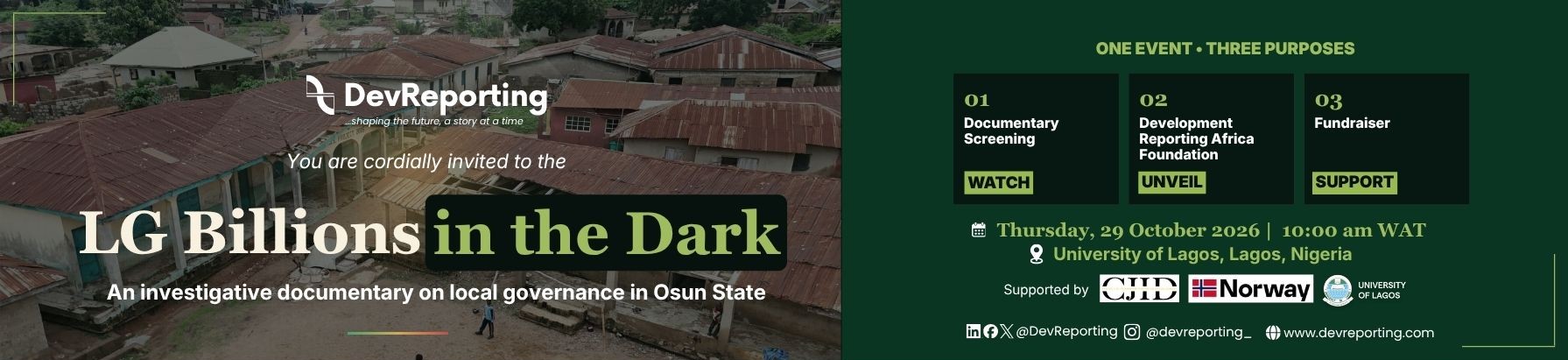
As Osun State prepares for its 2026 governorship election, DevReporting, in partnership with the Centre for Journalism Innovation and Development (CJID), through its Local Media Sustainability Fund (LMSF), and with support from the Royal Norwegian Embassy, invites journalists based in Osun State, South-West Nigeria, to apply for a training and story grant opportunity on governance, transparency, accountability, and public service delivery. The initiative comes against the backdrop of a prolonged leadership crisis that has disrupted governance across the state’s 30 local government areas and Modakeke Area Council. As political actors prepare for another election cycle, the project seeks to deepen…
Nigeria has recorded significant progress in macroeconomic stability in the first half of 2026, but the recovery is yet to translate into better living standards or improved business conditions, the Centre for the Promotion of Private Enterprise (CPPE) has said. In its half-year economic review and outlook released on Sunday, the Centre said improvements in exchange rate stability, moderating inflation, stronger external reserves, higher crude oil production and resilient financial markets have strengthened macroeconomic stability and boosted investor confidence. However, it noted that the gains have yet to deliver broad-based improvements in productivity, employment, business competitiveness and household welfare. “The…
Three years into President Bola Ahmed Tinubu’s administration, Nigeria’s economic debate has become trapped between two competing narratives. One insists the reforms have failed because fuel prices have soared, the naira has weakened, inflation has eroded purchasing power and millions of Nigerians are worse off than they were in May 2023. The other argues the reforms are succeeding because fiscal deficits have narrowed, external reserves have strengthened, investors’ confidence are gradually returning, and long-delayed structural distortions are finally being corrected. Both sides marshal evidence. Both cite data. Both tell important truths. Yet neither fully explains Nigeria’s present reality. The real…