



As Nigeria intensifies discussions around tax reforms and revenue generation, the launch of ‘Moria’s Scar: Agbekoya Uprising’ has revived historical warnings about the social costs of taxation imposed on economically strained populations.
Written by Nigerian author, Bimbo Bakare, the book revisits the Agbekoya uprising of the 1960s, a farmers’ revolt sparked by economic exploitation and unfair taxation using historical fiction to interrogate governance, power and resistance in both past and present-day Nigeria.
In June 2025, Nigeria’s President, Bola Tinubu signed four major tax reform laws including the Nigeria Tax Act, the Nigeria Tax Administration Act, the Nigeria Revenue Service Act and the Joint Revenue Board Act, marking what experts describe as the most ambitious overhaul of the country’s fiscal framework in decades.
Although the reforms are, according to experts, intended to simplify tax laws, expand the tax base and modernise compliance, they have continued to spark debate across the country, particularly around their potential impact on already economically strained citizens.
Speaking at the launch of the book held on Friday at the Chevron Recreation Centre, Gbagada in Lagos, Mr Bakare cautioned that introducing or increasing taxes during periods of widespread hardship risks deepening inequality and fuelling social unrest.
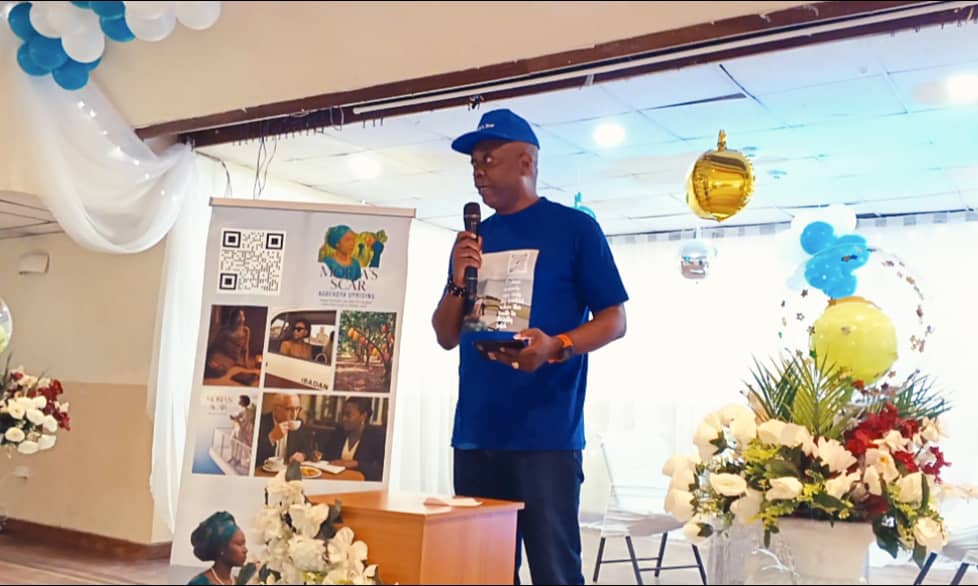
“When people are facing economic pressures, that is not the time to levy high taxes,” he said, drawing parallels between current economic realities and the conditions that gave rise to the Agbekoya revolt. He added that history consistently shows how fiscal decisions taken without social sensitivity can spiral into crisis.
The event drew educators and cultural advocates from Lagos, Ogun and Oyo States, many of whom agreed that the book serves as a bridge between Nigeria’s past and a generation increasingly detached from the historical forces that shaped the nation.
Beyond its local setting, Mr Bakare explained that Moria’s Scar examines how global economic forces shape local suffering, noting that decisions made far from rural communities often carry devastating consequences for those with little political or economic power.
“It tells the story of how what happens in one corner of the world has repercussions for people in other parts of the world,” he said.
Corroborating this view, the book’s reviewer, Ezinne Toyin-Asanmo, observed that political and economic decisions are rarely isolated.
“Political decisions are influenced by foreign interests, business actors entering the economy and attempting to destabilise it. For personal gain, certain groups capitalise on this, and we continue to see this playing out in our economy today,” she said.
Mr Bakare further linked the Agbekoya uprising to the manipulation of cocoa prices by foreign interests, a practice that impoverished farmers and triggered resistance, reminding the audience that global market forces often determine the fate of local communities.
Telling African stories in a digital world
Beyond politics, Moria’s Scar positions storytelling as a form of resistance against cultural erasure in a world dominated by Western narratives.
Mr Bakare noted that the book was part of a broader effort to project African experiences into the global knowledge space.
“We need to form a critical mass and populate the global space with our own experiences, our own African narratives,” he said.
He recounted how a Western acquaintance compiling a list of the top 100 people of the century found no African through online searches, a gap Mr Bakare attributed to the underrepresentation of African-authored works in digital and academic spaces.
“Not many of those authors are African. This is an attempt to bridge that divide and encourage each of us to put pen to paper,” he stressed.
Earlier in his opening address, Mr Bakare reflected on how global power relations and economic ambitions continue to shape conflicts and catastrophes across continents.
“The world has always belonged to those who are most powerful. Decisions made in British courtrooms can have global implications,” he said, explaining that Moria’s Scar seeks to illuminate how the selfish pursuit of profit and ambition can devastate communities far removed from decision-making centres.
Women, silence and the cost of history
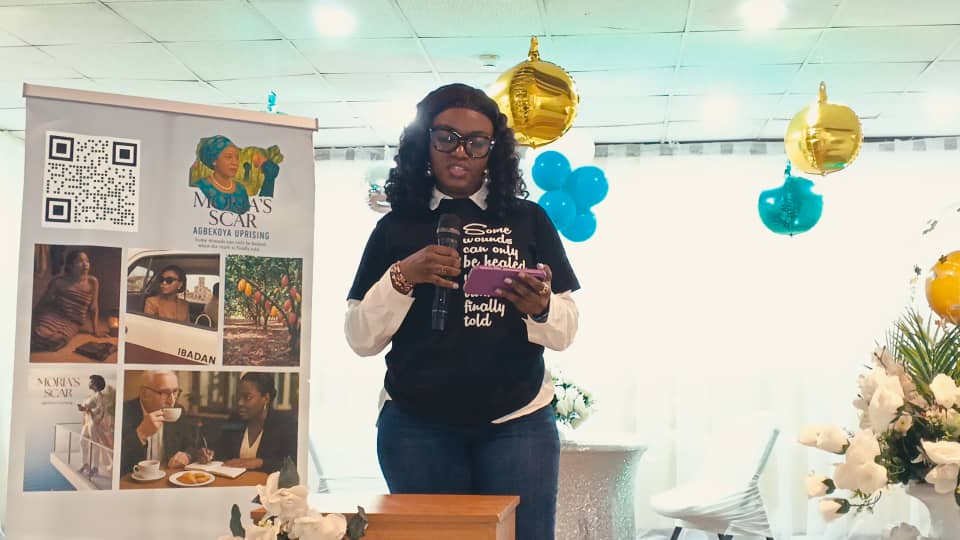
A central strength of the book, according to its reviewer, is its portrayal of women’s experiences across generations.
Ms Toyin-Asanmo described the book as “intriguing”, noting that it reveals “the silent pain women endure, both in the past and the present”.
“It is a story of how cocoa has been exploited and how we trade the most important things we have for little value,” she said, adding that the book deserves a place in homes and schools because “it is history itself”.
She further noted that the book shows how a child’s dreams can be truncated by economic choices and social upheaval, with different characters experiencing divergent outcomes from the same event.
“For Moria, she was flown to Boston and went on to build a successful life. For Mulika, she was forced into early marriage and struggled to recover,” Mr Bakare had earlier noted.
Ms Toyin-Asanmo linked the book’s themes to contemporary gender issues, stressing that marital rape, forced marriages and the silencing of women remain realities in modern society.
“Women’s voices are constantly being subdued or silenced. It is time we allow both the young girl and the grown woman to speak,” she said.
Reinforcing the cultural dimension, Mr Bakare’s wife, Safuratu Bakare described the book as vital for educating Nigerian children in the diaspora about their heritage and the injustices of the past.
“Our children abroad do not realise what transpired at home,” she said, recounting how some found it difficult to believe that forced marriages and night-time abductions once occurred.
“Moria’s Scar is not just a book. It is history, a way to give our children in the diaspora a glimpse of what happened back home so that we do not forget where we come from,” Mrs Bakare said.
She described the book as “a journey through inherited trauma and the defiant humanity of a girl”, while praising her husband’s dedication and perseverance throughout the writing and publishing process.
A story of trauma, exile and historical reckoning
Moria’s Scar tells the story of the Agbekoya uprising through the eyes of a young woman, Moria, whose life is abruptly altered by violence and displacement.
The author explained that Moria, like many young girls of her time, was helping her mother sell food when she was caught in the chaos of the farmers’ revolt. Injured and forced to flee, she eventually leaves Nigeria, carrying both physical scars and deep resentment towards her homeland.
Her journey changes after meeting a Swiss man, Eric Johansen, who reveals how Swiss pricing structures contributed to the collapse of cocoa prices that pushed the Agbekoya farmers into agitation. This revelation forces Moria to confront the wider forces behind her personal trauma.
The story follows her return to Nigeria, where she begins tracing her roots and interrogating the history she once fled, asking why the Agbekoya uprising occurred, who was involved, and what lessons must be learned.
Mr Bakare said the narrative was inspired by his desire to reconnect his children, raised partly outside Nigeria, with the country’s history.
“People without history will find it difficult to face the future,” he said, explaining that fiction allowed him to present historical realities in a form young readers could relate to.
He revealed that it took him about three years to complete the creative writing and rigorous fact-checking of the book. While Moria’s Scar is not a history textbook, he stressed that it remains grounded in historical truth.
The 216-page book is divided into 21 chapters, with a prologue and epilogue, designed to bring the events of the 1960s vividly to life for today’s readers.