





Today marks 27 years of uninterrupted democratic governance in Nigeria. While many spend the day watching Democracy Day analyses and celebrations, some children and teachers remain in captivity, enduring the consequences of violent attacks on schools. In this report, DevReporting chronicles the wave of attacks on Nigerian schools and the abduction of innocent students and educators, tracing the crisis from the Chibok kidnapping to recent incidents across the country.
Known as Jijinigbe in Yoruba, Ntọrọ mmadụ in Igbo and Garkuwa da Mutane in Hausa, kidnapping in Nigeria has evolved from isolated criminal incidents into a nationwide security crisis.
While Nigeria had long grappled with cases of child abduction for ritual purposes and other criminal motives, the large-scale targeting of schools emerged as a defining feature of the country’s insecurity in the last decade.

The turning point came on 14 April 2014, when Boko Haram insurgents stormed the Government Girls Secondary School in Chibok, Borno State, Northeast Nigeria and abducted 276 schoolgirls. The attack attracted global attention through the #BringBackOurGirls campaign, which featured global leaders, including the then American President and wife, Barack and Michelle Obama.
Barely two months before the Chibok school abduction, Boko Haram insurgents attacked the Federal Government College, Buni Yadi, in Yobe State on 25 February 2014, killing 59 boys. The attackers reportedly locked students in their dormitories and set the buildings ablaze, while those who attempted to flee were shot or hacked to death. The insurgents also razed 24 school buildings during the assault.
Earlier on 6 July 2013, Boko Haram insurgents attacked the Government Secondary School in the village of Mamudo, Yobe State, Nigeria and killed at least 42 people including students and staff. Similarly, on 29 September 2013, gunmen entered the male dormitory in the College of Agriculture in Gujba, Yobe State, killing 50 students and teachers.
Since the Chibok school abduction in April 2014, Nigeria has recorded 30 other school kidnapping incidents, resulting in the abduction of at least 2,573 students and teachers.
An analysis of data obtained from various sources, including SBM Intelligence, the International Centre for Investigative Reporting (ICIR), and other security trackers, reveals that schoolchildren and their teachers continue to pay the price for Nigeria’s worsening insecurity.
From Chibok to Oriire
The abduction of 39 pupils and seven teachers in Oriire Local Government Area (LGA) of Oyo State marks the first large-scale school abduction in the country’s Southwest region, triggering nationwide protests and reviving memories of the Chibok and Dapchi kidnappings.
On 15 May, armed bandits raided three schools in Oyo State, resulting in the abduction of about 46 persons, including pupils, teachers and a two-year-old.
The affected schools were Community High School and Primary School, Ahoro-Esiele and First Baptist Nursery and Primary School, Yawota, all in Oriire Local Government Area of Oyo State.
On the same day as the Oyo abduction, gunmen stormed Mussa Primary and Junior Secondary School in Askira-Uba Local Government Area of Borno State, abducting more than 50 children, most of them between the ages of two and five.
Eyewitnesses say the abductors used the children as human shields while fleeing on motorbikes, preventing security forces from opening fire on them.
Hours after the Oyo schools abduction, videos began circulating online showing some of the abducted teachers speaking under duress from what appeared to be a forest location.
Amid growing tension, authorities and media reports confirmed the beheading of one of the abducted teachers, Michael Oyedokun, a Mathematics teacher taken from Community High School during the attack. His killing sparked widespread outrage and renewed fears for the safety of other victims still in captivity. Twenty-eight days later, these innocent victims remained in captivity.
Armed bandits on 3 June, abducted seven students of Federal Polytechnic, Kaura Namoda from their off-campus student residences on the outskirts of the Low-Cost Area in Kaura Namoda Local Government Area.
According to the State Police Public Relations Officer, Yazid Abubakar, a deputy superintendent of police, one of the abducted students managed to escape from captivity and had since been reunited with authorities.
School abductions across states of Nigeria
Borno State
Since the Chibok mass abduction of innocent schoolgirls, kidnappings have spread beyond schools, with communities across Borno State repeatedly targeted by armed groups. The latest is the abduction of about 50 children (mostly aged 2-5 years) from three schools in Mussa, Askira-Uba LGA.
Yobe State
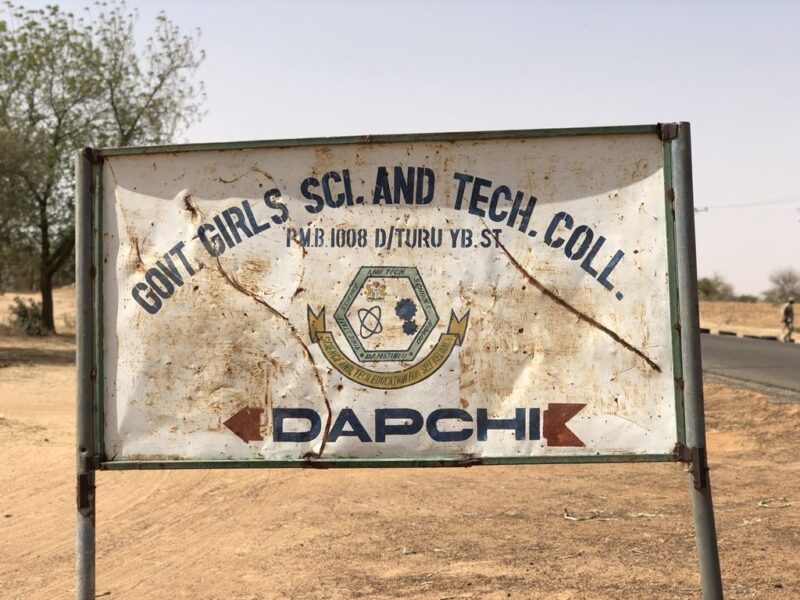
Earlier before the 2014 Chibok incident, there had been violent attacks on schools in Yobe State, leading to the death of many students and teachers. However, the first mass abduction of students took place when suspected Boko Haram militants in February 2018 stormed the Government Girls Science and Technical College, Dapchi, Yobe State and kidnapped 110 students. While most of the Dapchi schoolgirls were later released, Leah Sharibu remained in captivity after reportedly refusing to renounce her faith.
Katsina State
On 11 December 2020 armed men attacked the Government Science Secondary School in Kankara, Katsina State and abducted 344 students. They were released and reunited with their families after six days in captivity.
Bandits again abducted about 80 Islamiyya students of Hizburrahim Islamiyya, Mahuta village, Dandume on their way back from a Maulud occasion on the evening of 19 December, 2020. They were later rescued by the Katsina state police.
Kano State
In early December 2022, five-year-old Hanifa Abubakar was abducted outside an Islamic school that she attended. The owner of her school, Abdulmalik Tanko allegedly kidnapped her to demand a ransom of $14,600. According to the Police, Mr Tanko later killed Hanifa after realising she had recognised him.
Zamfara State
In February 2021, gunmen attacked the Government Girls Secondary School Jangebe, a boarding school in Zamfara State, kidnapping about 317 students. On 16 August 2021, 15 students and four staff were abducted from Zamfara College of Agriculture and Animal Sciences, Bakura. A police inspector and two civilian guards reportedly lost their lives while confronting the gunmen.
On 1 September 2021, armed bandits invaded Government Day Secondary School in Kaya village, Maradun Local Government Area of Zamfara, and abducted 73 teenagers including 53 male and 20 female students. They were released days later.
On 2 April 2023, bandits invaded a female hostel of the Federal University, located in Sabon Gida village in Bungudu, Gusau where they locked up the two civilian guards, dispossessed them of their mobile phones before abducting two female students of Microbiology Department of the university.
Again, on 22 September 2023, more than 24 students of the Federal University of Gusau were abducted after bandits invaded three hostels in the Sabon-Gida community of the Bungudu Local Government Area of Zamfara State. Following military response and search operations, 14 of the students alongside two other people were rescued a few days later, while the remaining abductees were released in April 2024.
Just recently, on 3 June 2026, seven students of Federal Polytechnic, Kaura Namoda, Zamfara state, Northwest were abducted, following an attack by armed bandits on off-campus student residences on the outskirts of the low-cost area. One of the abducted students managed to escape from captivity.
Niger State
On 17 February 2021, gunmen attacked the Government Science College in Kagara, Niger State, and abducted 41, including 27 students, three staff and their family members. Similarly, on 30 May 2021, bandits abducted about 150 pupils from Salihu Tanko Islamic School, Tegina, Rafi LGA while in November 2025, about 315 including 303 students and 12 teachers were abducted from St Mary’s Catholic School, Papiri, Agwara LGA.
Kaduna state
Gunmen abducted 39 students from Federal College of Forestry Mechanisation in Mando, Kaduna state, in March 2021, while about 20 students and two staff members of Greenfield University in Kaduna were abducted, with five of them reportedly killed by bandits in April 2021.
In July 2021, over 150 students and staff of Bethel Baptist High School in Chikun Local Government Area of Kaduna State were kidnapped and later released in batches.
On 8 March 2024, 287 children were abducted from the Local Education Authority (LEA) Primary and Junior Secondary School, Kuriga, Chikun Local Government Area of Kaduna State.
Kogi state
On 26 April 2026, gunmen attacked an “unregistered” orphanage and school facility in the Zariagi area of Lokoja, Kogi State abducting 23 pupils and the wife of the proprietor. Following a coordinated response led by the Nigeria Police Force, in collaboration with other security operatives, 15 of the abducted pupils were rescued. Others were later rescued.
Most recently, gunmen dressed in military uniforms invaded a secondary school in Iluke community, Kabba-Bunu Local Government Area of Kogi State, on Tuesday, 9 June 2026, killing a vice-principal and two others.
The attackers also disrupted the ongoing West African Senior School Certificate Examination (WASSCE) and attempted to kidnap students, having begun marching them into the forest before security operatives intervened.
The Kogi State Government confirmed the attack in a statement issued on 10 June by the Commissioner for Information and Communications, Kingsley Fanwo. According to him, security operatives engaged the attackers in a gun battle after they had already begun moving students towards the forest. He disclosed that all the students were rescued safely.
Mr Fanwo confirmed that three people from the community, including the vice-principal, were killed during the attack while one of the attackers was also killed during the operation. Kebbi State
On 17 June 2021, more than 96 students and eight teachers were abducted from Federal Government College, Birnin Yauri in Kebbi State.
While some of them were rescued by troops of the Nigerian army, many were reportedly released after ransom was paid and others regained freedom after some months in captivity.
Again, on 17 November 2025, police confirmed the abduction of 25 students and the killing of the vice principal of Government Girl’s Comprehensive Secondary School, Maga in Danko/Wasagu Local Government Area of Kebbi State after armed men attacked the school.
Sokoto State
On 9 March 2024, armed bandits attacked a Tsangaya Islamic boarding school in Gidan Bakuso, Gada LGA, abducting 15 children. They were all rescued unharmed by the Nigerian military about two weeks later.
Nasarawa State
In January 2023, six people were abducted at the LEA Primary School, Alwaza, Doma LGA, Nasarawa state. While two of them were rescued a day later, others spent 14 days in captivity before their rescue.
Also, four students of Nasarawa State University in Keffi were abducted when suspected gunmen attacked their lodge on October 10, 2023.
Lagos State
Lagos State has also recorded a number of school abductions. Before the Dapchi episode, three teenage girls were abducted from Babington Macaulay Junior Seminary, Agunfoye-Lugbusi village, Adamo-Ikorodu on 29 February, 2016. They were rescued six days later in the Igbokuta area of the state.
Months later, precisely on 25 May 2017, gunmen took advantage of security lapses around creeks to abduct six pupils from Igbonla Model College, Epe in Lagos. They regained freedom after spending 65 days in captivity. The abduction occurred seven months after four pupils and two members of staff of the college were kidnapped in October 2016.
Ogun State
In January 2017, armed men invaded the Nigerian Turkish International College, Isheri in Ogun state, abducting five students and three staff including one Turkish national. They were released 11 days later.
Also, in April 2026, five students of Gateway Polytechnic, Saapade, in Remo North local government area of Ogun State were intercepted and kidnapped by armed assailants while returning to their hostels after buying food.
The Ogun State Police Command mobilised a multi-unit task force, including the Anti-Kidnapping Unit and SWAT, and following sustained operational pressure and an intense gun duel with the abductors, the kidnappers were overpowered and forced to flee, allowing the police to safely rescue the students.
Ekiti State
In Ekiti state, gunmen ambushed a school bus on the Emure-Eporo road as it was conveying students and staff home on January 29, 2024. The gunmen abducted six school children, three teachers and a bus driver.
Oyo State
On 15 May 2026, armed bandits abducted about 46 persons, including pupils, teachers and a two-year-old from Community High School and Primary School, Ahoro-Esiele and First Baptist Nursery and Primary School, Yawota, all in Oriire Local Government Area of Oyo State.
From Kogi to the Southeast, WASSCE candidates under threat
Just a day after gunmen dressed in military uniforms invaded a secondary school in Iluke community, Kogi State, disrupting the ongoing WASSCE, killing the vice-principal and two others, and attempting to abduct students, members of the outlawed Eastern Security Network (ESN) on 10 June also attempted to kidnap students writing the WASSCE in some Southeast States.
A statement by the Department of State Services (DSS) revealed that the targeted schools were located in Enugu, Anambra, and Imo states.
According to the statement, operatives of the DSS, in collaboration with troops of the Nigerian Army, foiled the abduction attempt and rescued the students
What data shows
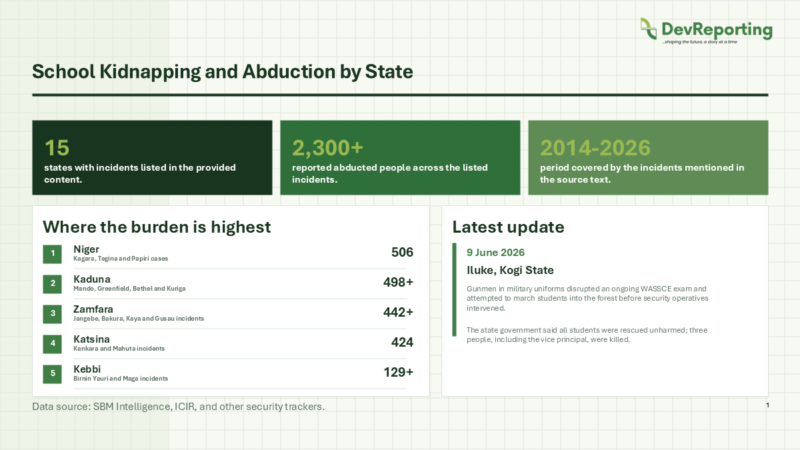
The analysis of data in Nigeria from 2014-2026 shows that school abductions have affected multiple states across Nigeria since the Chibok incident in 2014. However, the pattern differs from state to state in terms of frequency and scale. An analysis of documented school abductions between 2014 and June 2026 shows that at least 31 school abduction incidents occurred across 15 states in Nigeria, resulting in the abduction of approximately 2,573 pupils, students, teachers and other school-related victims.
Only school abduction incidents in which pupils, students, teachers, or school personnel were successfully taken away by the attackers were covered in this analysis. It excludes foiled abduction attempts in which intended victims were rescued before being removed from the school or its vicinity.
Consequently, the total of 31 incidents does not include recent thwarted attacks such as the attempted abduction of students during the ongoing WASSCE at a secondary school in Iluke, Kogi State, on 9 June 2026, where security operatives intervened and rescued all the students. Other foiled school abduction attempts reported in different states over the years were also excluded from the analysis where no victim was successfully abducted.
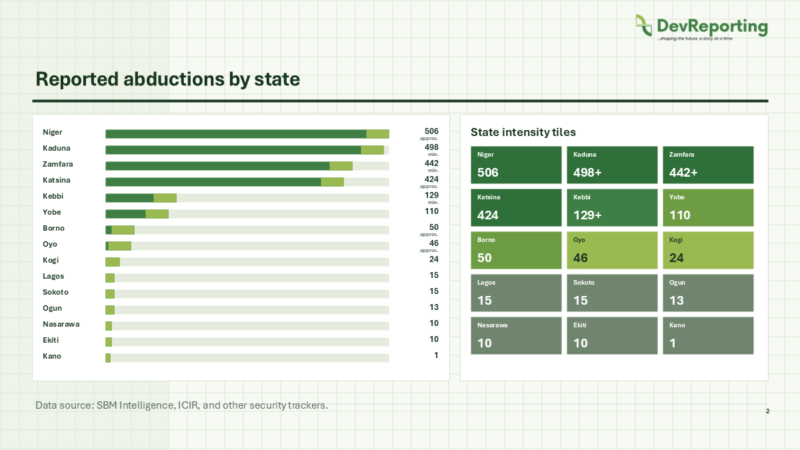
Data show that Zamfara State recorded the highest number of school abduction incidents in Nigeria from 2014 to 2026, with six separate attacks on schools, universities and student hostels. Kaduna State followed with four incidents, while Lagos and Niger States recorded three incidents each.
The states with the lowest number of school abduction incidents in the dataset were Yobe, Kano, Sokoto, Ekiti and Oyo, each with one recorded incident.
Shifting focus from the number of incidents to the number of victims, Niger State had the highest number of people abducted from schools, with about 506 abductees across three major incidents. This was followed by Kaduna State with about 498 abductees and Zamfara State with about 442 abductees.
The state with the least number of abducted persons was Kano State, where the recorded case involved a single victim, Hanifa Abubakar.
Overall, the analysis suggests that the frequency of school abduction attacks does not always correspond to the number of victims. Zamfara experienced the most attacks, but Niger recorded the largest number of abductees, showing that fewer incidents can still result in very large-scale kidnappings.
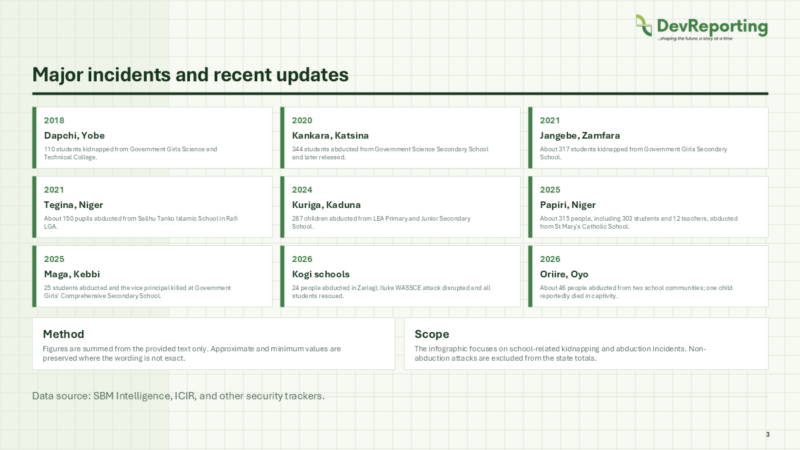
Every major mass school abduction recorded between 2014 and 2026 occurred in northern Nigeria, including attacks in Borno, Yobe, Katsina, Zamfara, Niger, Kaduna, Nasarawa, Sokoto and Kebbi states. Kogi State, in the North-central zone, recorded 24 abducted victims in October 2025, while Ekiti State, in the South-west, recorded the abduction of five pupils in March 2024.
The May 2026 attack in Oyo State, in which gunmen abducted 39 pupils and seven teachers from three schools in Oriire LGA during a single operation, represents the first large-scale school abduction in the South-west.
Security analysts have identified forest corridors spanning Oyo, Ondo, Ekiti and Osun states as routes increasingly exploited by armed groups.
Protests erupt across states
The Oyo school abduction triggered protests across several parts of the country, including Ogun, Kano, Lagos, and the Federal Capital Territory (FCT), Abuja among others.

Demonstrators called for the immediate release of the victims of the Oyo and Borno kidnap, a comprehensive overhaul of Nigeria’s security architecture, greater accountability from federal and state authorities, and improved protection for schools and rural communities.
The protests were preceded by the Nigeria Union of Teachers’ (NUT) declaration of an indefinite strike in Oyo State, alongside plans for nationwide solidarity rallies to press for the safe return of the abducted pupils and teachers.
Protesters under the aegis of the Take it back Movement also occupied the roads in Oyo state, demanding the safe return of the abducted children and teachers. “No retreat until every abducted teacher and child is brought home,” they say.
Tinubu orders forest guards, rescue push after Oyo abduction
Nigeria’s President, Bola Tinubu approved the recruitment of 1,000 forest guards in Oyo State and directed a specialised security unit with advanced rescue capabilities to intensify efforts to secure the release of abducted pupils and teachers in Oriire LGA.
According to a statement issued by the Special Adviser to the President on Information and Strategy, Bayo Onanuga, a high-level federal delegation visited Esiele and Yawota communities in Oriire LGA on 31 May, to convey the presidential directives to community leaders and lawmakers.
The delegation visited 16 days after the Oyo abduction and 14 days after the video of Mr Oyedokun’s beheading was released by the terrorists. They informed stakeholders that their request for a military base in the area had been forwarded to the President for consideration and approval.
Led by the President’s Chief of Staff, Femi Gbajabiamila, the delegation included the National Security Adviser, Nuhu Ribadu; the Inspector-General of Police, Tunji Disu; the Minister of Defence, Christopher Musa (retd.); and the Special Adviser to the President on Media and Public Communications, Sunday Dare.
Borno residents lament ‘unequal’ response
There is growing anger in Borno State over what residents describe as an uneven federal response to recent school abductions in Mussa, Askira-Uba LGA, accusing the government of neglect compared to its handling of a similar incident in Oyo State.
The concerns follow heightened federal attention to the Oyo abductions, where the President recently deployed a high-level delegation to affected communities after the May 15 attack in which dozens of pupils and teachers were kidnapped.

Residents and community representatives in Mussa say the response to the abduction of more than 42 pupils from a primary and junior secondary school in the area has been far less visible, leaving families distressed and without clear updates.
The councillor representing Mussa Ward, Peter Waba told DailyTrust that residents feel abandoned and questioned why similar urgency had not been applied to their case.
“Why should we be treated differently? We are Nigerians, and we voted for the president. The Federal Government should treat the abduction of our children with the same seriousness. Governor Zulum cannot do it alone,” he said.
One of the affected parents, Saleh Bala, said families have been left in anguish for more than two weeks without clear information on the whereabouts of their children. “We feel abandoned. It is as if our children do not matter. Many of them are between two and five years old, and we have not seen any significant federal intervention aimed at bringing them home,” he said.
The Chairman of the Network of Civil Society Organisations in Borno State, Abubakar Suleiman, also said there had been limited federal intervention since the abduction.
Confidence level seriously damaged
For education stakeholders, the consequences of school attacks go far beyond the immediate horror of abduction. According to the Programme Director of Educare Trust Nigeria, Folorunsho Moshood, the impact begins instantly but stretches far into the future.
While he identified the short-term effects of school abductions as trauma, truancy, absenteeism and total closure of affected schools and other schools around the area, he warned that the long-term implications could be more devastating.
“There will be an increase in the number of out-of-school children, child trafficking, child labour, child abuse, reduction in social activities in affected areas and zero academic activities which will lead to zero learning outcomes.”
Mr Moshood said fear has already travelled beyond rural communities as parents in urban centres are also jittery. “Even in the urban centres in Oyo State, parents are now jittery about what could happen to their children in schools. The confidence level has been seriously damaged.”
That damaged confidence, he warned, may translate into fewer school enrolments and eventually affect retention and completion rates.
School owners seek help
The National Association of Proprietors of Private Schools (NAPPS) described the attacks as an assault on education itself.
According to the national president of the association, Yomi Otubela, any attack on educational institutions is not only an attack on innocent children and teachers, but also a direct assault on the future of Nigeria.
He warned that repeated attacks on schools are creating fear among parents, learners, teachers and school proprietors.
“The recurring attacks on schools have continued to create fear among parents, learners, teachers and school proprietors, thereby threatening access to quality education and undermining national development.”
The association called for stronger security around schools, surveillance systems, improved intelligence gathering and increased investment in safety infrastructure. “Nigeria’s children deserve to learn in peace, not in fear,” it stressed.
When schools become soft targets
Responding to the Chibok crisis, Nigeria launched the Safe School Initiative in 2014. Since its inception, a $10 million fund has been set up to pilot 500 safe schools in northern Nigeria.
The initiative covers school-based interventions, community protection efforts, and special measures for institutions located in conflict-torn regions.
Findings by the Punch Newspaper revealed that the federal government earmarked a total of N144.7 billion for the Safe Schools Initiative between 2023 and 2026. Despite the huge investment, insecurity continues to pose a significant threat to schools across the country, with attacks, abductions, and disruptions to learning persisting in several states.
An education consultant and lead resource person for Safe Schools Lagos (SSLAG), Bisi Akin-Alabi, said that the incessant attacks exposes deep structural weaknesses in the protection architecture around rural schools.
“The coordinated abductions at Community High School, Baptist Nursery and Primary School, and L.A. Primary School in Oriire Local Government Area represent a catastrophic failure of local school safety architecture,” she said.
According to her, attackers were able to exploit multiple vulnerabilities. “We observed total perimeter failure. Rural schools like those in Ahoro-Esiele lack baseline access control. Open, unfenced boundaries allow attackers immediate, unimpeded access to classrooms.”
She also pointed to what she described as “zero early-warning capability”, saying, “The absence of remote duress alarms, panic buttons or dedicated radio links to local security hubs allowed the assault to persist for hours without immediate tactical resistance.”
Ms Akin-Alabi submits that the location of schools near forest areas also worsened the risk.
“Operating schools adjacent to unmonitored dense forest reserves, like the Old Oyo National Park, without military or paramilitary buffer zones creates a soft target with immediate escape routes for criminal actors.”
For her, shutting schools indefinitely is not enough. “Total educational paralysis cannot be the long-term solution,” she said, recommending physically strengthening school environments through fencing or geo-fencing, solar-powered emergency alarms, community intelligence networks involving hunters and vigilante groups, and regular lockdown drills.
She also suggested temporary decentralised learning spaces in safer town centres until security conditions improve.
Experts urge stronger security response to kidnapping threats
Nextier, a Nigerian policy advisory, consulting, and development organisation and the West Africa Network for Peacebuilding (WANEP) have warned of increasing operational collaboration among bandit groups, Islamic State West Africa Province (ISWAP) cells and Ansaru factions. Analysts say such alliances enable criminal groups to operate across wider territories and evade security operations.
Economic hardship, they say, is also a contributing factor as rising inflation and unemployment have expanded the pool of recruits available to ransom-driven criminal networks.
Meanwhile, forest belts in the South-west and South-east are increasingly serving as operational corridors for armed groups previously concentrated in the North-west.
Security analysts note that many rural schools lack perimeter fencing, security personnel, early warning systems and rapid-response mechanisms, conditions that made schools in northern Nigeria vulnerable and now pose similar risks in the South-west.
With national elections scheduled for 2027, analysts also warn that political instability, weak governance and criminal opportunism could further worsen kidnapping trends in the coming months.
