



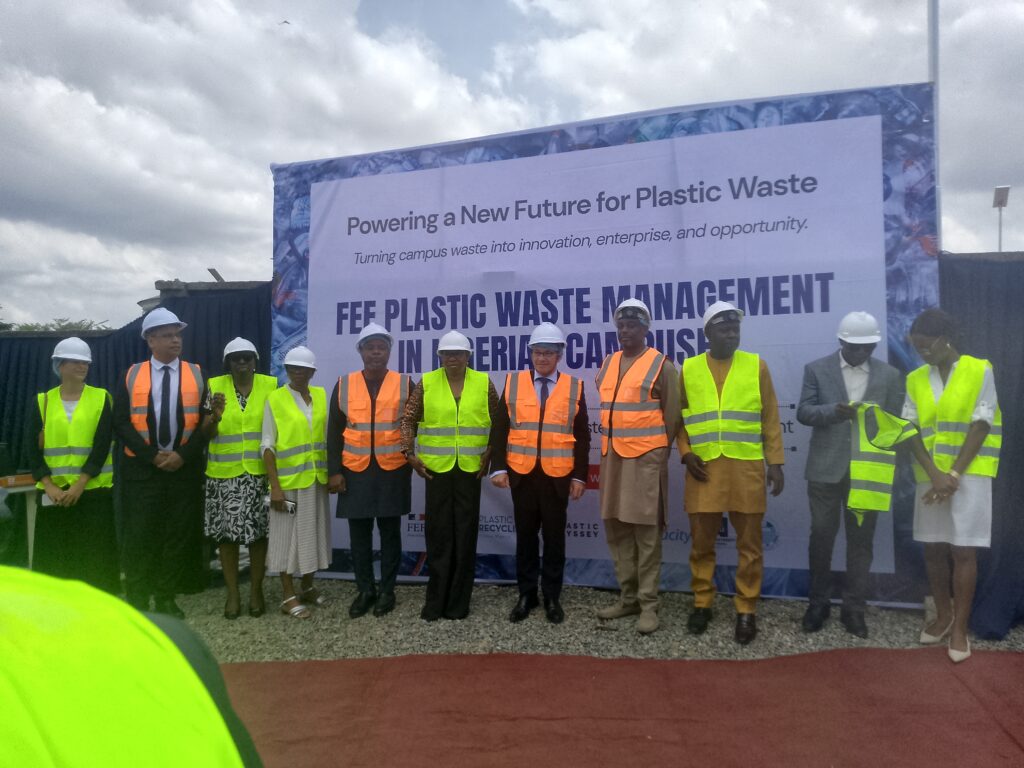
The University of Lagos (UNILAG) has commissioned a microplastic recycling plant on its Akoka campus under a €753,000 partnership with the French Embassy in Nigeria, in a bid to tackle plastic pollution through research, recycling, and green innovation.
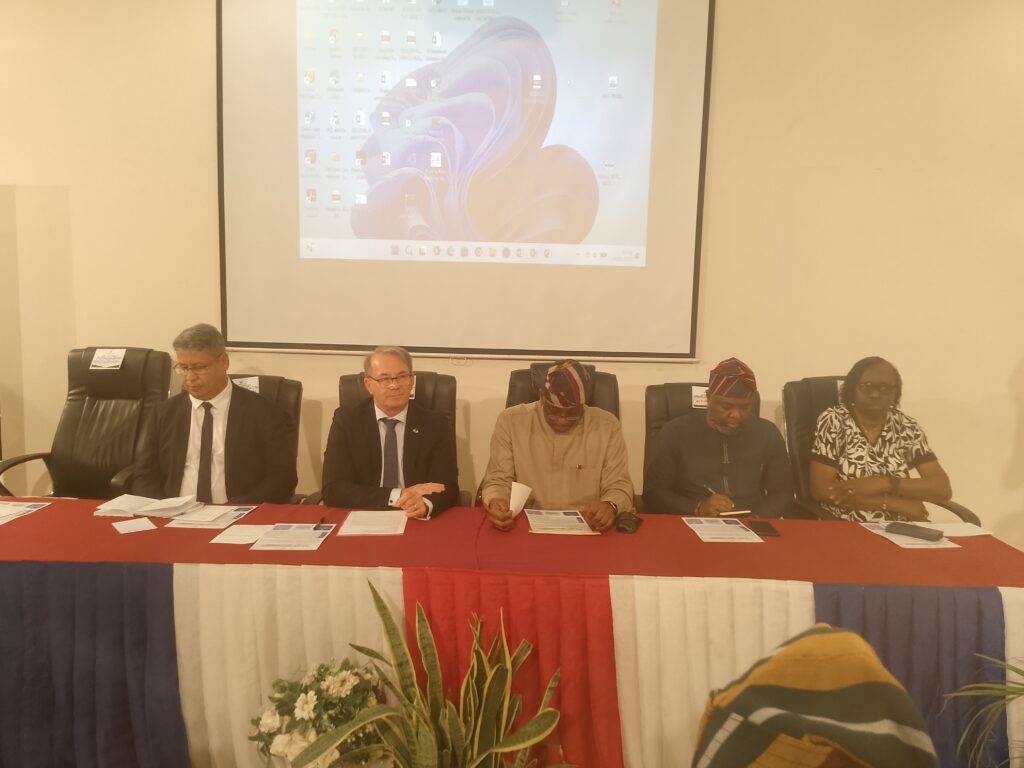
The commissioning, held on Wednesday at the campus in Lagos, brought together the Consul General of France to Nigeria, Laurent Favier; the Deputy Head of Cooperation at the French Embassy, Pierre Andriamampianina; Souleymane Ciss, a representative of Plastic Odyssey, the technical partner on the project; Nyananso Ekanem, the Managing Consultant of Weir Capacity; and senior officials of the university.
The Vice Chancellor of UNILAG, Folasade Ogunsola, a professor of medical microbiology, was represented by the Deputy Vice Chancellor (Development Services), Foluso Afolabi, a professor.
How it started
Mrs Ogunsola said the French Embassy, through its Cooperation and Cultural Department, launched the plastic waste management initiative on 14 June 2024 under the French Embassy Fund (FEF).
According to her, the programme engaged 13 Nigerian universities, with UNILAG emerging as one of only two selected to co-design and host a micro-plant facility.
She explained that the timing reflected the urgency of the problem, noting that the university generates an average of 32.4 tonnes of solid waste daily, making plastic a local challenge that demanded a practical response.
At full operational capacity, the plant is projected to recycle up to 126 tonnes of plastic waste annually into furniture planks, tiles, and other reusable materials. The machine, which arrived on campus inside a shipping container, processes between 50 and 60 kilogrammes of plastic per hour and carries a crusher, extruder, injection press, compression oven, and plate press.
Research, collaboration and sustainability
Abdulaganiyy Adelopo, a project coordinator who worked on the technical side of the plant, said the project rested on three pillars: data, human capacity, and infrastructure.
He said UNILAG’s waste management research had been published internationally, including in two journals in Algeria and one through Springer, giving the university a documented understanding of its waste volumes before any machinery arrived.
Mr Adelopo noted that the design and installation process was a joint effort, revealing that UNILAG’s engineering team carried out machinery and material assessments, while a technical team from Plastic Odyssey then travelled to Lagos to lead the configuration.
The process, he said, involved working across language barriers, with French-speaking technicians from the Plastic Odyssey team working side by side with local staff through installation and training.
“They did not just impose it on us. We had a discussion. We went into machinery assessment,” Mr Adelopo said.
The university’s Project Coordinator, Bola Obo, a professor, said the initiative was built on years of work that the university had already done.
“The university had previously launched the UNILAG Sustainability Challenge, Green Eco Hubs, and refresher waste management orientation programmes, all of which positioned it to receive the project,” she noted.
She said the plant aligned with the third phase of UNILAG’s Zero Waste Strategy, which moves beyond awareness campaigns into converting waste directly on campus.
“This project further demonstrates that waste is not merely an environmental burden but a resource capable of creating jobs, supporting education and driving community development,” Ms Obo said, adding that the plan was to convert recycled plastics into school furniture for children in less-privileged communities.
Tackling Nigeria’s plastic waste crisis
According to Nyananso Ekanem of Weir Capacity, Nigeria generates 2.5 million tonnes of plastic waste every year, clogging drains, worsening flooding, entering the food value chain, and causing health problems in the process.
“Plastic used to be regarded as a major innovation for carrying water and food, but now it is causing problems and we need to innovate to resolve them,” Mr Ekanem said.
He said universities were the right institutions to lead the response and credited the French Embassy for going to them with the problem. He also pointed to Yaba College of Technology (YABATECH), another institution in the programme, where a Plasto Gas Centre now converts plastic to gas that is already in use on the campus.
Mr Ekanem confirmed Weir Capacity’s commitment to continue supporting the French Embassy in rolling out the programme to other Nigerian universities.
France backs fight against plastic pollution
The Consul General, Mr Favier, described the commissioning as part of a wider global push against plastic pollution. He said in June 2025, France co-chaired with Costa Rica the third United Nations Ocean Conference in Nice, France, which listed the fight against plastic pollution as one of four key priorities. In April 2026, Lyon hosted the HEPS Summit, where a coalition of scientists published a declaration that specifically identified plastic as a threat to human health.
“Plastic waste kills. Everybody knows that,” Mr Favier said, noting that Nigeria had put in place a national policy for plastic waste management since 2021, aimed at cutting plastic pollution across the full life cycle, from production to disposal, while promoting recycling and reuse.
Mr Favier said the project’s first chapter had focused on engaging students through awareness campaigns and hands-on initiatives, which he described as a success. He said the decision to equip two universities with micro-factories came after a research phase that identified them for their work on plastic waste management.
He said the plant would serve students and researchers while also opening up new opportunities for experimentation and entrepreneurship.
“A soft-drink bottle that might have once slowly made its way along the paths of the university will now begin a second life in the machines and in the minds of those striving for its transformation,” Mr Favier said.
The Deputy Head of Cooperation, Mr Andriamampianina, used the occasion to acknowledge Mr Sébastien Pégué, who conceived and led the project from the French side, but returned to France before the commissioning. He also said the presence of the Consul General at the event sent a clear signal about the importance France attached to environmental projects.
Plastic Odyssey promotes circular economy solution
Souleymane Ciss, who represented Plastic Odyssey from its base in Senegal, said UNILAG’s plant was one of 10 micro-factories the organisation had helped establish across Nigeria through the French Embassy partnership.
“This facility is more than a workshop. It is a micro-factory that will transform plastic into furniture. It is a laboratory where ideas become experiments and experiments become solutions. And finally, it is an incubator where students, researchers, and entrepreneurs will shape the future of the circular economy,” Mr Ciss said.
He said plastic pollution was among the biggest challenges of our time but argued it was also an opportunity to create green jobs, design cleaner cities, and build products that are sustainable and useful.
He directed his words at the students in the room: “This space is yours. Test, fail, win, and build. The only limit is your imagination.”
A classroom without walls
The UNILAG Vice Chancellor said the plant would serve as a living laboratory for students and researchers across engineering, environmental sciences, business, and related disciplines, offering hands-on learning in recycling technology, circular economy systems, sustainable manufacturing, and green entrepreneurship.
While Mrs Ogunsola commended Plastic Odyssey, the FEF project team, and the Science and Higher Education Attaché at the French Embassy for their roles in delivering what she described as a state-of-the-art containerised mini-factory; she acknowledged leading UNILAG researchers and technical teams who contributed to the design, adaptation, and integration of local solutions into the facility.
“This micro-plant is more than a factory; it is a classroom without walls,” she said, adding that the university expected it to serve as a model for other institutions across Nigeria and Africa.

