



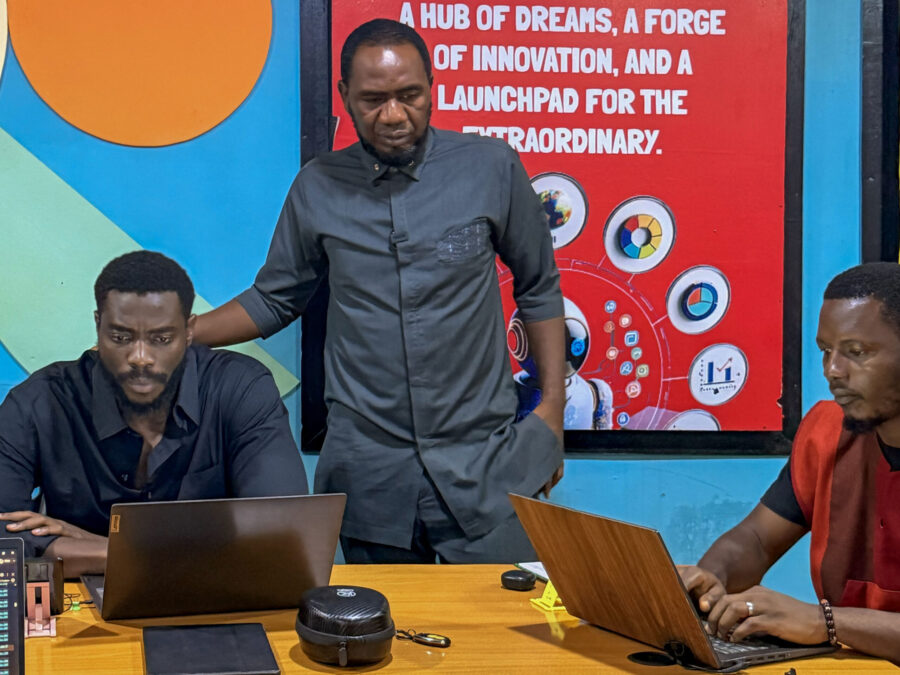
Chibuike Aguene left university with a computer science degree but lacked the practical skills needed for the industry. After gaining practical skills at NIIT and later struggling to find qualified employees, he built an AI-powered platform to bridge Nigeria’s education-to-work gap.
By Vera Chidimma Okoh, bird story agency
When it was time to fill out his Joint Admissions and Matriculation Board (JAMB) form, the official electronic application for Nigerians to gain admission for tertiary education, Chibuike Aguene chose to ignore the advice of family. Instead of pursuing medicine or engineering, he looked around the family and, identifying a computer scientist as the clan’s wealthiest member, chose that.
Today the words “Bildup – Empowered to Make a Difference” are written on the office wall of BildupAI, where the chief executive officer (CEO), Mr Aguene, now a third-time founder, moves between his team members as they work.
Pausing at workstations, he looks across screens and monitors the progress of those using the platform. This is the team that built a startup around a problem that Mr Aguene had first encountered as a student and would later encounter again as an employer.
A degree without the skills
At university, he began to notice a disconnect between what he was being taught and the work he expected to do.
“When I started computer science, you know, honestly, I didn’t learn anything that I’m currently doing or that has helped me in my career while in university as an undergraduate of computer science. And that’s quite unfortunate, because they were teaching us FORTRAN 77, QBasic, COBOL, something that you will never use in your life, right? So that makes that process meaningless, other than just to get the certificate,” he said.
By graduation, Mr Aguene had a computer science degree but did not feel prepared to use it.
“I left school with a certificate, but I didn’t have the clarity or the practical skills to apply what I had learnt.”
For many young Nigerians, finishing college is not equivalent to being ready for a job. The gap between what students learn and what businesses require remains an issue, especially as technology advances faster than many standard educational systems. According to ILO data published by the World Bank, 11.9 per cent of Nigerian youth were not enrolled in school, work, or training in 2024.
Mr Aguene enrolled at the National Institute of Information Technology (NIIT) in Lagos for additional technology training.
“It was an eye-opener; that was where I saw the real practical aspect of technology, how technology can be applied in real life,” he recounts.
After completing the course, he began teaching at NIIT. While still in Lagos, he encountered an inventory system developed for foreign businesses. He noticed that some of its features did not fit Nigerian businesses, so he studied the system and surveyed businesses in Lagos to understand what they needed.
He eventually built his own inventory management system for the Nigerian market. In 2008, he sold it to businesses for 25,000 naira each. The product helped them reduce losses, and the sales earned him his first million naira.
“That was the beginning of my entrepreneurial journey. I didn’t plan on becoming an entrepreneur until I saw this opportunity,” Mr Aguene recalls.
From frustrated graduate to frustrated employer

The experience changed how he viewed the relationship between education, skills and work. Years later, when he needed to expand his team to Abuja, he encountered the same problem from the other side.
Mr Aguene advertised vacancies and received more than 900 applications, but he said his team could not find candidates who were a good fit.
“It became a problem. But is this problem limited to only the candidates, or is there something we (employers) are missing internally?” he asked.
Building an AI solution to the skills gap
The question led him to BildUp AI, a platform founded in February 2025 designed to help learners identify and develop the skills they need for work.
BildUp is intended to take learners through more than just a standard online course. It starts by assessing what they already know, their learning objectives, and where they need help, and then utilises AI to design a learning route that can adapt as they progress. The AI facilitator can give classes, answer questions, and provide feedback, while guided exercises and real-world case studies are used to evaluate learners’ ability to apply what they have learned.
The problem Mr Aguene is addressing is also being discussed by employers and policymakers.
Eliezer Ajah, Head of Job Creation and Placement at 3MTT and formerly of Genesys, says the disconnect extends beyond individual graduates.
“The gap between what people are learning in the universities and what they are actually supposed to do in the job is huge. It’s a wide chasm, especially if you look at it from academia purely. Not only do we not have proper systems in our educational systems to help people understand stuff, but we’re not even doing a demand matching.”
The platform is also intended to work from the employer backward. Companies can specify the skills, workplace tools, and outcomes they require, while BildUp evaluates candidates using projects and AI-powered assessments. Instead of relying solely on a CV, the platform generates what it refers to as a capability profile, which shows what a potential employee can showcase.
In May 2026, Moniepoint CEO, Tosin Eniolorunda said the fintech company had struggled to fill more than 500 positions with candidates it considered suitable. His comments prompted criticism from people who argued that the problem should also be examined through the education and training systems that prepare young Nigerians for work.
Mr Aguene says BildUp is priced at about 80 per cent less than conventional learning platforms. The lower price, he says, is intended to reduce the cost of acquiring practical skills for young people.
From medicine to software development
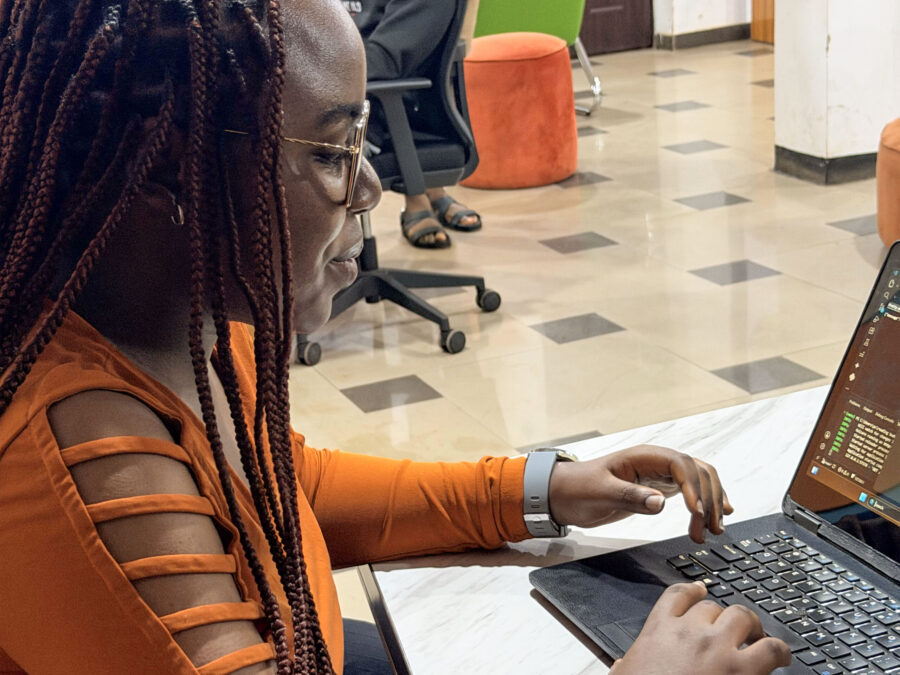
One of the people who used the platform, Theodora Onodugo, joined BildUp as a software tester while planning to study medicine and surgery at the University of Nigeria.
Working with Mr Aguene’s team exposed her to software development and AI and gave her a closer view of the skills required to work in technology. She eventually decided to learn to code and is now a backend developer.
“I started designing apps, and I built a JAMB app myself. I’ve deployed it; I’ve also gotten a lot of contracts. I’m no longer just a consumer, but a creator.”
For Mr Aguene, this is the outcome he wants to make possible for more young people before they leave school: not simply a certificate, but skills that can be applied to actual work.
Can AI solve Nigeria’s skills problem?
Mr Ajah says tools designed to address the skills gap also need to account for how young people access technology and whether the skills they develop lead to measurable outcomes.
“The most ideal AI tool that would help should be very mobile-friendly, because many youths cannot afford computers, and should be tied to real outcomes,” he recommends.
Mr Aguene is building BildUp while facing the wider constraints of running a technology company in Nigeria. He says access to investment has been difficult, leaving him to bootstrap much of the business.
“The biggest challenge is having to build from personal funds with no institutional framework that can enable us to scale at the level we want and should.”
He also says access to loans has been difficult compared with the opportunities available to entrepreneurs in other countries.
The challenge is significant, but Mr Aguene’s goal extends beyond building a technology company. He wants access to quality education and advanced skills to depend less on a person’s socioeconomic background.
“The person that can change our world might come from a poor family, but with the kind of barriers that we have now, we are limited. So, it is not just that person that is losing; it is the whole community that loses” he concluded.
bird story agency

