



Public secondary schools in Oyo State, Southwest Nigeria, have become zones of neglect and quiet suffering due to lack of basic water systems. As schools become unsafe, girls are forced into bushes to change menstrual pads, while state government support remains absent. African Angle’s Chief Correspondent, Adedokun Theophilus, reports.
Seated among nearly three hundred pupils in an overcrowded classroom, Kaosarat Fajobi, a Junior Secondary School Three (JSS3) student of Community Grammar School, Moniya, tried her best to focus on lectures as a Basic Science teacher droned on at the front of the classroom.
Though the air was thick, dusty, and heavy with the oozing sweat of too many bodies packed too closely together, it was little compared to what would happen in seconds to come. Ms Kaosarat ignored the discomfort, as it was not her first time; however, as the lesson dragged on, she shifted uneasily in her seat. Her attention, gradually, drifted; her mind wandered, and she became increasingly unsettled.
With every passing minute, Ms Kaosarat’s discomfort worsened. Soon, sweat beaded on her forehead, clung to her skin, and soaked her blue pinafore. Her physical presence no longer mattered because she was mentally absent, and the teacher’s voice faded into a dull hum in her ears.
Soon, she felt a sharp pain in her stomach, but she was determined to endure and fight in silence. The longer the teacher spoke, the more unbearable the pain became. She could no longer withstand it when blood droplets streamed down her clothes, so she excused herself to clean up in a bush within the school premises.
“I had to rush to the bush, and my friend accompanied me,” she said. Before she got to an elusive spot to change her menstrual pad and clean up, her uniform was already soaked with blood. She had to rinse her clothes and wait for them to dry before returning for the next class.
Like Ms Kaosarat, many schoolgirls in rural public secondary schools in Oyo State are facing a similar plight due to the dearth of infrastructure, inadequate sanitation, and the absence of a menstrual hygiene support system.
“We change our menstrual pads inside the bush, and to prevent the boys from peeping at us, we go in a group and form a circle to cover ourselves,” said Olayiwola Bidemi, a classmate and friend to Ms Kaosarat.
“We defecate openly inside that bush, and if one is not careful, one can step on faeces,” she added. “We use the buckets from the staff toilet to fetch water at the block industry close to the school because that is where we can get clean water.”
That is not all. The bush is also home to rogue boys who abscond from school and classes, hence, these girls are at risk of being harassed by the boys who abscond from classes.
Monthly menstruation
Menstruation is the monthly shedding of the lining of your uterus. Popularly called menses, menstrual period, menstrual cycle, or period, it is a time of the month when blood and tissue from inside the uterus partly flow from the uterus through the cervix and out of the body through the private organ. It is one of the signs of puberty that adolescent girls experience.
Issues of menstrual hygiene management are critical. It negatively impacts the participation of teenage girls in school. It is said to increase social stigma, absenteeism, and decreased focus. Studies explained that schools in rural Nigerian communities have limited access to menstrual materials, poor hygiene knowledge, and inadequate water, sanitation, and hygiene (WASH) facilities, which significantly contribute to menstrual-related educational issues.
According to experts, improving WASH facilities, menstrual education, and the affordability of menstrual products is indispensable for reducing gender disparities in education. A recent study showed that fewer than 20 percent of public primary schools in Oyo State have adequate sanitation facilities, while access to safe drinking water remains severely limited.
Poor water and toilet facilities undermine learning in Oyo public primary schools, hindering the realisation of Sustainable Development Goal 6, according to the Olympus Consciousness Initiative, a non-governmental organisation. Oluwaseun Addie, the lead researcher of the organisation, said the situation was most critical in rural schools, where basic water and toilet infrastructure were largely absent, increasing open defecation and exposing children to health risks.
More lamentations
More students who spoke to African Angle decried how the system has coerced them to learn under a sordid situation.
Hazanat Kazeem, a 15-year-old girl in SS 1 Art, who wants to become a teacher, said that she would never wish for any student to learn under the condition that she is learning when she actualises her dreams.
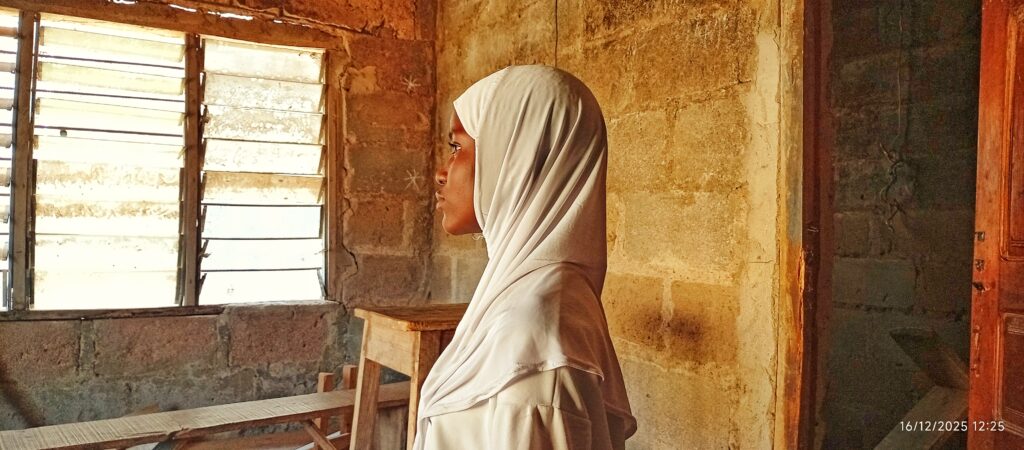
She explained that students are either forced to sit on the bare floor, lean on window frames, or even stand during lessons.
“In our literature classes, we sit on one another’s laps while others use slabs or wood. Many of us stand up,” she said, explaining that cramped and uncomfortable seating often makes it difficult to hear or follow lessons. The scarcity of desks and chairs is worsened during national examinations, when the few available are taken for senior students, leaving others to make do with whatever space they can find.
Ms Kazeem lamented that circumstances like this make it hard to imagine a safe and dignified learning experience, adding that while the teachers rarely give guidance on menstrual health, consistent support and basic facilities remain largely absent.
These challenges compound learning for students like Abodunrin Abosede, another 15-year-old SS2 student who spoke with African Angle. She now feels her dream of becoming a medical doctor is not realistic due to the poor learning situation at her school.
Free education comes at a cost for girls
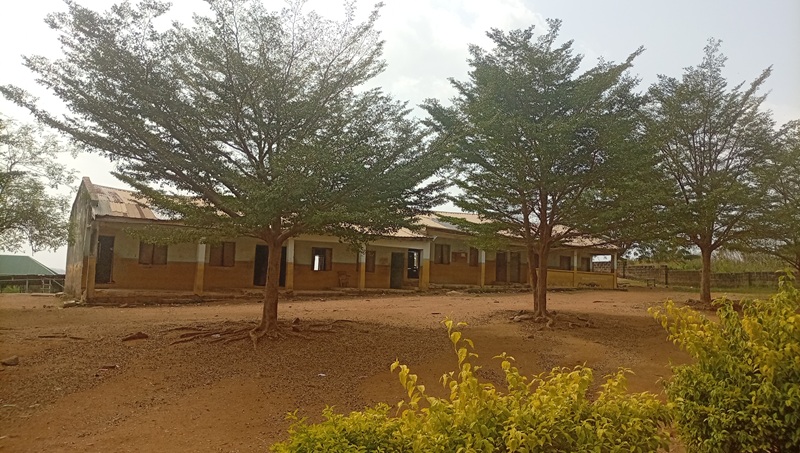
Established in 2007, Community Grammar School, Sawmill, Odo-Oba, is a source of educational hope for children of peasant communities in Moniya, and it is one of the 34 public secondary schools in Akinyele Local Government Area.
Despite its importance and long-term inception, the school is presently in a state of ruin. Its classrooms are crowded with shattered chairs and splintered tables, their surfaces scarred and uneven. Broken slabs lie in disarray across the rooms, and the chairs are held together by rotten wood and rust-eaten nails that scream under the slightest weight.
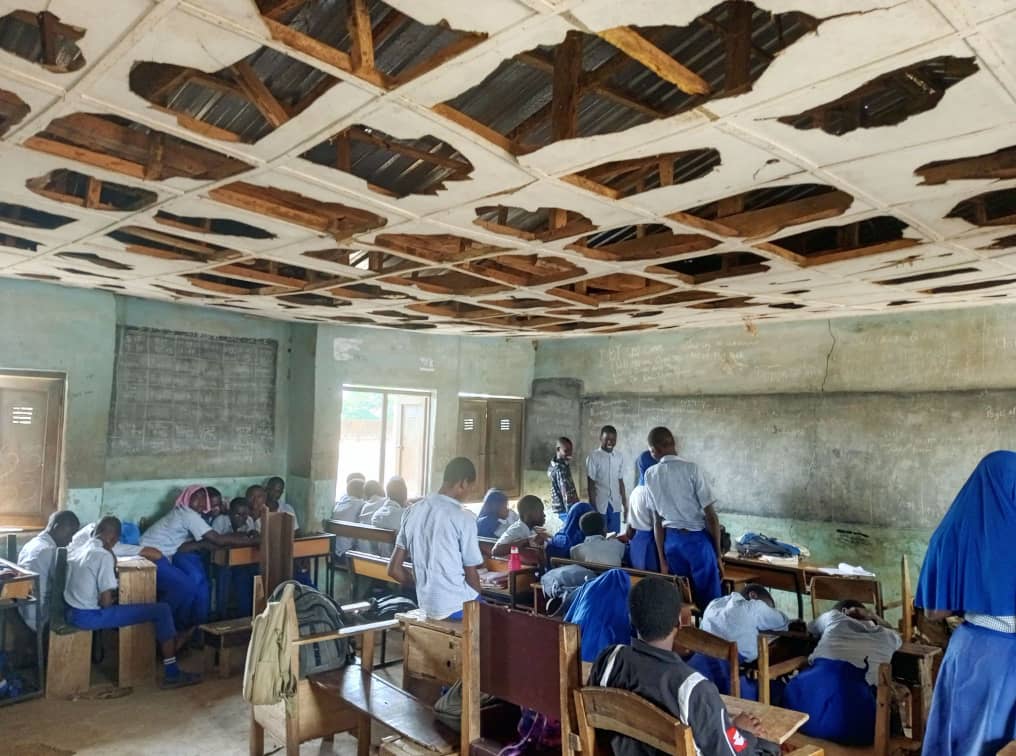
The painted walls are pale and peeling due to years of neglect. The school has no windows and doors, leaving the class open for wandering lizards, rodents, and straying animals to slip inside for shelter.
Above the classroom where the students are seated were sagging and dangling ceilings that are weakened and on the verge of collapse, while the classrooms feel cramped and suffocating, packed with seats so damaged they are barely usable.
That is not all. A building remains unfinished. It is the school hall, doubled as a classroom. It is a wide and unenclosed hall that serves as classrooms for students. It is open on every side, exposing the students to the sweltering sun, piercing rain, torrential wind, and dust. The blocks that hold the structure together are worn-out and crumbling, their surfaces chipped and fragile, as if they could collapse at any moment.
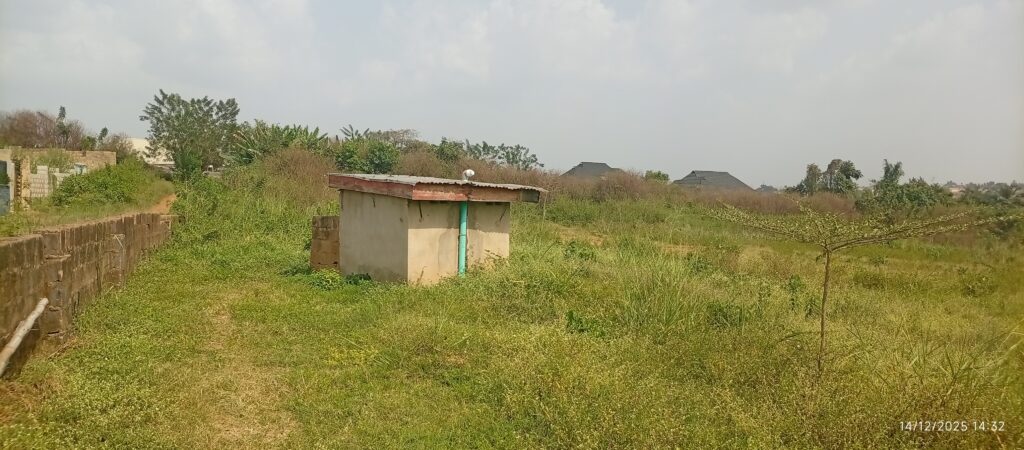
Behind it is a rank of overgrown bushes that have been littered with faeces and waste that oozes inside the class and disrupts learning at intervals. In fact, every corner of the school cries out for emergency intervention.
Multiple interviews showed that the students are disgruntled and stranded, but there is nothing they can do to mitigate their plights and pains.
“Our teachers are trying, but the buildings are not good. The ceilings are leaking, and when it rains, we are not always comfortable in class because we get drenched. We would be looking for classes that are not leaking,” said Olasupo Amidat, a 15-year-old science student.
The roof in her classroom is riddled with leaks and gives way at the slightest downpour. Her classmates, who are crammed into the rear seats, are usually drenched whenever it rains, and those in the front row are not spared. They live in constant trepidation that the ceiling might collapse on them.
Recounting a harrowing incident when the entire class was soaked by rain, Ms Amidat said it started in the middle of a lesson, and the teacher was forced to flee the room as water dripped through the leaky roof.
While lamenting that the teacher sought shelter in the science laboratory, they were barred from using the same laboratory as a safety net, and they ended up battered by rain. She said the incident was one of many instances in which they were left to their fate during rainy seasons.
“When it rains, and there is a teacher in the class, the teacher would definitely stop teaching us and run to the science laboratory, and if we want to hide in the laboratory until the rain subsides as well, the teachers will lock the door against us and chase us away and leave us to drench.
“We are more than 100 in class, both science and commercial students in that small class, while the art students are using a separate class, and they are more than us,” she decried, noting that most of the chairs and desks used by the students were taken to school by them.
Those who cannot afford furniture face even harsher brutality; they are either left to sit on the floor or to cob together makeshift seats from broken and decaying wood.
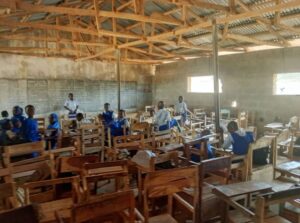
“We don’t have chairs and tables; each of us has to bring a chair and desk, but for some people who cannot afford it, they have to endure sitting inconveniently,” the female student who aspires to become a medical doctor said in Yoruba.
Despite these challenges, students are exposed to danger from rusty nails, and when injuries occur, they are unjustly blamed.
“We get wounded most of the time by broken chairs and tables; they (teachers) will blame us for not bringing a chair to school. There is nothing we can do about that. If we get injured, we cannot go and meet the teachers because there,” she decried to African Angle.
Though there is a toilet in the school, only teachers are authorised to use it, and the students who want to defecate either leave for the bush or their homes. Many female students who do not change their pads in the bush are forced to leave for their homes.
“If we are menstruating, we have no choice but to change inside the bush. Any student who brings menstrual kits can help, and we have to go to the bush. My friends who cannot change in the bush are forced to go home. Their clothes are always stained with blood at this point,” Ms Amidat added.
A teacher who spoke with African Angle, requested anonymity, noting that no teacher wants to fall into trouble. The teacher did not deny that the students’ condition is deplorable. She expressed concern about the complexity of the state’s education bureaucracy and the potential consequences of speaking out.
Several attempts to obtain a response from the school principal, Ibironke Akangbe, through calls and messages were unsuccessful.
Nigeria currently takes a spot among countries with low sanitation coverage rates. Only 26.5 percent of Nigerians use improved drinking water sources and sanitation facilities, said the United Nations Children’s Fund; 22 percent are said to practice open defecation. Many public secondary schools lack basic water and sanitation facilities, and hygiene teaching programs are frequently insufficient.
Studies said that the dearth of infrastructure affects the academic performance of students. It is noted that the educational system fails to achieve its purpose when the majority of secondary school leavers are not equipped with the necessary skills to empower themselves.
While female students struggle to change pads discreetly, often hiding in bushes or behind buildings, the government does not provide menstrual kits and facilities.
Experts said this crisis entrenches gender inequality and discrimination, stressing that the lack of private, safe, and clean sanitation facilities is a primary barrier to girls’ consistent school attendance.
“This repeated disruption exacerbates dropout rates, perpetuating a cycle of gender gaps in education that limit future opportunities and empower a cycle of poverty and disenfranchisement,” said Adefunke Ekine, a gender expert and professor of Childhood Education at Tai Solarin Federal University of Education,
Also, these conditions violate Nigeria’s National Policy on Education, which mandates safe and conducive learning environments and is way below the global standard that Nigeria is committed to through the African Charter on the Rights and Welfare of the Child. The situation in Community Grammar School is below the minimum standard.
The gender expert pointed out that the reality of the school showed the failure of educational governance.
“It appears that rural schools function in a monitoring vacuum, allowing situations to worsen to crisis proportions without prompting action,” Ms Ekine noted, adding that there is no sustained, credible, and locally owned stream of data on the real-time status of school WASH facilities. “Official government inspections are often infrequent and cursory, while NGO assessments provide only fleeting snapshots.”
As problems remain invisible to decision-makers, the dearth of reliable evidence allows systemic neglect to continue unseen and unchallenged, and this data vacuum is compounded by a completely broken feedback loop.
Two sides of the same coin
The situation of public school students in Oyo State is two-sided. From Saint Louis Grammar School in Mokola to Yejide Girls Grammar School in Molete and Queen’s School, Oke-Offa, the three single-sex schools visited are well maintained, contrary to the rural public school.
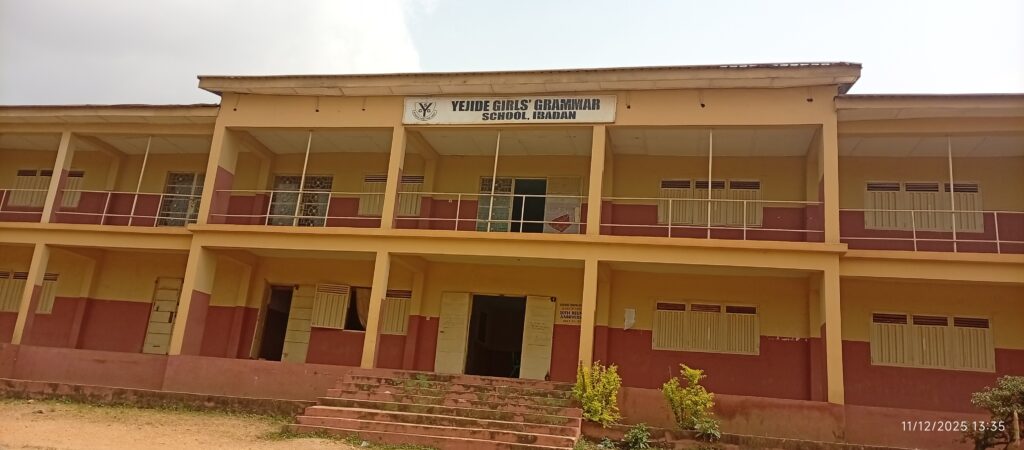
The schools are well structured, and the classrooms are largely in a conducive condition. “Our classes are fine, and we sit on good chairs and a table,” Oluwatimileyin Adewunmi, a Senior Secondary School 2 student of Queen’s School and health ambassador, said shyly as she looked sideways, but her voice carried a quiet pride that could not be hidden about her school.
“Our teachers even go beyond the curriculum by teaching us how to take care of our bodies. How to help ourselves when a colleague is menstruating. There are some menstrual kits in school. I am part of the school ambassadors, and there are menstrual kits available for students.”
Unlike many Community Grammar Schools, menstrual kits and hygiene materials are made available for the students’ use, and they are also taught how to protect and safeguard themselves. When African Angle approached the principal of Queen’s School, Oke-Offa, for comments, she declined to respond to press inquiries on Friday, 9 December, 2025. She also refused to disclose her name, stating that African Angle needed clearance from the State Ministry of Education.

Also, the situation was encouraging at Saint St Louis School (Junior), Mokola. The school has benefited greatly from the goodwill of its Alumni Association. In particular, the Old Girls’ Association has played a vital role in addressing gaps in the school’s infrastructural and educational needs.
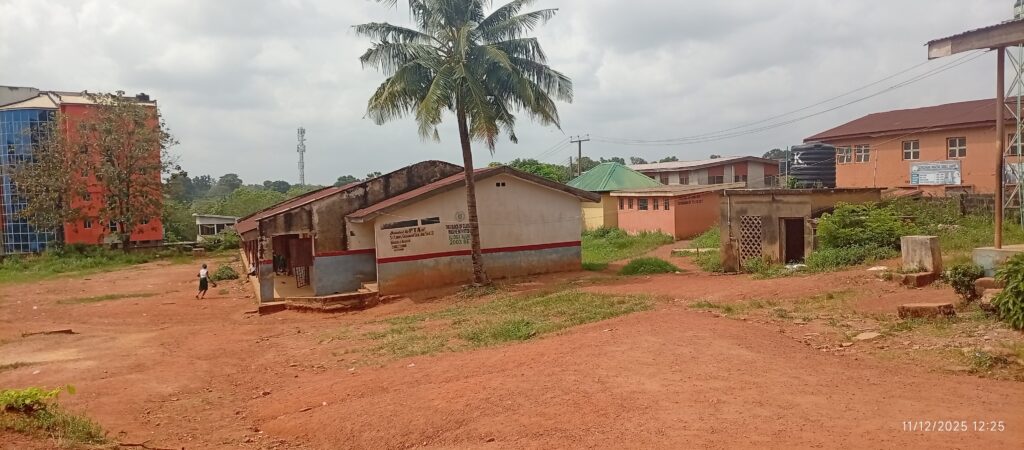
Despite the destruction of some chairs and tables, St Louis School still boasts of an infrastructure that supports effective teaching and learning. “We have chairs and tables, and most of these are managed by the old girls’ association. We still need more. We have classrooms and toilets,” said Christiana Ayeni, the school principal.
Beyond the generosity of the old girls, the school gets menstrual pads and kits every academic term through a plastic bottle exchange program. “We partner with an NGO that brings menstrual pads for the students, and we give them used plastic bottles,” she explained, stressing that the materials are always accessible to every girl who needs them.
While the initiative is innovative, no school is without its challenges. At Saint Louis’s School, these challenges extend beyond the classrooms to the school pitch, the access roads, and the drainage system. This neglect is a visible scar for anyone who goes inside the school compound.
“I will start from the sports field. That our field is not good enough for sports. We need the assistance of the government concerning that. The old girls and I are trying to manage it. If you look at that field during this holiday, we have to use a bulldozer with the help of the Catholic mission to level it.
The topography is not balanced and not good because it is sloppy. Students used to fall there, and even teachers. The old girls tried for us. They are the ones who did the drainage; they constructed all the gutters because the place was so big that the erosion eroded the land,” she stressed.
Despite these infrastructural hurdles, the school maintains a firm stance on student safety. Ms Ayeni explained that there has not been an incident of sexual molestation, assault, or harassment between or among the students and teachers, which was made possible by its conscious internal policies, programmes, and enlightenment.
Oyo’s big budgets but little funding
To ascertain the causes of the gender gap and the lack of infrastructure in the Oyo State education sector, African Angle analysed the approved budgets and the budget performance of the State Ministry of Education, Science, and Technology and the State Universal Basic Education Board (SUBEB) from 2023 to 2025. SUBEB is created to manage, develop, and provide quality, accessible basic education in primary & junior secondary for all children in a state. The board also focuses on teacher training, infrastructure development, and curriculum implementation.
A review of a budget analysis document showed that Oyo State approved N107,964,574,944.86 for capital projects, personnel, and recurrent expenditure in the 2025 fiscal year for its Ministry of Education. However, only N58,621,844,382.18 was spent, leaving the budget to fall short by N49,342,730,562.68.

This allocation was shared among 13 commissions, colleges, institutions, and boards under the Ministry of Education, with overall expenditure amounting to just about 54.3 per cent of the approved budget.
In the same year, the State Universal Basic Education Board also suffered brutally from this decision, as the board got a meagre allocation of N127,536,869.04 out of an approved sum of N305,698,911.01, leaving the agency to get less than 50 per cent of its allocation.
But it did not start in 2025. The state education ministry’s approved budget is N23,879,765,063.62 in 2024, and between January and December, less than three hundred million was spent, N293,539,875.00. A sordid performance of less than 1.2 per cent of the approved budget.
In usual rhetoric, only N50,000,000.00 was approved for the State Universal Basic Education Board despite the enormity of its function. One would not expect what happened in 2024, as only N9,137,700.00 got released by December that year, which is about 18.3 per cent of the budget.
In a similar trend, the Oyo State government does not care to show much value to the education sector, as its budget is N13,139,395,748.00 and only cash-backed N2,131,416,169.98, which is about 16.2 per cent of the approved budget for the 2023 fiscal year.
With the paltry allocation and release for the 2023 fiscal year, SUBEB was also affected, as only N1,716,000,000.00 was approved as its financial expenses. But sadly, N678,000.00 was realised.
African Angle made several attempts to reach relevant state officials for clarification and response; however, these efforts proved unsuccessful, as the officials remained largely unresponsive. The attempts included repeated phone calls, Short Message Service (SMS), and WhatsApp messages.
To begin with, multiple inquiries concerning the condition of Community Grammar School, Sawmill, were directed to the Chairman of the State Universal Basic Education Board (SUBEB), Nureni Adeniran. Despite these efforts, he neither answered calls nor responded to messages sent via SMS or WhatsApp.
Similarly, African Angle reached out to the Oyo State Commissioner for Information, Dotun Oyelade, on Monday, 5 January. At the time, he asked this reporter to call back the following day, Tuesday, 6 January. However, he has remained unreachable, as subsequent calls and messages went unanswered.
But, there appeared to be a brief glimmer of hope when Olarenwaju Sulaimon, the Chief Press Secretary and Special Adviser on Media to the Oyo State Governor, acknowledged African Angle’s inquiry on Saturday, 3 January, and assured this reporter that he would follow up on the matter.
Subsequently, on Tuesday, 6 January, he redirected this reporter to the Commissioner for Education, Olusegun Olayiwola, who, in turn, promised to respond to the inquiry. However, when this reporter followed up on Wednesday, no concrete response had been provided, as the commissioner explained that the matter had been forwarded to the Permanent Secretary of the ministry.
This report was facilitated by DevReporting in partnership with Education As a Vaccine (EVA) and supported by the Malala Fund.

