



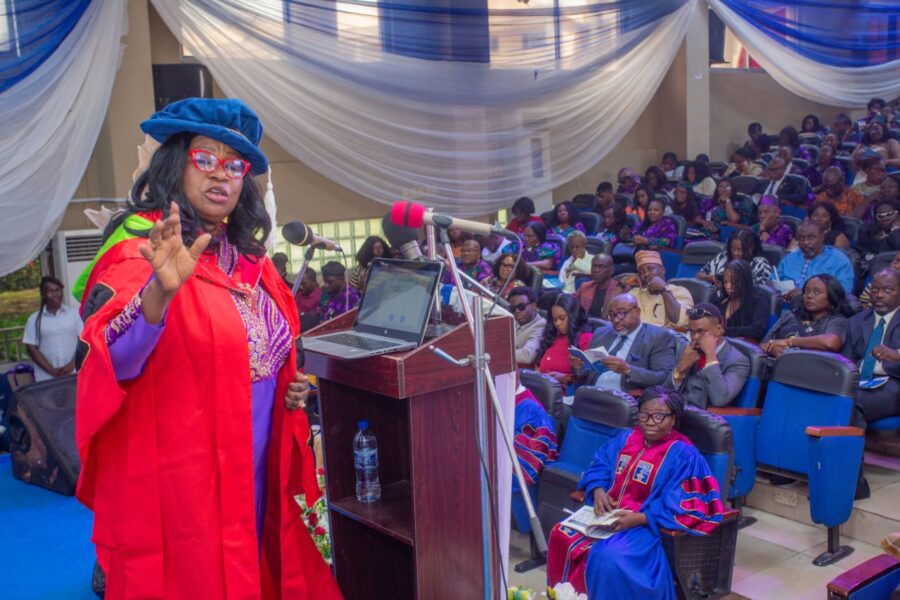
A professor of Criminal Law and Criminal Justice Administration at Babcock University, Ilishan-Remo, Ogun State, Adekunbi Imosemi has called for the establishment of specialised family courts across Nigeria to handle cases of domestic violence, child abuse, child marriage and human trafficking.
She also urged the federal and state governments to undertake sweeping reforms of the country’s justice system, strengthen anti-corruption institutions and address overcrowding in correctional facilities.
Ms Imosemi made the recommendations on Thursday while delivering Babcock University’s 63rd inaugural lecture, titled “The Dangling Pendulums of Lady Justitia: Re-echoing Justice for the Victims, the Criminals and the Law in a Permissive Society,” at the Babcock Business School auditorium.
She said Nigeria’s justice system requires urgent reforms to ensure that justice is accessible to all, protect vulnerable groups and hold perpetrators of crimes accountable.
Calls for specialised family courts
Addressing the protection of vulnerable persons, the professor said specialised family courts were necessary to ensure that cases involving domestic violence, child abuse, child marriage and human trafficking received appropriate attention.
She urged all states to establish such courts to strengthen the country’s response to abuses within families and against children.
Ms Imosemi also called on states yet to domesticate the Violence Against Persons (Prohibition) Act 2015 to adopt the legislation, which currently applies in the Federal Capital Territory.
She said wider adoption of the law would strengthen legal protection against gender-based violence and help address marital rape, which the Act has partially criminalised.
She cited Lagos State as an example, noting that its legislation expressly provides that a husband can be found guilty of sexual assault by penetration, with life imprisonment as the penalty upon conviction.
Wants independent anti-corruption agencies
On corruption and governance, Ms Imosemi said the fight against corruption would remain ineffective without genuinely independent anti-corruption institutions.
She called for institutional independence for the Economic and Financial Crimes Commission (EFCC) and the Independent Corrupt Practices and Other Related Offences Commission (ICPC), including security of tenure for their leadership, adequate funding and protection from executive interference.
She also advocated stronger asset declaration requirements through public disclosure and independent verification.
The professor described the enactment of a comprehensive whistle-blower protection law as long overdue, arguing that people who expose corruption need adequate legal protection.
She further called for an amendment to Section 308 of the 1999 Constitution to exclude economic crimes from the immunity currently enjoyed by certain public office holders.
Seeks nationwide adoption of criminal justice law
On the administration of criminal justice, Ms Imosemi urged all states to domesticate the Administration of Criminal Justice Act (ACJA) 2015 to improve the administration of criminal justice across the country.
She called for comprehensive training on the ACJA and the Nigeria Police Force Establishment Act 2020.
According to her, the training should cover all major stakeholders in the criminal justice system, including judges, magistrates, police officers, prosecutors, defence lawyers and correctional officials.
She said equipping these officials with adequate knowledge of the laws would improve justice delivery and strengthen compliance with established legal procedures.
Calls for prison decongestion, better funding
On correctional services, the professor urged the government to increase funding for the management of correctional facilities and ensure that officials were held accountable for complying with the law.
She also called for the decongestion of prisons and greater independent monitoring of correctional facilities by civil society organisations and faith-based communities.
Ms Imosemi said such oversight would help strengthen accountability and ensure that the rights of inmates were protected.

