


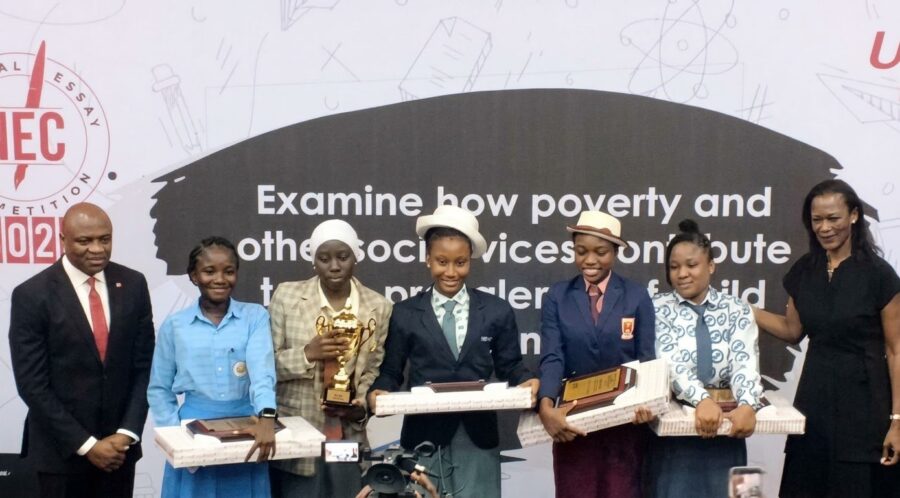
Five female students have emerged winners of the 16th edition of the United Bank for Africa (UBA) Foundation National Essay Competition, with the overall winner, 15-year-old Khaira Bala, receiving a N15 million educational grant and other prizes.
Khaira, an SS3 student of Metro International School, Kubwa, Abuja, emerged first among about 15,000 entries submitted for the competition.
The first runner-up, 15-year-old Udom Otobong, an SS2 student of Topfaith International Secondary School, Mkpak, Akwa Ibom State, received a N10 million educational grant and other prizes, while the second runner-up, Flourish Chimbunumoma, an SS3 student of University of Port Harcourt Women Association (UPWA) International School, received N7.5 million and other prizes.
Godsfavour Udo of Federal Government Girls’ College, Ikot Obio Itong, Akwa Ibom State, came fourth and received a N5 million grant, while Uchenna Anyanwu of Coral Impacts International School, Abuja, clinched fifth position with a N3.5 million educational grant and other prizes.
The grants will support the winners’ future studies at any university of their choice in Africa. They also received other prizes.
The latest outcome marks a return to female dominance after last year’s competition produced a male winner for the first time in eight years. The 15th edition was won by 13-year-old Ebunoluwa Oluwatimilehin, an SS2 student of Igando Community Senior High School, Lagos.
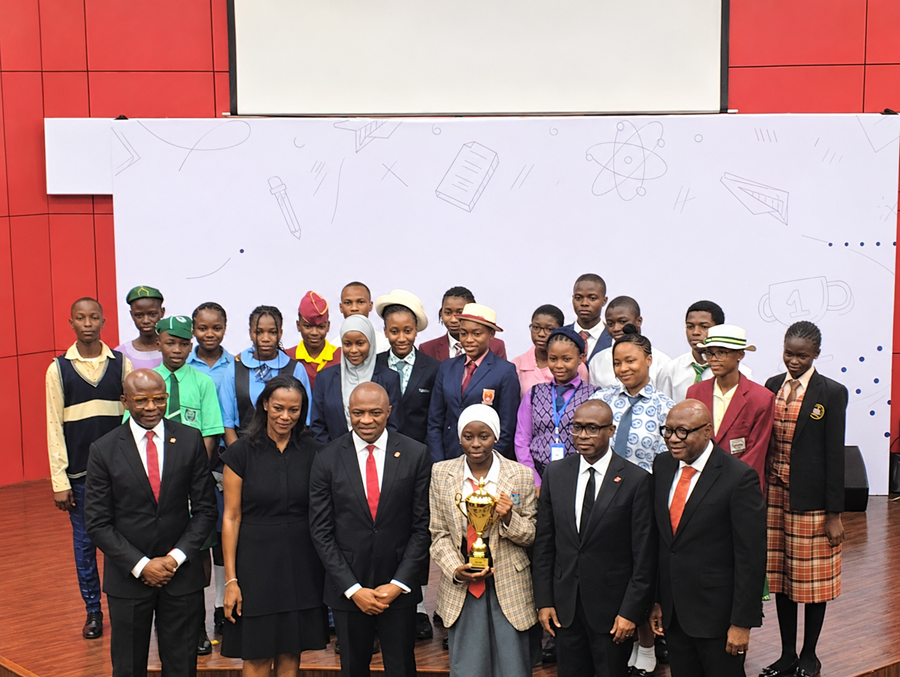
According to the Managing Director and Chief Executive Officer of the Foundation, Bola Atta, the educational grants for the top five winners had been increased to reflect inflation and prevailing economic realities. She also said the number of finalists had increased from 12 in the previous edition to 20 this year.
The remaining 15 finalists received laptops and other educational materials to support their academic pursuits.
They are Lisa Okereke of Creative Kids Elementary and High School, Abuja; Esther Anuolowapo of Peculiar International College, Jos; Shalom Abisoye of The Sprouters Schools, Katsina; Ezeani Uchenwanne of Kuje Senior Secondary School, Lagos; Fawwaz Alabi of Heritage Global Academy, Ikorodu; Queenesther Gabriel of Redemption Academy, Uyo; Chibuike Nworie of Hez-Dike Schools, Awka; Nneji Chinemerem of Dennis Memorial Grammar School, Anambra.
Others are Mustapha Hauwa of Intercontinental College, Kano; Kingsley Emmanuel of Lagos City Senior College, Sabo, Yaba; Ebunoluwa Louis of Igando Community Senior High School, Lagos; Usman Fauzyah of St Anne’s School, Ibadan; Roseline Adedoye of Molusi College Senior, Ogun State; Ayomide Dada of Softnet Technology Academy, Abuja; and Dominica Azuoma of Oxford Secondary School, Ulakwo, Owerri.
“We will keep ensuring that the reach is wider,” Ms Atta said, adding that the Foundation had committed more than N3 billion to the competition since its inception in Nigeria.
Essay topics, judging and AI concerns
According to the organisers, the 16th edition of the competition attracted about 15,000 entries from secondary school students across Nigeria.
Participants were required to write on the topic: “No nation can develop without food security. How can Nigeria deal with this problem?”
Following a rigorous screening process conducted by professors of English from universities across the country, 20 finalists were selected and invited to participate in a physical essay-writing exercise.
At the final stage, the students were asked to “Examine how poverty and other social vices contribute to the prevalence of child marriage in Nigeria.”
The panel of judges comprised Samuel Onuigbo of the University of Nigeria, Nsukka; Ini Uko of the University of Uyo, Akwa Ibom State; Asabe Usman of Usmanu Danfodiyo University, Sokoto; and Emmanuel Omobowale of the University of Ibadan. All four are professors of English.
Presenting the panel’s report, Ms Uko raised concerns about the use of artificial intelligence (AI) in the submitted essays. Preliminary assessments showed that about 40 per cent of the entries were largely AI-generated.
She added that five per cent of the submissions had titles that were completely different from the original topic, while several others had no titles. The judges also identified multiple submissions.
Ms Uko cautioned students against using AI-generated content in its raw form, urging them to develop their critical thinking and research skills rather than rely on the technology to produce their essays.
She recommended the deployment of tools to detect plagiarism and the irresponsible use of AI.
“It is not a problem to use AI. It will give you the information but you’ve got to be able to show responsibility by domesticating what you obtain from AI and applying your mind so that you are not copying verbatim. You read and get back to your materials to do your research and write,” she said.
Assessment criteria, call for critical thinking
Ms Uko described the essay topic as relevant to contemporary national realities and central to Nigeria’s development concerns.
She explained that the entries were assessed using six criteria: content, which accounted for 30 per cent; expression, 20 per cent; organisation, 15 per cent; mechanical accuracy, 15 per cent; depth of analysis, 10 per cent; and adherence to essay guidelines, including word count, 10 per cent.
The Group Managing Director and Chief Executive Officer of UBA Plc, Oliver Alawuba, commended the judges for the rigour of their assessment and urged policymakers to take the feedback seriously and use it to inform policy decisions.
He also encouraged Nigerian students to remain committed to writing and developing their intellectual abilities. “Keep writing, keep believing, and keep building the Africa of our dream,” he said.
Mr Alawuba added that the bank was considering expanding training opportunities for teachers to equip them with the skills to promote critical thinking among students.
“We are looking at how we can expand training opportunities for teachers so that they can be equipped to help the students think critically,” he said.
He also commended the Foundation for sustaining the competition over the past 16 years, noting that the initiative had helped promote reading culture and healthy competition among secondary school students in Nigeria and other African countries.

