



The Managing Editor of DevReporting, Christiana Alabi-Akande, has been named the Best Graduating Postgraduate Student in the Mass Communication Department at Caleb University, Imota, Lagos, after securing a cumulative grade point average (CGPA) of 4.71 out of a possible 5.0 to earn a Master’s degree.
The recognition came as the university conferred degrees on a total of 1,924 students during its 15th convocation ceremony on Wednesday, 18 February, in Lagos. Of this number, 1,625 students completed undergraduate programmes, while 299 completed postgraduate programmes.
Mrs Alabi-Akande’s husband, Olutayo Akande, also earned a Master’s degree in Economics during the convocation ceremony. The banker and chartered accountant previously obtained a Higher National Diploma (HND) in Accounting before earning a Bachelor’s degree in Economics from the University of Ibadan, prior to this latest achievement.
Graduands’ statistics
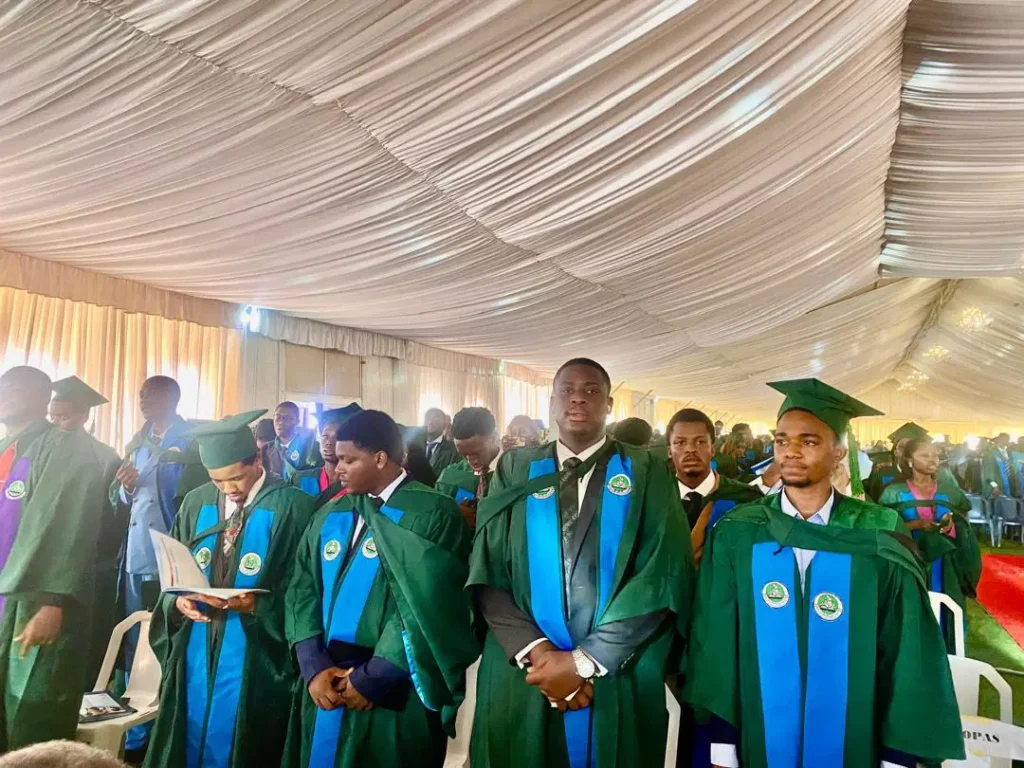
Among the undergraduate graduands on Wednesday, 96 earned First Class degrees, 719 secured Second Class Upper, 728 were awarded Second Class Lower, while 82 graduated with Third Class honours.
Meanwhile, postgraduate graduands included 22 PhD recipients; 31 MSc students with Distinction, 86 with Merit, and 51 with Pass; five MBA students with Distinction and 29 with Merit; and PGD graduands with 10 Distinctions, 28 Merits, and 37 Passes.
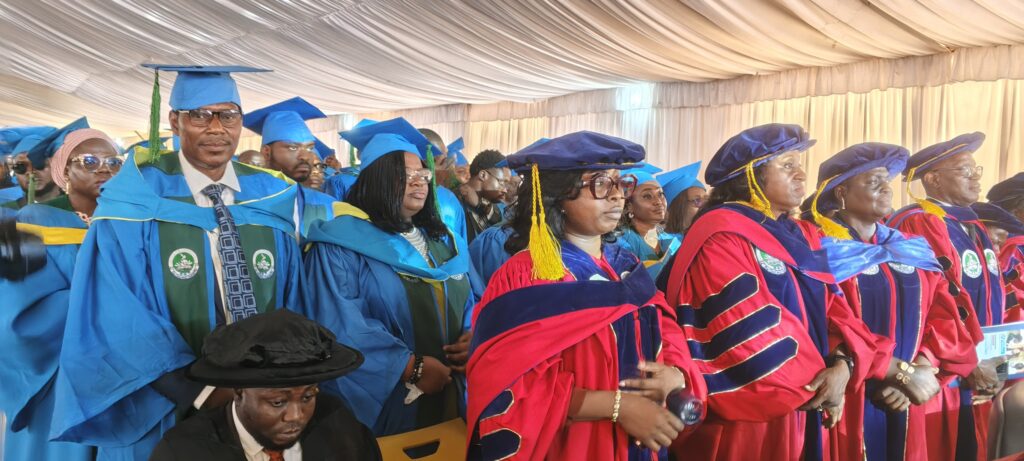
At the 15th convocation ceremony, Gbemisola Oshikoya of the Department of Microbiology and Industrial Biotechnology emerged as the overall best graduating student with a CGPA of 5.00, while Abdulrasaq Shomope of Computer Science Department was named the overall best postgraduate student. Outstanding students across the various colleges and departments were also recognised and presented with letters of academic excellence.
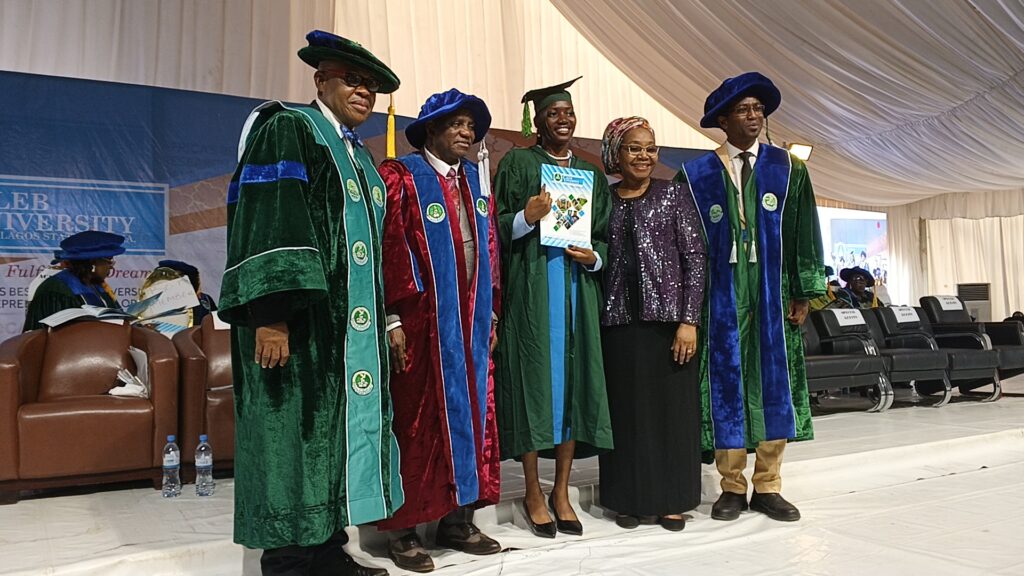
A major highlight of the ceremony was the conferment of an Honorary Doctoral Degree in Humanities on Foluke Adeboye, a pastor, author, and wife of the General Overseer of the Redeemed Christian Church of God (RCCG), Enoch Adeboye.
Vice Chancellor unveils reform agenda
In his address, the university’s Vice-Chancellor, Olalekan Asikhia, a professor, outlined the university’s ongoing reforms under what he termed a seven-point agenda, which is said to be anchored on spiritual vitality, academic excellence, research innovation, global partnerships, entrepreneurship, governance, and environmental sustainability.
He said the institution had consolidated full accreditation for its undergraduate programmes and expanded its academic structure with new colleges in Communication and Media Studies, Health Sciences, and Computing and Information Studies.
Mr Asikhia emphasised that his administration prioritised creating a godly environment for students’ personal and academic growth, strengthening chapel activities, and introducing biometric attendance systems to improve accountability. He noted that more than 8,000 staff and students have already been enrolled in the digital system to enhance compliance and safeguard examination integrity.
“Our vision is to produce graduates who are not just certificate holders but solution providers, innovators and nation-builders,” the vice chancellor affirmed.
He reported major accreditation milestones in Nursing Science and Medical Laboratory Science, alongside the introduction of new programmes, including Artificial Intelligence, Care Giving, and Data Science, which he noted are designed to align the university with national development goals and global standards.
The Vice Chancellor also highlighted recruitment drives to fill staffing gaps, revised salary structures to improve staff welfare, and measures to stabilise the academic calendar.
Over 3,600 new students, he said, were admitted for the 2025/2026 session, reflecting rising confidence in the institution.
On research, he said the university had launched a five-year action plan aimed at improving global rankings, increasing Scopus-indexed publications, and strengthening international collaborations. He disclosed that partnerships with universities across Europe, North America, Asia, and Africa are part of efforts to boost visibility and impact.
Mr Asikhia disclosed that new hostels, a 5,000-seat chapel, staff quarters, and a shopping mall are under construction, alongside the procurement of a 1,000KVA generator to reinforce campus power supply.
Ethical leadership, innovation
Delivering the convocation lecture, the General Overseer of the Foursquare Gospel Church, Sam Aboyeji, a reverend, urged graduates to combine competence with character in navigating a rapidly changing global environment. He emphasised ethical leadership, resilience and service as critical to national transformation.
In his lecture, he called on graduates to deploy knowledge in solving real societal problems, emphasising that innovation must be guided by values, warning against the misuse of technology and influence.
He charged the graduating class to embrace entrepreneurship and adaptability in a competitive global economy. According to him, resilience and lifelong learning remain critical in an era shaped by digital transformation and shifting labour markets.
The cleric commended the university for blending Christian principles with academic pursuit, noting that institutions of higher learning must produce leaders who are both intellectually sound and morally grounded.
He encouraged collaboration across disciplines and borders, stressing that sustainable development requires collective responsibility.
The lecture concluded with prayers for wisdom and courage as graduates step into new roles.
Graduands urged to pair competence with character
Speaking on behalf of the graduating class, Valedictorian Gbemisola Oshikoya described the journey as both demanding and transformative.
She reflected on perseverance, faith and collective effort, noting that the university’s emphasis on academic rigour and moral discipline had shaped the graduating class.
Her speech paid tribute to lecturers, parents and mentors whose guidance sustained students through academic and personal challenges.
She also acknowledged the university’s emphasis on character formation, describing it as a defining feature of the Caleb experience, and urged graduates to uphold integrity in their workplaces and communities.
Ms Oshikoya beseeched her fellow graduates to remain ambassadors of excellence and integrity and build networks of support as they continue to invest in self-development.