



The Akin Fadeyi Foundation (AFF) has called for urgent behavioural change among Nigerians as a critical step towards reducing the rising spate of road accidents across the country.
Speaking at the unveiling of a one-minute advocacy drama focused on road safety, the Executive Director of AFF, Akin Fadeyi maintained that taming accidents on Nigerian roads must begin with citizens taking responsibility for their conduct behind the wheel.
“Even the most sophisticated road systems cannot compensate for human indiscipline or moral abdication,” he said, stressing that over-speeding, improper overtaking, driving under impairment, illegal parking and overloading are not acts of fate but “behavioural infractions masquerading as accidents.”
Grim statistics
Describing road crashes as a “national emergency” normalised by complacency, Mr Fadeyi noted that many Nigerians have either witnessed accidents, lost loved ones or experienced the anxiety caused by reckless driving.
Mr Fadeyi noted that road crashes account for approximately 1.2 million deaths globally every year, averaging about 3,200 deaths per day. This crisis, he said, cuts across countries such as the United States, the United Kingdom, Canada and the United Arab Emirates.
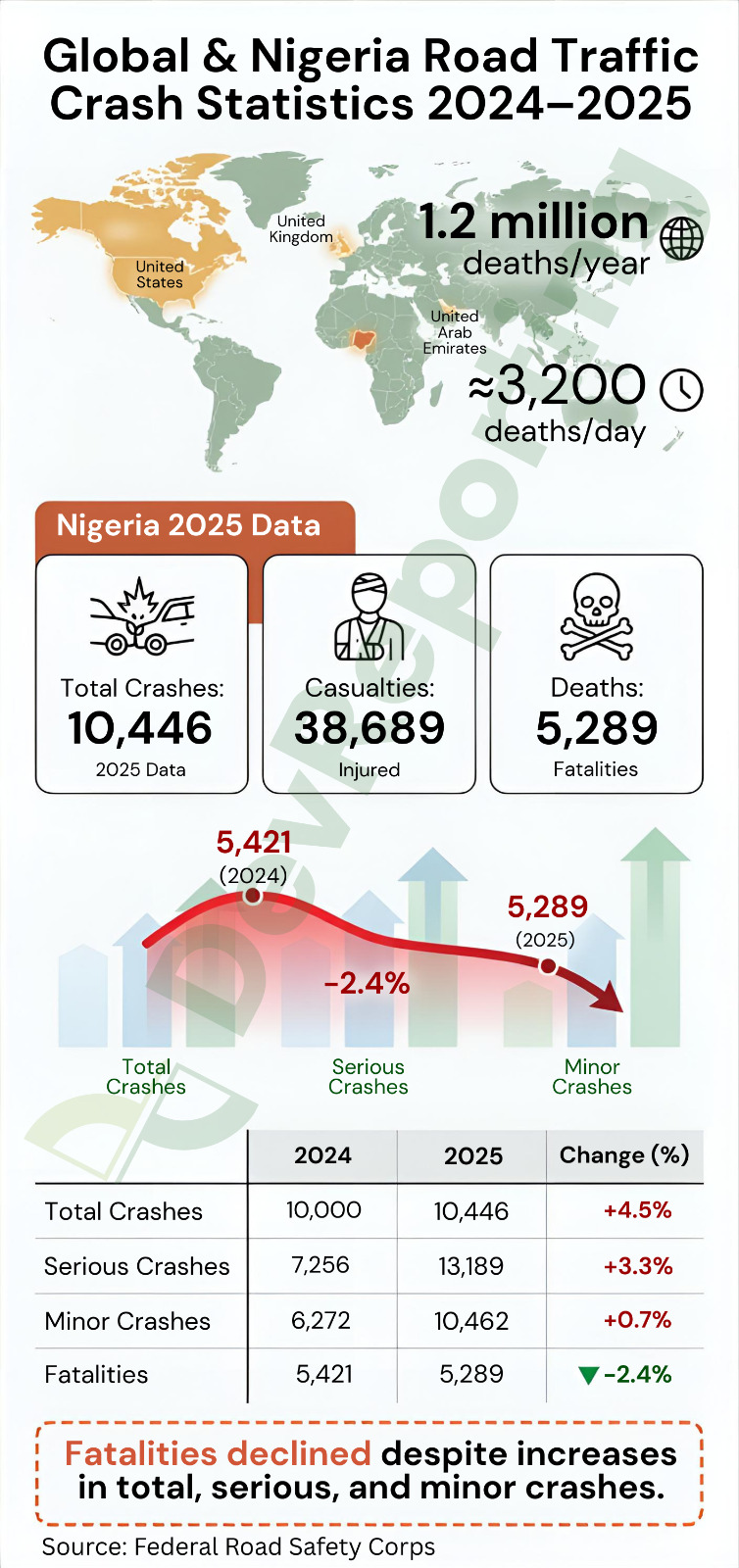
In Nigeria, 2025 data from the Federal Road Safety Corps (FRSC) paints a chilling picture: 10,446 crashes, 38,689 casualties and 5,289 deaths.
Conversely, the number of lives lost to road crashes declined from 5,421 in 2024 to 5,289 in 2025, representing a 2.4 per cent reduction.
Comparative analysis of 2024 and 2025 crash data shows that total crashes increased by 9.2 per cent from 9,570 to 10,446. Fatal crashes rose from 2,532 in 2024 to 2,608 in 2025, representing 3.0 per cent; serious crashes by 10.5 per cent from 6,131 in 2024 to 6,772 in 2025 while minor crashes rose from 907 to 1,066, signifying a 17.5 per cent increase.
“These are not just numbers; they are unfinished stories, extinguished potential and families condemned to enduring grief because of choices that are often reckless and avoidable,” Mr Fadeyi lamented.
One-minute drama as civic alarm
Mr Fadeyi explained that the newly unveiled one-minute advocacy drama was informed by street-level research conducted to capture citizens’ lived experiences and perceptions about road use.
The campaign, delivered through emotionally resonant storytelling and performed by Nollywood veterans, is a civic alarm designed to interrupt dangerous habits that have become culturally entrenched. He cited Nelson Mandela’s principle that effective communication must reach people in the language they understand, noting that the content was scripted in-house to ensure authenticity.
Call for institutional and public support
While acknowledging the importance of infrastructure and enforcement, Mr Fadeyi warned against corruption within regulatory systems, saying that trading compliance for inducements effectively places a market value on human life.
However, he emphasised that even strong institutions cannot replace individual responsibility.
The Foundation called on the Federal Ministry of Information and National Orientation Agency (NOA) to amplify the campaign across national broadcast platforms, including NTA, AIT and Channels Television, as well as digital platforms.
Mr Fadeyi also urged public institutions, private organisations, civil society groups, faith communities, artists, influencers and citizens to share and broadcast the one-minute drama widely.
“We cannot do this alone. Let road safety become not merely a rule, but a culture.”
He maintained that through collective vigilance, shared responsibility and national solidarity, Nigeria can move closer to a future where every journey is safe and every citizen returns home.
Commissioner calls for responsibility
The Lagos State Commissioner for Information and Strategy, Gbenga Omotoso who also attended the event commended the Akin Fadeyi Foundation for contributing to efforts aimed at reducing accidents on Nigerian roads, urging citizens to prioritise responsibility over constant claims of rights and privileges.
Mr Omotoso said Nigerians must begin to take collective responsibility for safety, especially on the roads.
“We live in a country where people are quick to talk about their rights and privileges. Nobody ever thinks about responsibility the way you are thinking now,” he said while addressing the Foundation.
The Commissioner defended traffic enforcement authorities, particularly officials of the Lagos State Traffic Management Authority (LASTMA), noting that many officers endure hostility and life-threatening attacks while performing their duties.
He recounted visiting a LASTMA officer who was stoned to death while controlling traffic, describing the incident as a painful example of the dangers faced by traffic officials.
“A young officer was killed simply for doing his job. Many others are in hospital because of attacks from members of the public,” he said.
He also criticised the culture of resistance that often greets government enforcement policies, including the restriction of commercial motorcycles on certain roads. According to him, accident figures dropped significantly following the restrictions, yet enforcement efforts were resisted on economic grounds.
Mr Omotoso also justified government policies restricting commercial motorcycles on major highways, stating that accident and fatality rates dropped after the enforcement began.
He criticised the culture of resistance that often greets safety regulations, noting that economic arguments are frequently prioritised over human lives. “When the government says people are dying, the public don’t care about lives, they talk about livelihoods,” he lamented.
Diaspora difference lies in discipline and enforcement
An International Project Management Consultant and Academic Don based in Canada, Kunle Ojeleye said the differences between Nigeria and countries in the diaspora are rooted not only in infrastructure but also in systems, accountability and individual responsibility.
According to him, while gaps in infrastructure and processes have been widely acknowledged, the more pressing concern is the failure of both citizens and officials to uphold responsibility. He urged motorists to avoid drink-driving, suggesting practical measures such as arranging designated drivers at social events or using ride-hailing services instead of getting behind the wheel after consuming alcohol.
Mr Ojeleye also raised concerns about vehicle maintenance, particularly the condition of commercial vehicles on Nigerian roads. He questioned the credibility of the roadworthiness certification process, noting that visibly dilapidated vehicles are often cleared to operate.
“You see vehicles on the road and you know this one should not even be there at all,” he said, describing such vehicles as dangers waiting to claim unsuspecting victims.
He challenged officials responsible for certifying vehicles and issuing licences to reflect on their roles, stressing that they are members of the same communities affected by road crashes. Drawing a comparison with practices abroad, he said stricter adherence to procedures, rigorous driver training and regular competency checks make a significant difference.
Recalling the process of obtaining his driver’s licence in 1977, he described it as thorough and demanding, in contrast to what he characterised as a more relaxed system today. He criticised situations where licences are processed without proper training or testing, adding that periodic vision tests and other assessments common in other countries are often not strictly enforced locally.
Ultimately, he argued that lasting change would require closing gaps in enforcement and restoring integrity to established procedures.
“What makes the difference in the diaspora is that the processes are kept true and the procedures are followed,” he said, emphasising that individual and institutional responsibility remains key to improving road safety in Nigeria.
Foundation’s behavioural change legacy
Founded in 2016, AFF has positioned itself as a behavioural change advocacy organisation, combining media storytelling, civic technology and institutional partnerships to challenge corruption and promote accountability.
The foundation’s previous initiatives include the “Corruption Not In My Country” series, produced with support from the MacArthur Foundation, the European Union, the United Nations Development Programme (UNDP), the United Nations Office on Drugs and Crime (UNODC), and the U.S. Mission in Nigeria.
AFF has also partnered with the Nigeria Police Force on citizen engagement initiatives and introduced the FlagIt App, a civic-tech tool designed to report misconduct, tackle cyberbullying and support victims of violence.
In the road safety sector, the foundation has collaborated with the FRSC to train over 2,200 officers in ethical and service-delivery competencies. Its radio advocacy platform, ‘Make We Sama Corruption’, has produced over 200 episodes.

