



By Samson Ademola
The outgoing Vice-Chancellor of the Federal University Oye-Ekiti (FUOYE), Abayomi Fasina, a professor, has described his five-year stewardship as a period shaped by trials, faith, institutional discipline and hard choices, saying leadership tested him, but God sustained him through the journey.
Mr Fasina said this while delivering his valedictory lecture, a public accounting of leadership of the institution for five years, beginning from 2021.
“I passed through the proverbial needle’s eye, indeed through fire, to arrive at this point. This has not been by my own power, but by the fulfilment of God’s will, manifested through those He ordained as destiny helpers,” he said.
Leadership, storms and difficult choices
Reflecting on his five-year tenure steering the affairs of FUOYE, Mr Fasina warned that leadership often comes with invisible storms, some emerging from unexpected quarters.
He noted that early leadership decisions, including appointments, were made after prayer, consultation and strategic deliberation, but acknowledged that not all choices produced the expected outcomes.
“Leadership is not the art of choosing perfect people, but the courage to walk with imperfect people while remaining faithful to purpose. Expect the storm before it gathers, prepare your heart before the wind rises, and steady your convictions before the clouds appear. Storms do not announce themselves. Sometimes they come from those who once stood beside you,” he advised.
Accountability, university autonomy
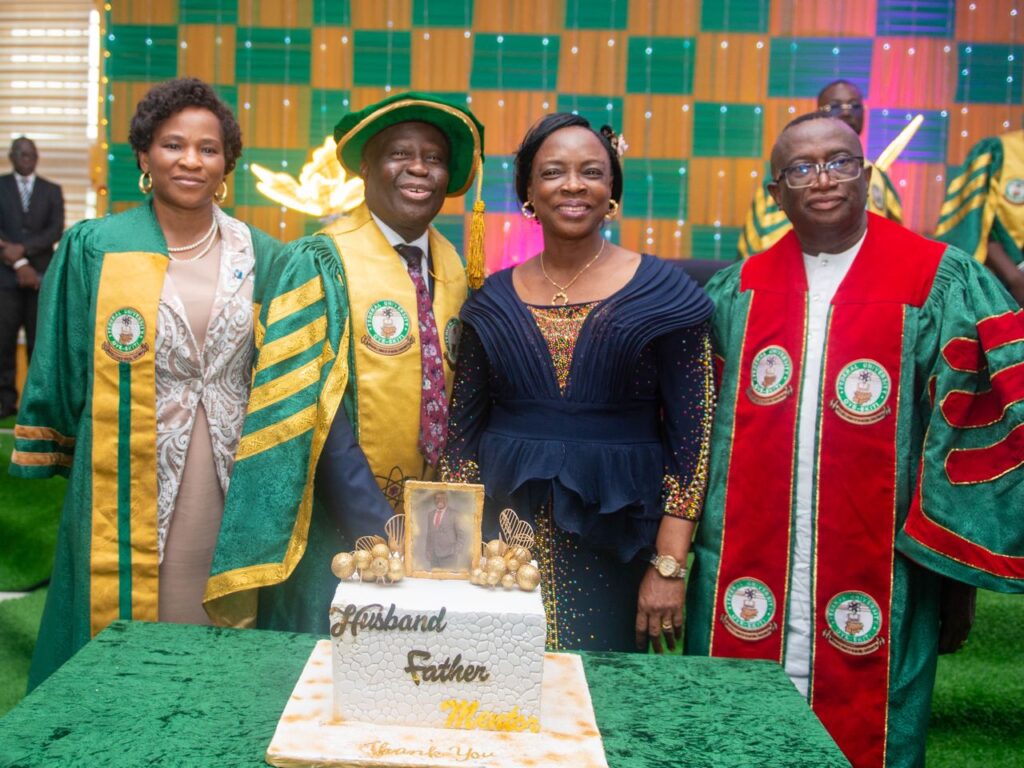
The Vice-Chancellor of the Federal University of Technology, Akure (FUTA), Adenike Oladiji, a professor, who chaired the occasion, said a valedictory lecture is a core expression of university autonomy and accountability.
“When a university speaks of autonomy, it is because it is expected to regulate itself. Professor Fasina has served for five years. It is only right that he gives an account of his stewardship,” she said.
The Pro-Chancellor and Chairman of FUOYE’s Governing Council, Victor Ndoma-Egba, a Senior Advocate of Nigeria, echoed this position, describing the lecture as a moment of reckoning.
“Accountability is one thing we cannot run away from. One day, you must account, if not to men, then to God.”
He congratulated Mr Fasina for completing his tenure and exiting office at the due time, describing it as leadership concluded “on his own terms”.
Governance reforms, institutional growth
In his lecture, Mr Fasina revisited key governance decisions taken during his tenure, including the creation of the office of Deputy Vice-Chancellor for Strategic Partnerships, Research, Innovation and Linkages, in response to FUOYE’s rapid expansion and growing complexity.
He explained that the university’s growth, now serving a diverse student population exceeding 60,000, required deliberate coordination of research priorities, innovation systems and national development alignment.
That office was later headed by Joshua Ogunwole, a professor who would be succeeding him as FUOYE’s fifth substantive Vice-Chancellor following what Mr Fasina described as a “rigorous, competence-driven appointment process”.
According to him, both his own appointment and that of his successor were conducted under intense pressure but ultimately anchored on due process, transparency and merit.
“What emerged was not an accident, a compromise or a concession to sentiment. The process vindicated itself,” he said.
Growth pressures and unresolved challenges
While outlining achievements recorded under his administration, Mr Fasina also identified some challenges now confronting the university as a result.
According to the vice-chancellor, these include staffing shortages amid rising enrolment, infrastructure strain, hostel deficits, weak research commercialisation, digital infrastructure gaps, labour relations pressures, community tensions and financial sustainability challenges.
He stressed that expansion without consolidation carries risks, and urged the incoming leadership to align growth with institutional capacity.
Strategic imperatives going forward
Drawing from these realities, Mr Fasina outlined strategic priorities for FUOYE’s future, including strengthening academic staffing, expanding smart learning infrastructure, diversifying revenue while keeping fees affordable, improving research impact, enhancing student welfare and security, stabilising labour relations and fully implementing the university’s 25-year strategic plan.
He urged stronger collaboration between the Governing Council and Management through structured engagement, noting that inclusive governance and due process are essential to sustaining institutional stability.
Emphasising financial sustainability, Mr Fasina called for the diversification of revenue beyond federal allocations through grants, partnerships, endowments and consultancy services, stressing that this approach would help keep fees affordable while funding development.
He also encouraged academic staff to pursue competitive research grants more aggressively, noting that 10 per cent of such grants accrues to the university and can be reinvested in infrastructure and institutional systems.
Faith, family and institutional support
Mr Fasina acknowledged the role of faith, family and institutional actors in sustaining his leadership journey, thanking the Pro-Chancellor and Chairman of the Governing Council, external and internal members of the Governing Council, management team, staff unions, students’ union, his wife, children and members of the Fasina family.
Fondly referred to as “Godwin” by some students and lecturers, Mr Fasina closed the lecture by reiterating that his journey as vice-chancellor of FUOYE has been demanding, yet through it all, God has remained faithful.

