


The Lagos State University (LASU), Ojo campus, was agog on 18 August as thousands of graduating students, their families, friends and well-wishers gathered for the university’s 29th and 30th convocation ceremonies for the 2024/2025 and 2025/2026 academic sessions
While graduates received congratulatory messages, posed for photographs and celebrated the culmination of years of hard work, Ayomide Aboaba, an Accounting graduate, was not among them.
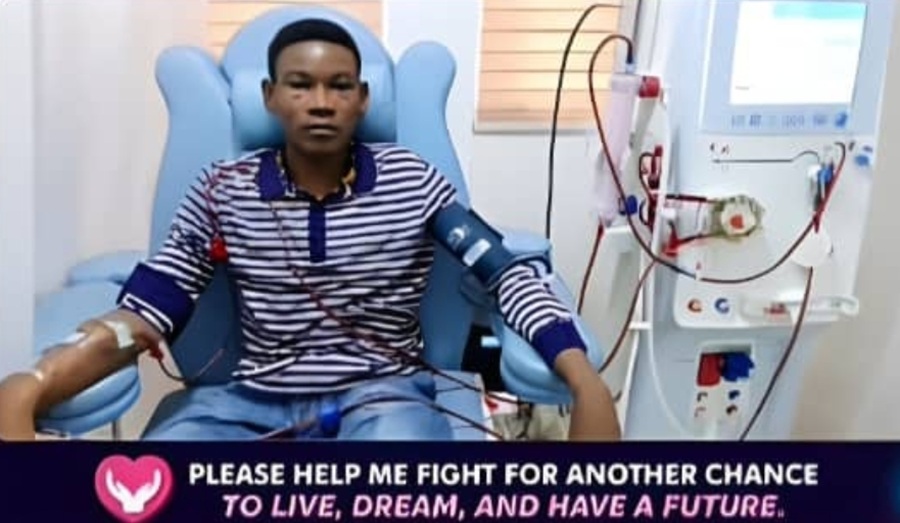
Instead, the 23-year-old was at a dialysis centre with his mother and aunties, marking a milestone he had fought for through eight years of kidney disease, recurring medical crises and prolonged hospital admissions.
Ayomide should ordinarily have been among the graduates celebrating on the Ojo campus but he was not because his health condition could not withstand the stress and crowd of the convocation ceremony.
The young graduate, who has battled kidney (renal) disease throughout his university years, undergoes dialysis twice and sometimes three times a week. He now needs public support to raise over ₦42.5 million for a kidney transplant.
Despite the recurring medical crises, surgeries and prolonged hospital admissions that disrupted his education, Ayomide completed his degree with a Second Class Upper division and has continued pursuing professional accounting qualifications.
“I feel happy that I was able to push through,” Ayomide told DevReporting. “Even though I’m going through a lot, I was still able to pass my exam. I came out with a 2-1.”
How it all began
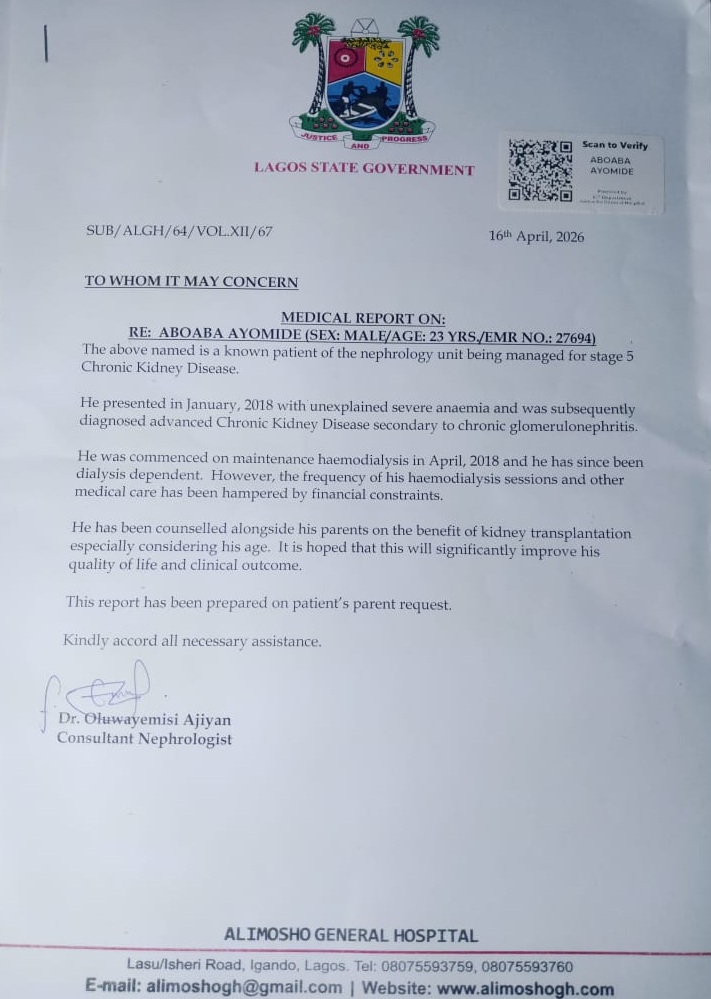
According to Ayomide’s mother, Matron Aboaba, the health crisis began in January 2018 when her son was 15 and in SS1. “He started dialysis around April 2018,” she said.
“Since then, Ayomide has been undergoing dialysis twice a week and, at times, three times a week, depending on his health. 4th April made it eight years,” his mother said.
She further explained that after about two years on dialysis, nephrologists advised the family to pursue a kidney transplant.
“We started working him up for transplant then, but along the line, he had extra pulmonary tuberculosis because of the immunity that is low,” She said.
The tuberculosis treatment, she said, lasted about a year, delaying the transplant process.
The family was later invited to Zenith Medical and Kidney Centre in Abuja, where Ayomide underwent several investigations, including a biopsy.
“We did a biopsy; we did so many things. So, then they said they cannot carry out the surgery until he’s fit and okay,” she said.
By the time he completed treatment and was considered fit, however, the transplant opportunity had been lost.
“At the time he was out, the treatment was over, all the funds that we gathered then were gone and the donor also couldn’t wait,” she said.
Since then, the family has continued to manage his condition through repeated hospital visits and dialysis.
What medical report says
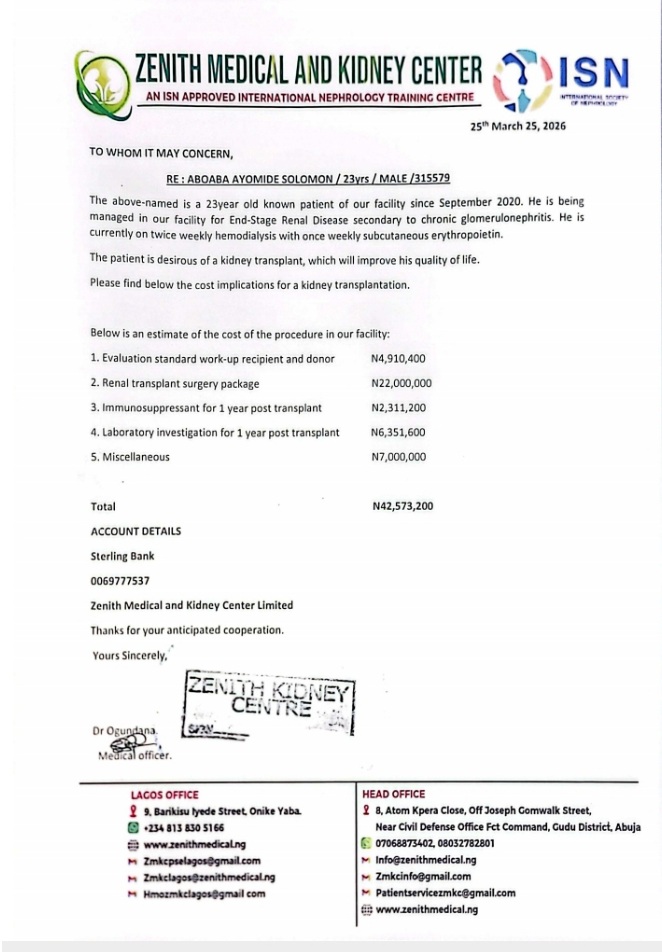
According to a medical report dated 25 March, sighted by DevReporting, Ayomide, a patient of Zenith Medical and Kidney Center since September 2020 is being managed for end stage renal disease secondary to chronic glomerulonephritis.
The report says that Ayomide who is currently on twice weekly hemodialysis with once weekly subcutaneous erythropoietin needs a sum of N42,573,200 for a kidney transplantation in the facility.
The cost covers evaluation of standard work-up recipient and donor, renal transplant surgery package, immunosuppressant for one year post transplant, laboratory investigation for one year post transplant and miscellaneous.
About renal (kidney) disease
Human kidneys are small but powerful organs, each about the size of your fist. Their main function is to filter toxins and excess water from the blood, while carefully balancing salt, water, minerals such as sodium and potassium, and blood acidity.
They also help regulate blood pressure, support the production of red blood cells, and keep bones healthy. Day by day, this quiet work keeps the body balanced and functioning well.
The World Health Organisation (WHO) says kidney disease occurs when the kidneys can no longer remove waste and excess fluid from the bloodstream normally. It added that Acute kidney Injury (AKI) has an abrupt onset and is often reversible with timely intervention.
In contrast, chronic kidney disease (CKD) progresses gradually and is frequently irreversible, with severity ranging from mild dysfunction to kidney failure. People with kidney failure typically require dialysis or kidney transplantation to survive.
According to WHO, kidney disease can develop silently, often showing no symptoms until it has reached an advanced stage. Regular testing is therefore vital for people at risk, as severe cases may cause fatigue, breathlessness, itching, swollen legs, muscle cramps, nausea, or vomiting among others.
The progressive loss in kidney function over a span of months or years is called Chronic kidney Disease (CKD). It is common, with one in 10 of the adult population having some form of kidney damage.
An estimated 674 million people have chronic kidney disease worldwide; most reside in low-and middle-income countries; ranking number seven in the top ten causes of death among noncommunicable diseases worldwide.
Experts say, for treatment of kidney failure, kidney replacement therapy (dialysis or kidney transplantation) may be required.
A mother carrying the financial burden
Ayomide’s mother, popularly known as Matron Aboaba works as an Assistant Director of Nursing Services with the Lagos State Government. She is the Head of the Ophthalmology Department at Alimosho General Hospital, Igando.
She said caring for her son has placed a huge financial burden on the family, compounded by the fact that her husband lost his job shortly after the health crisis began. Mrs Aboaba said her husband was working on a contract with Chevron before he lost his job. Since then, she has largely relied on her salary, assistance from others and loans to keep her son on dialysis.
“We’ve been managing my little salary, and people helping. At times when we run out of funds for dialysis, we cry out to people, and some assist us in any form that they can render help,” she said.
“As I speak to you, I have three loans that I am currently servicing, with a total outstanding repayment of about ₦3.8 million. When salary comes and everybody jubilates that salary has been paid, I don’t jubilate because there’s nothing to really jubilate about other than to pay up my debt,” she added.
She explained that whenever the family is unable to raise money for dialysis, she has had to take another loan to pay the bills.
“Someone recently connected us with Agbala Gabriel, who is also helping us to solicit support. I also posted on my church page. I beg Nigerians to please help my son to live,” she said, calling on Nigerians and Governor Babajide Sanwo-Olu, the Commissioner of Health, Akin Abayomi, a professor, and well meaning Nigerians to help give her son an opportunity to live..
Managing dialysis through school
Despite his health challenges, Ayomide continued with his education. He gained admission into LASU in 2021 to study Accounting and, according to his mother, the family managed his condition throughout his four years in the university. “We managed him through school for four years,” she said.
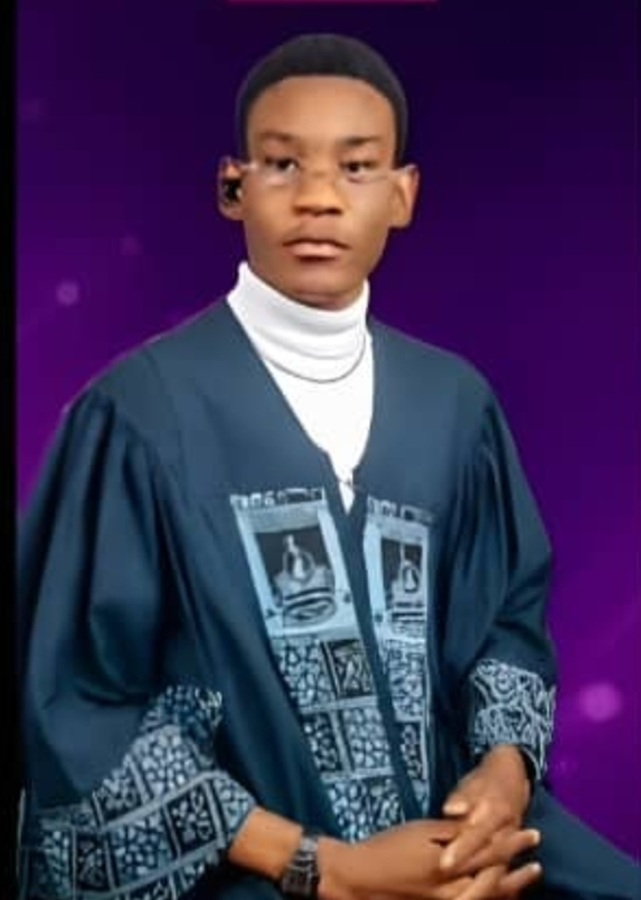
Ayomide’s mother said the family decided to relaunch an appeal for a kidney transplant after he completed his university education. “Now that he’s done, we felt there won’t be any hitch to his career and he will have all his time for recuperation.
Having struggled to complete his four-year course, Ayomide could not attend his convocation due to his health condition. “Since he could not go to school to celebrate on that day, he went to the hospital to rejoice with his mummies and aunties in the dialysis centre,” his mother said.
According to her, Ayomide was not seriously ill that period, but could not withstand the stress and crowd at the convocation ceremony.
Despite the challenges, Ayomide has continued to pursue his professional ambitions. His mother also said he wants to register for the National Youth Service Corps (NYSC).
“He was first posted to Imo State, but we declined. So, we want to remobilise him, so that he can stay in Lagos,” she said.
‘I was still able to push through’
For Ayomide, completing university despite years of dialysis and repeated health crises is an achievement he is proud of. “I feel happy that I was able to push through,” he said.
“Even if I’m going through a lot, I was still able to push through, pass my exams because I’m a person that is determined and knows what I’m going for.
“I didn’t come out with a third class or a 2-2. I came out with 2-1 (a second-class honours). I’m very happy that despite all odds, I was able to achieve something good,” he said.
Ayomide recalled several health crises that disrupted his education and nearly derailed his studies. He said one of his earliest major crises occurred after his body reacted to a drug, causing his blood pressure (BP) to rise severely.
“My body reacted to a drug and affected my BP, making it high to the extent that I convulsed in the emergency,” he narrated.
Another major crisis occurred during his final year at the university when he was admitted for pericardial effusion. He underwent surgery but had to return to school quickly to write his final examinations.
“I had to rush back to school to write my finals but as I was writing my exam, things got worse,” he said.
He was admitted at his mother’s hospital, where he also underwent dialysis, while trying to complete his examinations.
“When I was writing the last paper, I was rushed back to the hospital for admission because I was not feeling comfortable,” he said.
He was subsequently taken by ambulance to Lagos State University Teaching Hospital (LASUTH) for emergency surgery.
During the prolonged hospitalisation, he missed important moments with his classmates. “It was quite painful because the day my friends defended their projects, I was actually in the theatre battling for life. I only saw their pictures later .”
Despite the setbacks, Ayomide said he returned to complete and defend his project and eventually graduated.
‘I have a lot to render to society’
Ayomide’s biggest hope now is to receive the transplant and regain the freedom to pursue his career without his health constantly holding him back.
“I just hope that I get this transplant done and forget about anything else because I actually want to work,” he said.
“I don’t want to have something hindering me from doing some things because I had to forfeit some things in school, some classes, which really affected me academically,” he lamented, saying he wants to give his best to his career and contribute to society.
“I have a lot to give to society. I’m very intelligent, talented, and I’m just wonderful. So, let me put it that way. So, I have a lot that people need to know about.”
A future in accounting and medicine
Ayomide plans to pursue a career in accounting, with the possibility of becoming an auditor.
“I want to pursue my accounting career, I just want to move in that direction, and I hope to become an auditor,” he said.
But his experience with kidney disease has also inspired another ambition as he hopes that, later in life, he could pursue a second degree in medicine. “I want to take care of people and help them get better, tell them my experience, how I got better, and just help people generally,” he said.
A mother’s appeal
The priority now, according to Mrs Aboaba, is to raise ₦42 million and get her son the transplant as soon as possible.
“If the money completes today, we are ready,” she said, appealing to Nigerians to support her family to raise the money and save her son’s life.
Every contribution, according to her could give the young graduate an opportunity to live and pursue the career he has fought so hard to build.

