



By Juliet Buna
The Oyo State Government has announced plans to relocate scrap metal dealers operating at the Agodi spare parts market and construct a perimeter fence around HLA Grammar School, Ibadan, following DevReporting’s investigation that exposed health and safety risks to students and residents.
The decisions were taken at a high-level stakeholders’ meeting convened by the Oyo State Ministry of Environment and Natural Resources, bringing together school authorities, Agodi market leaders, the Amotekun Corps, officials from the ministries of environment and education, and community representatives.
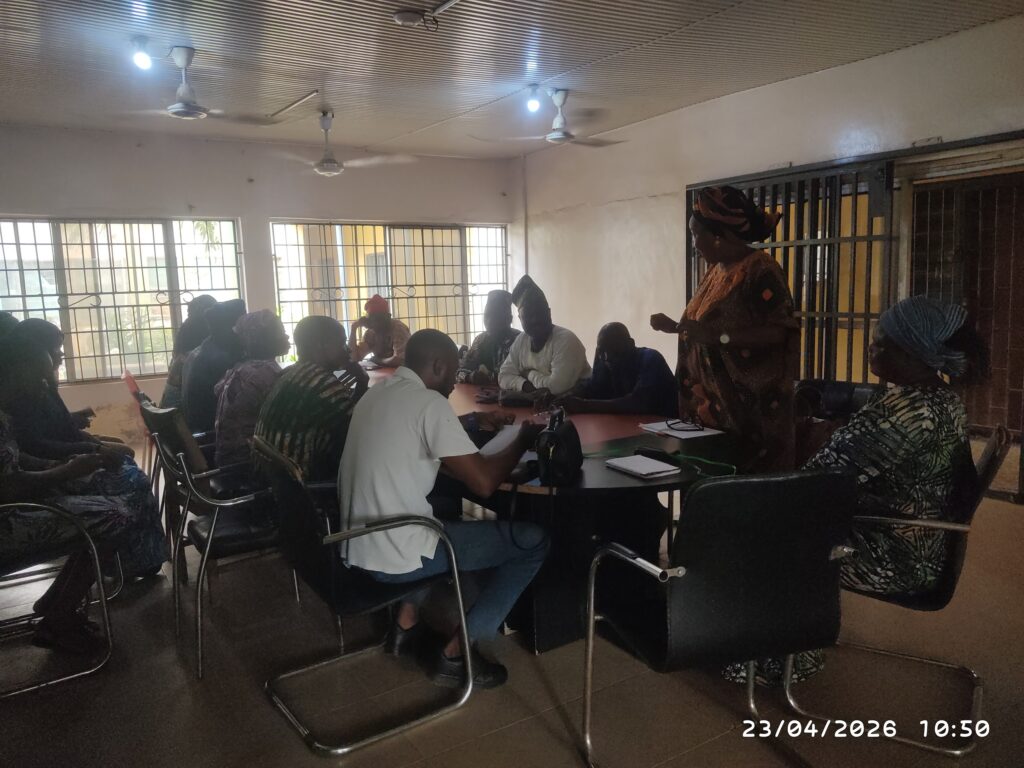
Speaking at the meeting, the Director of Pollution Monitoring, Evelyn Adesina, who represented the commissioner, said the intervention became necessary following concerns over persistent air pollution and security threats linked to the activities of scrap dealers, locally referred to as ‘omonile’, who burn scrap materials within the market during school hours.
Measures announced
Stakeholders agreed on several measures, including the deployment of Amotekun operatives at strategic points within the market to curb illegal burning, the relocation of scrap metal dealers away from the school environment, and the construction of a perimeter fence around HLA Grammar School to restrict unauthorised access and protect students.
Stakeholders react
The Vice Principal, HLA Grammar School, Olaleye Ayinde, welcomed the outcome, saying it would improve safety within the school.
“The relocation of scrap dealers, the fencing of the school, and monitoring by Amotekun will greatly help both the school and the community,” she said.
Similarly, the Chairman of the Landlord/Tenants’ Association, Ajakiru Adegbayi, Onipasan Kamal, described the intervention as long overdue.
“We have complained for a long time, but enforcement was difficult. This meeting is timely. The investigation has come to the rescue of the community,” he said.
Other residents in attendance said the pollution remains a daily health challenge that must be attended to urgently.
“Whenever they burn metals, I cough for up to seven days. My voice becomes unclear. I am even considering relocating,” said 74-year-old Morakinyo Akinropo.
Another resident, Lukman Adigun, said the smoke rises daily from morning until late evening, affecting breathing and quality of life.
Regulatory action
Following the report, the National Environmental Standards and Regulations Enforcement Agency (NESREA), Oyo State, conducted an on-site inspection and forwarded its findings to its national headquarters for further action.
Investigation that triggered action
For nearly three months, this reporter traced students’ daily routes, walking through smoke-filled paths between the market and the school, documenting how the open burning of wires and metals exposed children and teachers to hazardous air.
Findings revealed that students and residents were routinely inhaling thick fumes from burning copper wires, resulting in persistent coughing, breathing difficulties, and repeated disruptions to academic activities. In several instances, classes were halted as smoke drifted directly into classrooms.
Laboratory analysis of residue from burn sites showed dangerously high levels of heavy metals: lead at 2,105 mg/kg, about 25 times the World Health Organisation’s recommended limit of 85 mg/kg; chromium at 116.50 mg/kg (above 100 mg/kg); nickel at 50.55 mg/kg (exceeding 35 mg/kg); cobalt at 9.05 mg/kg (far above 0.005 mg/kg); and cadmium at 0.65 mg/kg.
Health experts warned that exposure to these toxins could severely damage the brain, lungs, and kidneys, particularly in children, with pulmonologists cautioning that prolonged inhalation may cause irreversible harm.
Beyond environmental risks, the investigation also exposed security concerns within the school. Some scrap metal dealers reportedly gain access through the school’s wooden fence, where they vandalise property and steal items. School authorities further revealed that the situation is affecting students’ behaviour, with some pupils losing focus in class and gravitating towards scrap trading instead of their studies.
The report also highlighted weak and inconsistent enforcement, allowing scrap dealers, often operating at odd hours, to evade arrest.
Stakeholders raise concerns about implementation
While stakeholders have welcomed the resolutions, concerns remain about implementation. Previous attempts to halt illegal burning have failed, as offenders often evade authorities. Residents say sustained monitoring and accountability will be crucial.
The meeting also raised concerns about untreated sewage allegedly flowing from the nearby Agodi Correctional Centre into the surrounding environment.
For now, the investigation has triggered official action and concrete commitments. However, for students and residents who continue to breathe polluted air daily, the true measure of success will not be in resolutions, but in cleaner, safer air.

