



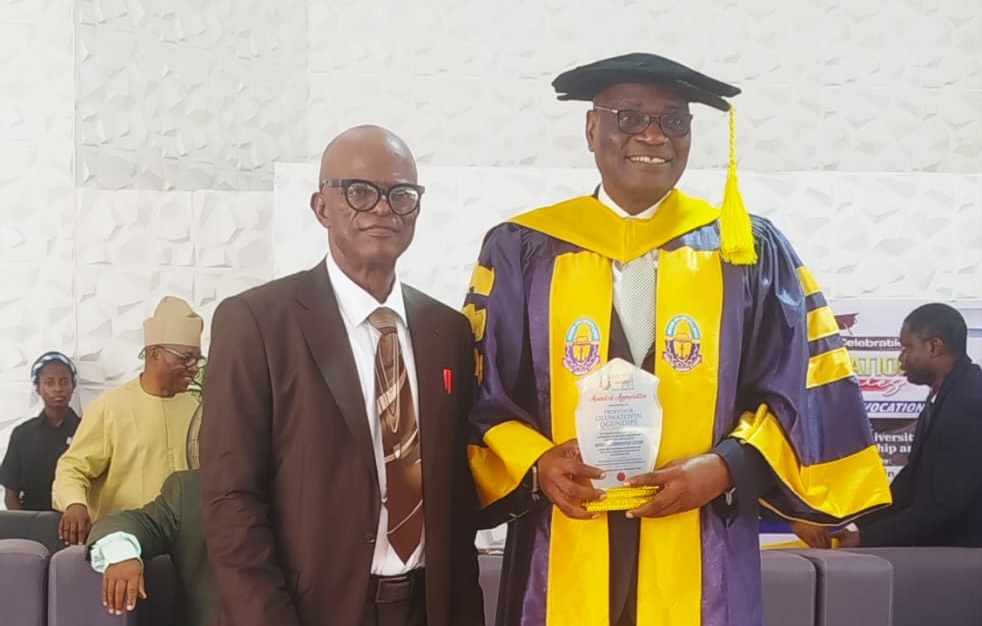
African universities must strengthen research, promote innovation and produce ethical leaders capable of addressing the continent’s development challenges, Chairman of the Governing Board of the National Universities Commission (NUC), Oluwatoyin Ogundipe, a professor of botany, has said.
He said higher education institutions must move beyond conventional knowledge transmission to become centres of innovation, enterprise and technological advancement, capable of translating research into practical solutions for societal problems.
Mr Ogundipe, who is the former Vice Chancellor of the University of Lagos made the call while delivering the 2026 convocation lecture of Anchor University, Ayobo, Lagos, on 20 November.
Speaking on the theme, “University Education, Transformational Leadership and the Future of Africa,” he argued that the continent’s prosperity would depend more on the quality of its human capital, knowledge production and leadership than its abundance of natural resources.
He said Africa continued to grapple with poverty, unemployment, weak institutions and infrastructure deficits despite its considerable mineral and agricultural resources.
According to him, the continent’s development challenges are rooted largely in institutional weaknesses and leadership failures, stressing that universities have a responsibility to prepare people capable of building effective institutions and driving sustainable development.
“Africa’s future will be decided less by what lies beneath its soil than by what is cultivated in its minds,” he said.
Universities must connect research with development needs
Mr Ogundipe said universities must reposition themselves as research-intensive and entrepreneurial institutions that respond to local challenges while maintaining global standards.
He identified energy, healthcare, agriculture, climate resilience and digital technology as critical sectors where African universities should direct their research and intellectual resources. He also called for stronger partnerships among universities, government and industries, noting that collaboration was necessary to transform research findings into products, businesses and employment opportunities.
According to him, graduates equipped only with knowledge acquired in lecture halls could struggle to remain relevant in an economy increasingly shaped by artificial intelligence, biotechnology, robotics and other emerging technologies.
He urged universities to integrate digital literacy, data science and artificial intelligence across academic disciplines while promoting internships, innovation hubs and industry-driven curricula.
Transformational leadership key to Africa’s future
Mr Ogundipe further emphasised the importance of ethical and transformational leadership in strengthening institutions and addressing Africa’s governance challenges. He said universities must deliberately cultivate moral reasoning, civic responsibility, critical thinking, public-service values and emotional intelligence among students.
According to him, academic competence without integrity could produce individuals who use their knowledge for personal gain rather than the common good.
Addressing the graduating students, he urged them to combine godly character, professional competence and courage in their personal and professional lives.
He challenged them to become problem-solvers rather than merely join the growing number of job seekers, encouraging them to identify challenges within their communities and develop solutions.
“The certificate in your hand is a beginning, not a guarantee,” he said, urging the graduates to embrace lifelong learning and acquire skills that would remain relevant in a rapidly changing world.
He also encouraged them to contribute to national development, create employment, mentor younger people and strengthen the institutions they would work in.
Ogundipe outlines priorities for Anchor University
As Anchor University marked its 10th anniversary, the professor urged the institution to position itself as a regional centre of excellence in teaching, research, innovation and leadership development.
He identified six priorities for its next decade including: research excellence, digital transformation, industry partnerships, academic collaboration, leadership and character formation, and community impact.
He said the university should ensure that its presence delivers tangible benefits to Ayobo, Lagos State and Nigeria.
Mr Ogundipe maintained that the future of Africa depended on universities that could generate knowledge, stimulate innovation, uphold values and develop leaders capable of transforming society.