

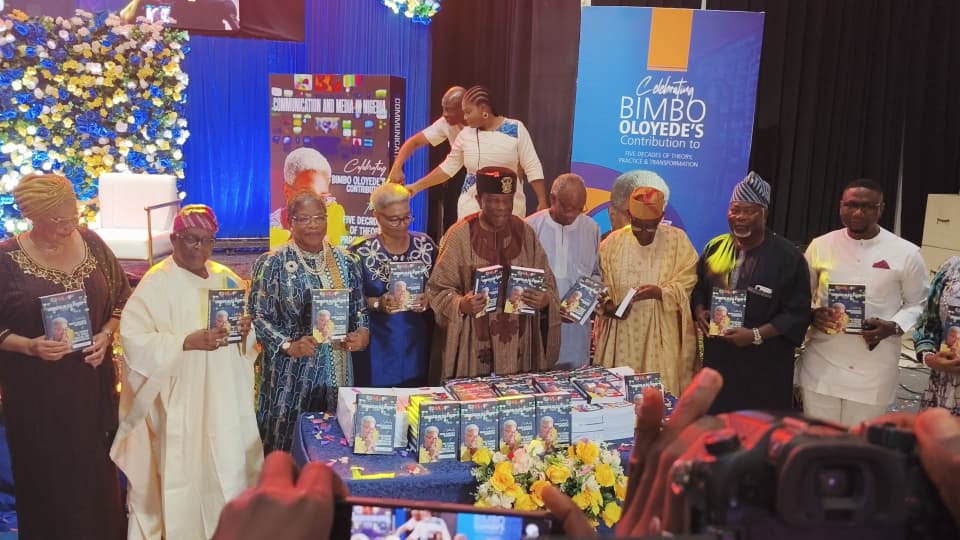
After five decades of shaping Nigeria’s media landscape, veteran broadcaster, Bimbo Oloyede has been celebrated by colleagues, scholars and public figures with a 60-author festschrift that honours her remarkable journey while passing her wealth of experience on to a new generation of media professionals.
The Coliseum, Lekki, in Lagos on Tuesday, came alive as media veterans, younger practitioners, scholars, public officials, private-sector executives and creative industry leaders converged for the public presentation of ‘Communication and Media in Nigeria’, a festschrift honouring veteran Nigerian broadcaster Bimbo Oloyede’s 50 years of active media practice.
The event celebrated the 72-year-old for her contributions to media theory, professional practice and transformation in Nigeria. The book, which contains contributions from 60 authors, explores different areas of communication and media, documenting Mrs Oloyede’s five-decade journey in broadcasting, communication and media training, and tracing the transformation of Nigeria’s media industry from the analog era to today’s digital landscape.
Former Managing Director of Daily Times of Nigeria, Yemi Ogunbiyi, chaired the event, while Arise News anchor, Reuben Abati, reviewed the book, describing it as a valuable resource for students of mass communication, advertising, digital media and public relations and for connecting academic knowledge with the realities of media practice.
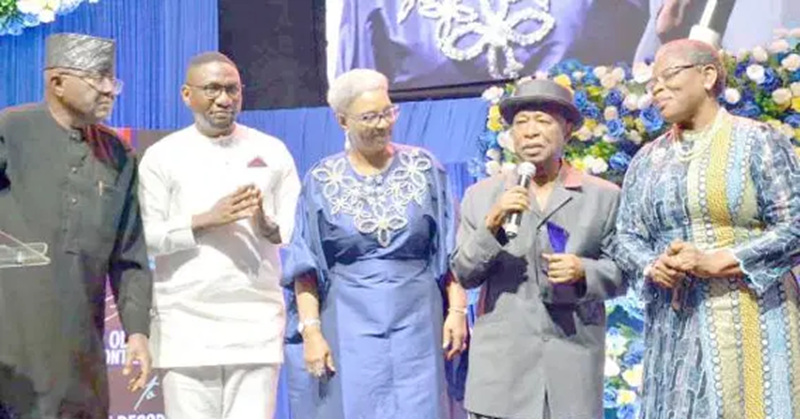
The book was unveiled by an endocrinologist and co-founder of Eko Hospital, Sonny Kuku, amid a burst of confetti, sustained applause and a standing ovation from guests and well-wishers.
Among the guests were the Lagos State Governor Babajide Sanwo-Olu who was represented by his Special Adviser, PR, Documentation and Repository, Segun Fafore; veteran journalist and founder of Vanguard Newspapers, Sam Amuka-Pemu; former Minister of Education, Obi Ezekwesili; pioneer Director-General of the Nigerian Television Authority (NTA), Vincent Maduka; former Deputy Vice Chancellor of the University of Lagos, Duro Oni, a professor; Secretary-General of the Committee of Vice Chancellors, Andrew Haruna, a professor; current VC of UNILAG, Folasade Ogunsola, a professor; veteran broadcaster Soni Irabor; Director-General of the Federal Radio Corporation of Nigeria (FRCN), Ahmed Bulama; veteran broadcaster, Cyril Stober, among numerous others.
Others included Mrs Adenike Giwa, who represented former Lagos State Governor Babatunde Fashola; filmmaker Tunde Kelani; actress Joke Silva; actor Yemi Sodimu, entertainer Charly Boy; former Lagos State Deputy Governor, Sinatu Ojikutu-Kuti; Chairman and Editor-in-Chief of ThisDay/Arise Media Group, Nduka Obaigbena; founding Executive Director of the International Centre for Investigative Reporting, (ICIR), Dayo Aiyetan; Executive Director of the Wole Soyinka Centre for Investigative Journalism (WSCIJ), Motunrayo Alaka and Team Lead/Editor-in-Chief of DevReporting, Mojeed Alabi among others.
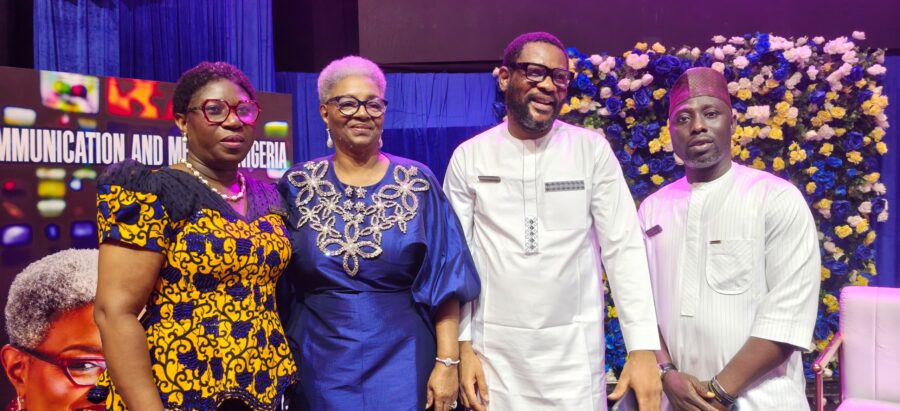
At the event, Mr Amuka was honoured with the ‘Media Icon’ award in recognition of his contribution to journalism.
Mr Obaigbena, who delivered a goodwill message, also reflected on his own journey in the media industry, announcing that he would mark 50 years in the profession on 11 November. He said he began his career as a cartoonist and writer with The Nigerian Observer.
“Looking back at the Nigeria we saw and looking forward to the Nigeria we wish for, it’s a good thing,” he said.
How Irabor’s milestone sparked Oloyede’s legacy project
Speaking during a fireside chat, Mrs Oloyede said the journey towards the book was inspired by a chain of conversations at Soni Irabor’s 50th anniversary celebration in September 2024.
“I think I should first of all say that it all began with Mr Irabor, even though he doesn’t know that it began with him.”
She said Mr Irabor had invited colleagues to a wellness retreat to mark his milestone, and that at the retreat, veteran broadcaster, Bisi Olatilo, a chief, spoke about how he intended to mark his own 50 years in the industry.
“Somewhere along the line, Bisi Olatilo said, ‘I’m not going to run this retreat. That’s not the way I’m going to do mine,” Mrs Oloyede recalled. “He said he was going to have a bash to celebrate his 50th anniversary.”
“So I started thinking that in September 2025, I would also be clocking 50 years. What would I do?” she said.
After speaking with the Executive Director of WSCIJ, Mrs Famuyiwa-Alaka, and some other individuals, Mrs Oloyede decided to mark the milestone with a book that would draw on the experiences and knowledge of other media professionals and scholars.
“Then I thought: let me invite others to write,” she said. “There are so many of them who have stories to tell, who have experiences, who have knowledge, who may never write. But perhaps with this kind of situation, they can share their notes.
“I was surprised by the number of people who said yes. That was why we could not complete the project last year. There were so many contributions, and it took us a long time to review them and send them back and forth.
“Since then, it has truly been a journey of learning. There were many things I read from my colleagues that I had never heard before. I thought that if they were new to me, they would certainly be new to students of this generation. So, yes, it has been an interesting journey,” Mrs Oloyede said.
During the book presentation, Mrs Oloyede announced plans to donate copies of the publication to 200 federal, state and private universities, polytechnics and private academies offering communication and media-related courses.
She said the initiative was part of her contributions to the development of media education in Nigeria. The books, she explained, would be distributed through sponsored campus tours and direct donations to institutional libraries.
Beyond students, Mrs Oloyede said media practitioners, researchers and scholars would also benefit from the publication as a reference material and historical resource.
Why the media, civil society must work together
Speaking on the importance of collaboration between civil society and the media, former Minister of Education, Obi Ezekwesili, said every Nigerian has a duty to be civically engaged and demand a society that works.
Mrs Ezekwesili, who described herself as a citizen active in civil society rather than a career civil-society practitioner, said accountability could not be delivered by one institution alone. Rather, she said, it depends on a chain of actors, with the media and civil society carrying a particularly heavy responsibility.
“Civil society generates awareness, legitimacy and organised confidence,” she said. “The media generates the reach, the steadiness and the pressure of public attention.”
She warned that neither institution could effectively perform its role without the other. “Evidence without amplification dies quietly inside reports that no one reads,” she said. “Amplification without evidence becomes noise, and those in power have become extraordinarily skilled at waiting out noise.”
She urged journalists to protect the credibility of their profession and to remain committed to evidence, public interest and accountability. Nigeria’s governance failures, she said, would not change until citizens and the media collectively decided that they had had enough.
“Do not allow your profession to be reproached by a bunch of economic gangsters masquerading as political leaders,” she said.