


Journalists in Nigeria say poor access to reliable data, inadequate newsroom funding and weak collaboration among key stakeholders are making it harder to effectively investigate school safety and hold authorities accountable.
They said reporting on school safety should go beyond documenting attacks after they occur to examining whether schools have been mapped, security commitments implemented and communities consulted about risks facing children.
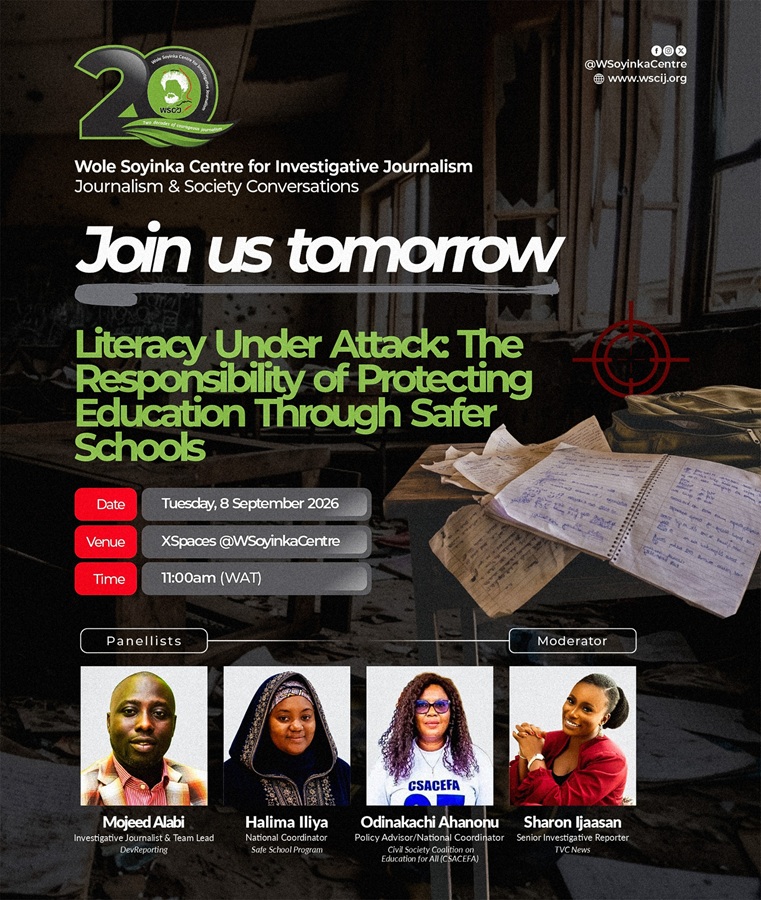
The concerns were raised on Tuesday at the September edition of the Journalism & Society Conversations organised by the Wole Soyinka Centre for Investigative Journalism (WSCIJ).
Themed “Literacy Under Attack: The Responsibility of Protecting Education Through Safer Schools,” the dialogue brought together journalists, government officials and civil society actors to examine Nigeria’s continuing school safety challenges and the role of the media in pushing for reforms.
The conversation, moderated by Sharon Ijasan, a senior investigative reporter with TVC News, was built on a 2021 investigation by Juliana Francis, which documented the trauma experienced by survivors of mass school abductions and the reluctance of some students to return to school without visible security measures.
Data gaps hamper accountability
Speaking during the discussion, the DevReporting Team Lead, Mojeed Alabi, said access to reliable information was fundamental to effective journalism and development.
Mr Alabi warned that when authorities make themselves inaccessible to journalists, the resulting information vacuum creates room for misinformation, disinformation and fake news.
“We are ready as journalists to get accurate information,” he said, adding that journalists do not always approach government institutions to expose wrongdoing.
“Sometimes we just want to help. Journalists want to point your attention to where actions are needed.”
He described journalists as being positioned between policymakers and the people affected by government policies, making access to accurate information critical to ensuring that policies are properly understood and assessed.
Mr Alabi, however, noted that the challenge extends beyond access. He said Nigeria also suffers from inadequate data on basic indicators such as the number of schools, teachers and students, making it difficult to properly plan interventions or hold authorities accountable.
“You can’t go for accountability when you don’t even know what the budget talks about,” he said.
He urged journalists to investigate school safety from the perspectives of data, infrastructure, budgets and government commitments, rather than focusing only on attacks after they occur.
He also called on journalists to move beyond publishing reports to sustained advocacy and monitoring of government responses.
“Without creating a reform coalition, there is nothing, absolutely nothing we are going to get from all these conversations,” Mr Alabi said.
Funding constraints threaten education reporting
The Africa Editor at the Centre for Collaborative Investigative Journalism (CCIJ), Ajibola Amzat, identified inadequate funding within newsrooms as another major obstacle to sustained education reporting.
Mr Amzat questioned how many Nigerian newsrooms have dedicated education desks with sufficient funding to undertake investigations into issues affecting schools.
“Hardly can you find any newsroom with a budget to report on education, let alone doing some kind of investigations on education and the issues of education and safe schools in Nigeria,” he said.
He also identified access to information as a major challenge for investigative journalists.
According to him, journalists frequently encounter government officials who decline to provide information, sometimes citing the Official Secrets Act or directing reporters to other agencies.
Mr Amzat said removing such barriers was necessary if journalism was to produce the kind of evidence capable of driving policy reform.
Government promises greater access, partnership
Responding to the concerns, the National Coordinator of the Safe Schools Programme, Halima Iliya, said government agencies had information that could be made available to journalists.
Mrs Iliya said the Safe Schools Programme had a secretariat containing relevant documents and argued that much of the information was public.
“The government is by the people and for the people,” she said. “There is no reason why we should hide certain information from you.”
She called for a strategic meeting involving government, journalists and civil society organisations to identify gaps and develop areas of collaboration.
According to Mrs Iliya, the Federal Government provided N15 billion for the implementation of the Safe Schools Programme in 2025, while N5 billion was provided for the programme in the 2026 budget.
She said the intervention had established Safe Schools coordinators across the 36 states and the Federal Capital Territory, as well as designated officers across the 774 local government areas.
The programme, she said, had also engaged communities, trained children and strengthened the capacity of security agencies to detect, deter and respond to threats. “Communities are encouraged to take ownership of security architecture. It takes a village to protect our schools. It is our collective responsibility.”
Mrs Iliya said funding and infrastructure remained major gaps, but added that the government was working to address them through partnerships with states, communities, private sector organisations and development partners.
Communities must become school safety partners
The Policy Adviser and National Coordinator of the Civil Society Coalition on Education For All (CSACEFA), Odinakachi Ahanonu, said communities should no longer be treated merely as beneficiaries of government interventions.
“We need to start moving away from seeing the community as a beneficiary and start seeing them as partners in school safety,” she said.
Mrs Ahanonu said people living around schools often understood local risks better than officials based outside the communities.
“They know the routes children take to school, areas where threats may occur and circumstances that could make schools vulnerable,” she said.
She therefore called for stronger collaboration between government and communities, with states required to ask practical questions about risks around schools and the preparedness of communities to respond to emergencies.
The Safe Schools coordinator also disclosed that the government had engaged communities across the six geopolitical zones, including training on child protection, early warning signs, emergency preparedness, bullying and security awareness.
Earlier, Mrs Iliya said more than 4,000 students had received training through the programme, while more than 9,000 community participants were trained in the previous month as part of efforts to strengthen community resilience.
She said the government was also developing a transition plan to provide a longer-term framework for financing and implementing school safety interventions.
Towards a reform coalition
The speakers agreed that protecting schools requires more than security personnel or physical infrastructure.
Mr Alabi said journalists, government, parents, teachers, school owners, communities and civil society organisations must work together to ensure that commitments translate into measurable improvements.
He said journalism should combine investigation with advocacy and follow-up to determine whether government promises are implemented.
Mr Alabi, who is also chairman of the Education Writers’ Association of Nigeria (EWAN), disclosed plans by the association to convene stakeholders in Lagos on 14 October for another conversation focused on school safety and education rights.
He said the meeting would provide another opportunity for journalists, government officials and civil society organisations to move from conversation to action.