




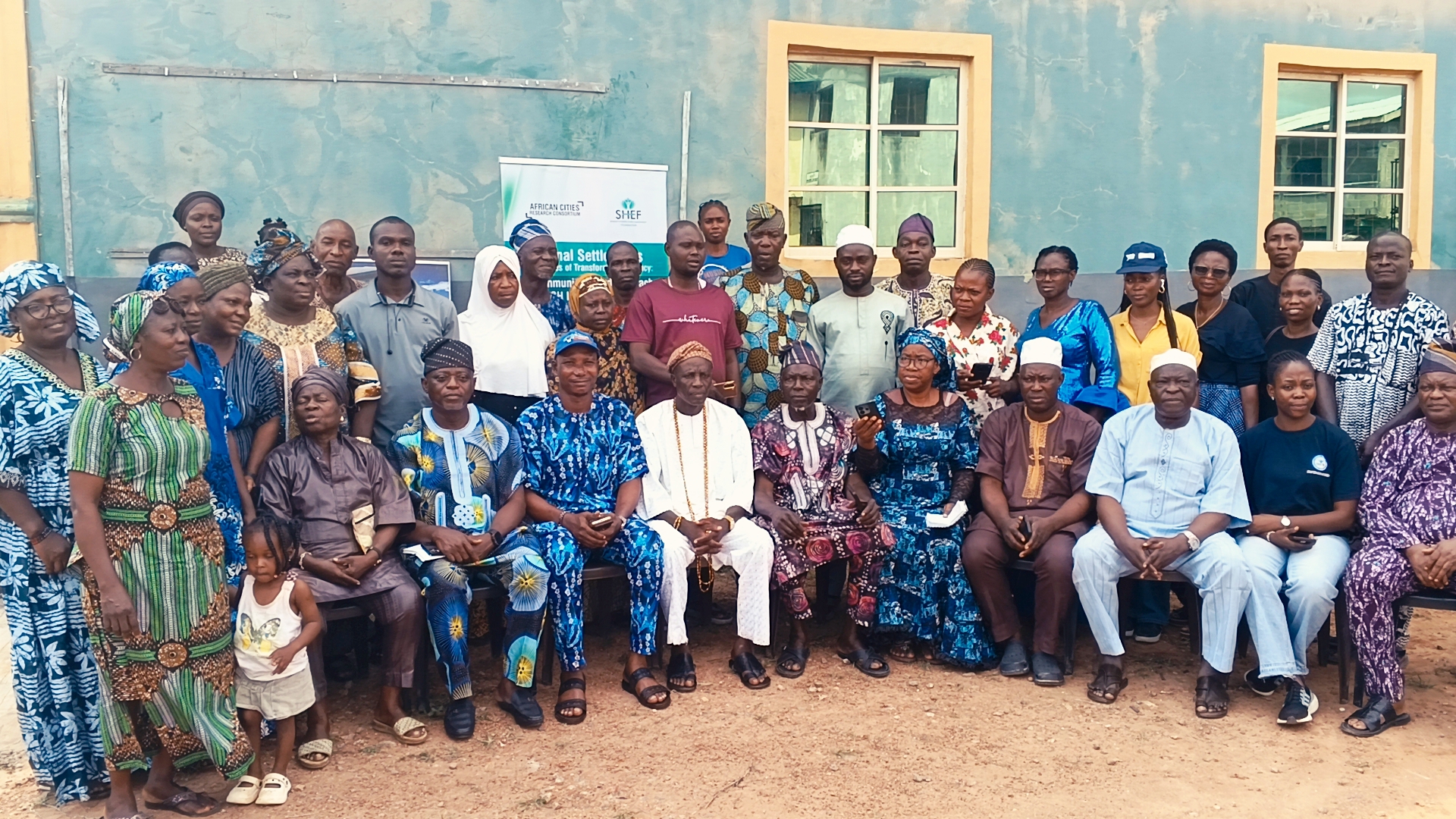
Residents of Okerube, an informal settlement in Alimosho Local Government Area of Lagos State, are working with the Shantytown Empowerment Foundation (SHEF) and the African Cities Research Consortium (ACRC) to develop community-led solutions to water, sanitation and hygiene (WASH) challenges affecting their living conditions.
A stakeholders’ engagement held on Saturday, 14 November, brought together community leaders, residents, development stakeholders and project representatives to review progress, assess pressing needs and discuss interventions ahead of the project’s implementation.
Titled ‘Informal Settlements as Spaces of Transformative Agency: A Community-Based Approach to WASH Infrastructure in Okerube, Lagos, Nigeria’, the initiative adopts a participatory approach that places residents at the centre of identifying development challenges and shaping solutions that respond to their needs.
Rather than imposing external interventions, the project seeks to build on existing community structures, strengthen local capacity and promote shared responsibility for the management and sustainability of facilities.
Community participation as a foundation for development

Speaking at the gathering, the co-lead of the WASH action research project, ACRC, and lecturer at the University of Lagos, Muraina Oluwaseun, expressed appreciation to the community for its support and commitment, particularly the joint Community Development Associations (CDAs), CDA chairpersons, youth groups, the Women Water Community and traditional leadership.
She explained that Okerube was selected partly because of the solidarity and existing community structures that could support collective action and development.
According to her, the project’s engagement with the community had revealed that its needs extended beyond access to water, making a broader assessment necessary to understand the different challenges confronting residents.
She noted that the ACRC-supported engagement had involved examining the community’s needs and identifying areas requiring intervention.
“Development works better when people work within interest groups in a community,” she said, emphasising the importance of bringing together groups with shared interests and development priorities.
Ms Oluwaseun disclosed that land had been secured for the project’s planned interventions, adding that implementation would commence on the site soon.
“We have gotten land and we have paid. The government has also assured us that there would not be future problems on the ownership of the land, so the land belongs to the community and implementation is starting soon,” she said.
She added that implementation would commence between the end of November and December, when enumerators and other necessary project personnel would arrive in the community.
She further explained that the project would address some of the existing water infrastructure challenges, including the replacement of non-functional boreholes in areas such as Pako and Agbole.
Beyond infrastructure provision, she said the project was also focused on building the technical capacity of community groups to ensure that the facilities provided would remain functional.
She disclosed that members of the Women Water Community were undergoing training in plumbing and basic technical maintenance to enable them to respond to equipment faults. The training also covered water hygiene, purification and pump operation.
“This is not an individual effort, and development can only be achieved through collaboration,” she said.
Situational analysis to guide interventions
Also speaking, Kazeem Abiodun, a lead planner working with SHEF on the project, presented an overview of the situational analysis approach, explaining that understanding a community’s challenges and needs before embarking on interventions was essential to achieving meaningful development outcomes.
Mr Abiodun said the assessment would require the cooperation of residents across different households, community leaders and other stakeholders to provide relevant information about conditions in Okerube.
“We would need the support of the community from different households, stakeholders and community leaders to provide information about these community challenges,” he said.
He explained that the process would involve mapping the community to identify the locations of essential services and infrastructure, including schools, healthcare centres and other public facilities.
He added that the findings would subsequently be presented to residents for deliberation and validation to ensure that the assessment reflected their experiences and priorities.
The validated findings would then be documented to guide the project’s interventions.
Mr Abiodun also noted that training would be provided to strengthen the capacity of community members to identify development gaps and contribute meaningfully to the assessment.
Community leaders seek wider development support
In his goodwill message, Olasunkanmi Awolowo, the Public Relations Officer of the Community Development Committee (CDC), Igando/Ikotun LCDA, commended the community’s efforts and the collaboration among the different CDAs and local development structures in addressing their challenges.
He expressed appreciation to the convener of the gathering, Funmi Daniel, and used the Yoruba expression, “Agbajo owo la fi nso ya”, to underscore the importance of collective effort in achieving development.
Delivering a goodwill message, the councillor representing Ward B, Abaranje/Okerube, Igando-Ikotun LCDA, Olawale Hassan, said, “We are already having a round table to collaborate and assure the community of safety of the infrastructure, safety of all facilities and amenities provided.
“As we speak now we have ensured that the land is secured and we as government have given our word and we are committed to maintaining the project through safety for the longevity and durability.”
Residents highlight healthcare, drainage challenges
During the question-and-answer session, residents raised concerns about healthcare access and persistent flooding, highlighting the need for development interventions beyond water infrastructure.
The chairman of Ifesowapo CDA, Azeez Idowu, sought support for residents facing health challenges, particularly through access to drugs and improved healthcare services.
Elder Alfred of Ile Eja CDA also called for a proper sewage and drainage system to address the community’s flooding challenges.
Responding to the concerns, Mr Hassan said the government had provided and equipped a primary healthcare centre for the community, encouraging residents to make use of the facility.
Similarly, the chairman of Oremeji Street Ifesowapo CDA, Ghazal Lukman, appreciated SHEF’s support, particularly the borehole intervention and the promised transformer intervention to address electricity supply challenges in the community.
He urged residents to cooperate with the project team by providing the necessary information and taking responsibility for protecting and maintaining the facilities provided to ensure their sustainability

