


Kenya’s stock exchange is pushing to bring African investors into Dangote Refinery’s record initial public offering (IPO), while discussions over a possible Nairobi cross-listing put the sale at the centre of a wider effort to connect Africa’s capital markets. The bigger test is whether African savings can help finance the next generation of industrial companies at scale. Bonface Orucho, bird story agency Dangote’s US$1.6 billion (₦2.15 trillion) refinery IPO is turning one of Africa’s biggest industrial projects into a publicly investable asset, drawing retail and institutional investors into its ownership. The early scramble for access, including efforts to bring investors…
Author: Development Reporting
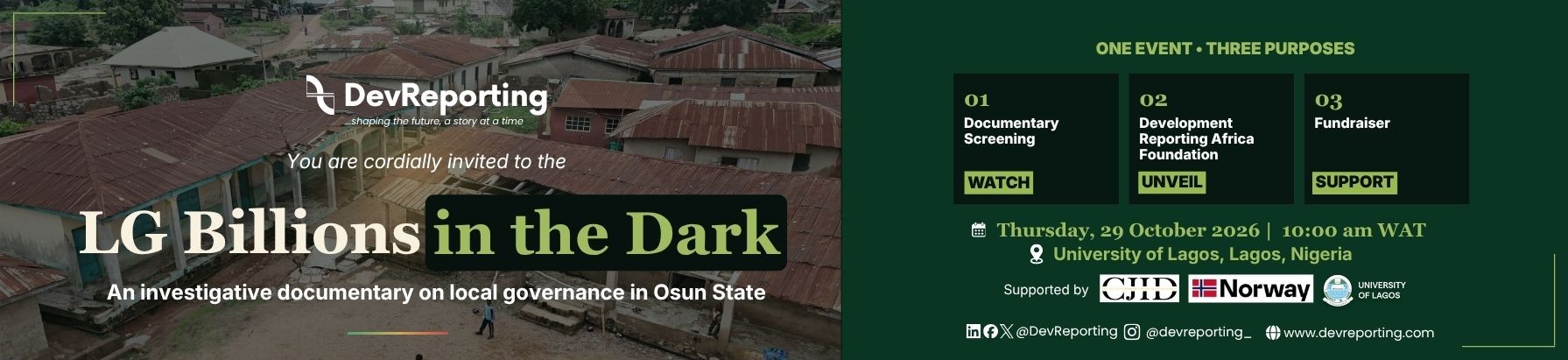
The management of DevReporting, a cinematic media platform committed to rigorous, data-driven reporting on development issues across Nigeria and Africa, on Monday paid a courtesy visit to the management of the University of Lagos (UNILAG) to flag off awareness for its forthcoming 3-in-1 event scheduled for Thursday, 29 October. In a statement issued by DevReporting, the delegation, led by its Managing Editor, Christiana Alabi-Akande, briefed the university management that the event will feature three key activities, including: the screening of ‘LG Billions in the Dark’, an investigative documentary; the unveiling of the Development Reporting Africa Foundation (DRAF), the non-profit arm…
By Malik Samuel Nigeria’s worsening security crisis is forcing federal and state authorities to experiment with solutions that would once have appeared unlikely. One of the most striking is the recruitment and deployment of former Boko Haram members from the Northeast to support efforts against bandits and jihadist groups in Northwest and Northcentral Nigeria. Interviews with former Boko Haram members involved in these deployments reveal that some have been deployed to Niger and Zamfara states, while others have been sent to Kaduna, Kebbi, Sokoto, Katsina, and the Federal Capital Territory. According to those interviewed, the State Security Services (SSS), Nigeria’s…
The central question raised by the Dangote Refinery IPO is not whether the company is worth ₦65 trillion. It is whether Nigeria’s institutions are prepared for the risks created when one private enterprise becomes an energy-security asset, investment destination, capital-market heavyweight and instrument of industrial policy. Dangote Petroleum Refinery and Petrochemicals is offering 4.1 billion shares at ₦525 each, seeking ₦2.15 trillion and implying a post-offer market capitalisation of about ₦65.2 trillion. Reuters reports that it earned $1.82 billion in the first half of 2026 on revenue exceeding $13 billion, after a loss in 2025. Investors must decide how much…
The industrial dispute over the proposed concession of King’s College, Lagos to its old boys’ association has taken a new turn, with the Association of Senior Civil Servants of Nigeria (ASCSN) and the Joint Workers Committee of Unions (JWC) directing workers to suspend their strike and resume duties, while a faction of ASCSN has ordered the continued shutdown of federal unity colleges nationwide. The conflicting directives followed a conciliatory meeting between the Federal Ministry of Education and organised labour, during which the proposed concession to the King’s College Old Boys Association (KCOBA) was placed on hold for two weeks to…
Amid the controversy over the concession of King’s College, Lagos, and the disruption of academic activities in several Federal Unity Colleges, the school’s old boys have rolled out the drums for Kingsweek 2026. While KCOBA celebrates the school’s heritage and future, parents, unions and education advocates continue to demand answers about the fate of one of Nigeria’s most prominent public schools. The King’s College Old Boys’ Association (KCOBA) on Monday unveiled plans for Kingsweek 2026, the annual celebration of the Lagos school, as controversy over its concession to the association continues to unsettle parents, unions and the wider federal unity-school…
The West African Examinations Council (WAEC), Nigeria, says only 69 out of 2,267 candidates whose 2026 West African Senior School Certificate Examination (WASSCE) results were reviewed had their grades adjusted. The figure represents 3.0 per cent of the candidates whose scripts were subjected to a comprehensive review following requests from some schools and the Minister of Education. WAEC said the review, which covered scripts from 47 schools, confirmed the credibility and reliability of the 2026 WASSCE results. The Council made the disclosure in a statement issued amid recent controversies surrounding the 2026 WASSCE results. According to a statement, the adjustments…
The years of smooth academic calendars hitherto enjoyed by the Lagos State Government-owned tertiary institutions may have just come to an end as lecturers across the state’s universities have declared an indefinite strike action. The Joint Campus Group of the Academic Staff Union of Universities (ASUU), comprising the Lagos State University (LASU), Lagos State University of Education (LASUED), and Lagos State University of Science and Technology (LASUSTECH), on Tuesday asked its members to down tools with “immediate effect”. A statement signed by the trio of the Coordinator of the Steering Committee of ASUU in LASU, Olusegun Babalola; Acting Chairman of…
Kenyan businesses and community groups are turning discarded cotton stalks, gin waste and textile offcuts into briquettes, household textiles and mattress filling. The emerging industry could create new income for farmers and women-led enterprises. By Gitonga Njeru, bird story agency For years, Peterson Mwadau regarded the stalks and other plant residue left after his cotton harvest as little more than a disposal problem. Mr Mwadau grows cotton on 18 acres in Kilifi County on Kenya’s coast. Once the crop has been picked, a considerable amount of plant material remains in his fields. Now, instead of burning or discarding all of…
The Federal Government has said that King’s College, Lagos, has not been sold or privatised, stressing that the institution remains a publicly owned national institution with legal title retained by the government. The Minister of Education, Tunji Alausa, gave the assurance while clarifying the Public-Private Partnership (PPP) concession between the Federal Government and the King’s College Old Boys’ Association (KCOBA). Under the concession agreement, KCOBA is responsible for financing, rehabilitating, modernising, operating and maintaining the 117-year-old institution, while the Federal Government retains ownership as well as its statutory regulatory, monitoring, inspection and enforcement powers. Mr Alausa also said the agreement does…