



By Sodiq Mojibola & Aminat Miskilu
Nigerian scholar and critic, Biodun Jeyifo, has called for the republication of a missing preamble from the 1979 Constitution, saying its removal marked a retreat from Nigeria’s original commitment to social democracy, equitable development and wealth redistribution.
Mr Jeyifo, an emeritus professor of English and African Literature at Cornell University and of African and African American Studies at Harvard University, made the call at a symposium hosted by the Wole Soyinka Centre for Investigative Journalism (WSCIJ) in Lagos to mark his 80th birthday.
The event, themed “Pedagogy, Curriculum and Decolonisation: Then and Now,” brought together academics and public intellectuals to reflect on education, power and national development.
He explained that the missing preamble argued for the simultaneous pursuit of economic growth and wealth redistribution.
According to him, the document made clear that a national project based only on growth without fairness would deepen poverty and inequality.
‘Nigeria was envisioned as a social democratic state’
Mr Jeyifo said the preamble, drawn from a minority report prepared during the constitution-drafting process, framed Nigeria as a social democratic state, and not an economy shaped by neoliberal policies.

“The idea was clear: Nigeria would develop and redistribute at the same time. Not development first and redistribution later,” he said.
He added that the preamble was removed not through legislation but through editorial decisions.
“They didn’t remove it legislatively; they removed it editorially, and that is why we are going to republish it.”
According to him, the document forms part of the fundamental objectives and directive principles of state policy and provides a framework linking growth with social protection and equity.
“By the logic of that preamble, Nigeria should be a social democratic state, not a full-blown capitalist one, and certainly not a neoliberal state,” he said.
Mr Jeyifo argued that abandoning this foundation had widened inequality and weakened public trust in governance.
Life expectancy, poverty as evidence of failed policy
Linking the constitutional debate to broader development failures, Mr Jeyifo cited stagnating life expectancy and rising poverty rates as evidence of policy failure.
He recalled that life expectancy at birth in Nigeria stood at 45 years in 1975, when he returned to the country after postgraduate studies in the United States.
“Twenty years later, it grew by only 10 per cent, to 54. It is 54 per cent now. Can you imagine what it means? All of my generation are gone. I am very lucky to make it to 80years. So there is a deep, deep anguish and sadness in my life because I was there. Many of my generation did not live long enough to enjoy the promises of independence.”
He described the statistics as deeply personal, noting that several of his siblings and contemporaries died before old age. “These are not abstract numbers. They represent lives lost, people I loved and still miss. I was the second of seven siblings, all male. There are only two of us left out of the seven.
“Three of them did not make it past 50years. They did not make it past their mid-60s. So again, I may have said this is statistics but it is not abstract statistics. This is deeply, deeply personal. I miss Jide so much. I still miss him.”
On poverty, he said Nigeria’s poverty rate stood at 47 per cent in 1975 but has since risen to about 62 per cent, with young people disproportionately affected.
“Poverty matters to me because much of my work has been against what I describe as the predatory state. Many young people, overwhelmingly under 20, are multidimensionally poor. I started out when I returned in 1975. I became the editor of a journal of a movement called the Anti-Poverty Movement of Nigeria and poverty, which is very superficial the way it is discussed, made me insist on the term I now use – ‘redistribution’.”
“Restructuring, yes, but it does not talk of redistribution of wealth. You can restructure administratively on paper, but not redistribute. So we must change even that slogan. It is not just restructuring. You can restructure and have all these six regions become 18 but without redistribution, nothing fundamental changes.”
He criticised reforms that focus on administrative restructuring without addressing wealth redistribution; stressing that development that ignores equitable access to resources risks reinforcing the same inequalities that anti-colonial struggles sought to correct.
The professor, who served as the first president of the Academic Staff Union of Universities (ASUU) from 1980 to 1982, added that the current generation must revisit questions of justice, social welfare and the purpose of the state.
Enforcing social welfare laws
Reacting, human rights lawyer and Senior Advocate of Nigeria (SAN), Femi Falana in his remark pledged renewed legal action to enforce existing social welfare laws, including provisions for at least one nutritious meal a day for pupils at the primary school level and free education for persons with disabilities up to secondary school.
He said, “The laws exist. Nigerians are not aware of them, so they are not being enforced. We intend to drag the government to court to ensure they are enforceable.”
Decolonisation and the persistence of inequality
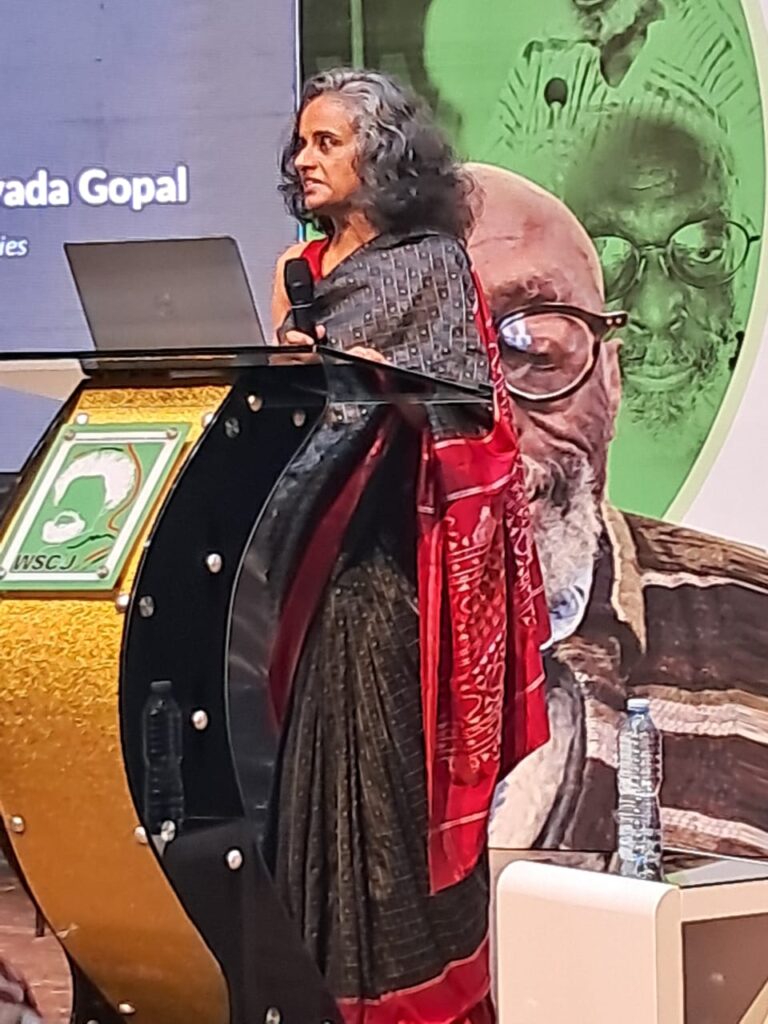
In her keynote address, Priyamvada Gopal, a professor of Post-Colonial Studies at the University of Cambridge, argued that economic and political systems inherited from colonial rule continue to shape inequality across many post-colonial states.
She said that while formal independence brought new flags and leaders, colonial structures that concentrate power and wealth in the hands of a few remained intact.
“The enrichment of a small number at the expense of the majority is one of the most enduring features of the colonial system,” she said.
Ms Gopal added that colonial security institutions were barely reformed after independence.
“The apparatus, including police and military and the legal system of the colonial state, was largely left intact and again used for repressive and authoritarian purposes, now in the name of the nation-state rather than the king-emperor.
“In some cases, some post-independence contexts have taken on forms of ‘recolonisation’, where states treat sections of their own populations much like former imperial rulers did,” she said, warning that the renewed interest in decolonisation must not degenerate into ethnic or cultural dominance.
Drawing from debates following the Bandung Conference, she said there were early concerns that cultural chauvinism could replace genuine liberation.
Nationalism’s double edge
Ms Gopal acknowledged that nationalism was critical to anti-colonial struggles but added that it also contained dangers.
“Nationalism enabled decolonisation to be initiated, but also opened the way for ethnic, racial and religious majorities to be treated as the prime beneficiaries of sovereignty, even when minority groups were given juridical or constitutional equality,” she explained.
She warned that majoritarianism has fuelled conflict in many countries. “In some cases, majoritarianism has resulted in civil wars, while in others, religious and ethnic nationalism has been galloping steadily towards full-fledged authoritarian and exclusionary visions of nation,” she said, while she criticised assumptions that political independence alone equals liberation.
“Independence came to stand in for decolonisation while cutting off its more radical possibilities,” she argued, adding that exploitation exists within nations as well as across borders.
“Subjugation, domination and exploitation both within and without nations must come under scrutiny,” she said. She stressed that leaders at Bandung never fully resolved how to prevent future abuses after colonialism formally ended.
Jeyifo’s intellectual influence
Reflecting, Ms Gopal traced her intellectual formation to Mr Jeyifo’s supervision at Cornell University.
“I see BJ in myself,” she said, recalling how the doctorate supervisor taught her, and generations of students, to reject the false choice between scholarly excellence and social relevance.
What mattered, she explained, was rigour, engagement and argumentation, not ideological conformity.
She explained further that freedom gave her permission to undo the false distinction between excellence and relevance, a lesson that continues to shape her work on empire, resistance and decolonisation.
Remembered for generosity and rigour
Other panellists, including Chairperson of the Editorial Board of The Nation, Sam Omatseye; proprietress of Sunshine Nursery and Primary School, Ile-Ife, Bisi Anyadike; lawyer and poet, Ogaga Ifowodo; and co-founder of The News and PM News, Kunle Ajibade, described Mr Jeyifo as intellectually generous, uncompromising in standards, ideologically consistent and expansive in spirit, with an influence that spans continents, disciplines and generations.
In his closing remarks, Mr Jeyifo deflected praise with characteristic humility, crediting his students and collaborators across Nigeria, China, Germany and beyond.
“It is a collective project,” he said, describing teaching as the space where he has felt most welcomed, cherished and alive.

