




By Ibrahim Awotunde
The University of Medical Sciences, Ondo graduated 771 students at its 7th Convocation Ceremony on Thursday, with a stark warning that artificial intelligence is rapidly transforming medical practice and Nigeria’s health workforce must adapt or risk being left behind.
Delivering the convocation lecture titled “Adapting to the AI-Driven Future of Medicine: Educating, Equipping, and Leading Nigeria’s Health Workforce for Emerging Clinical Realities,” former Vice Chancellor of the University of Lagos, Oluwatoyin Ogundipe, a professor, said generative AI has moved from research laboratories into clinics and everyday clinical workflows.
He told the gathering that the shift would affect every speciality and level of healthcare delivery.
“The value of AI in health is determined by the people who design, validate, deploy and use it. If clinicians, educators and leaders do not mold these technologies, they will be shaped by them,” he said.
How AI is changing medicine
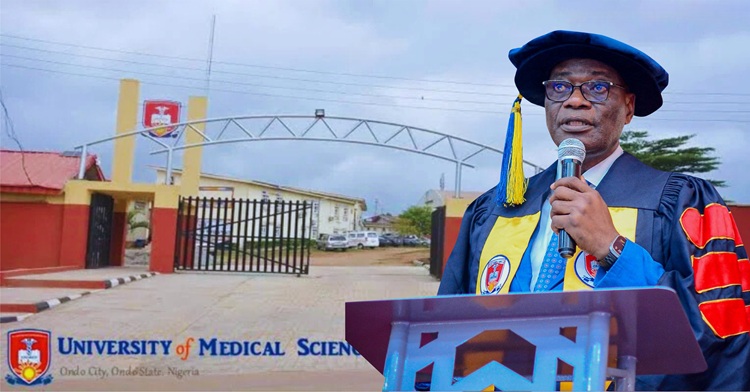
Mr Ogundipe discussed how AI is prescreening and prioritising imaging studies, enabling radiologists to identify urgent cases more quickly. According to him, machine learning tools now generate patient-specific risk assessments linked to electronic health records, while voice recognition technologies transcribe doctor–patient conversations in real time, reducing documentation burdens.
For Nigeria, he said, such tools offer opportunities to bridge gaps in access and quality of care, particularly given the uneven distribution of specialists and pressing public health needs.
However, he cautioned that clinicians must understand both the capabilities and limitations of AI.
“A model developed using images from one population may perform badly in another. A predictive tool that detects high risk without clear action paths may generate alarms without benefit,” he remarked.
He listed risks including biased outcomes from non-representative data, privacy breaches due to weak data governance, and overreliance on AI that could lead to de-skilling of clinicians. He also highlighted infrastructure constraints such as unstable power supply and intermittent connectivity.
A phased approach to adoption
The former UNILAG VC proposed a phased strategy for institutions adopting AI. Quick wins, he said, would include literacy workshops for staff and pilot programmes using validated tools in single departments.
He added that capacity building would involve integrating AI modules into curricula and conducting local validation studies. Scaling up, he added, would require shared datasets, national standards and public-private partnerships.
Addressing fears that AI could replace health workers, he said routine tasks may be automated, but human judgment, empathy and ethical decision-making remain irreplaceable. “The goal is to augment clinicians, not replace them,” he stressed.
771 graduands, strong academic performance
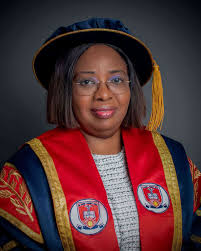
In her address, the Vice Chancellor of UNIMED, Ebunoluwa Adejuyigbe, a professor and first female VC in the university, announced that 598 undergraduates and 173 postgraduates were graduating.
Among undergraduates with classified degrees, 33 earned First Class Honours and 267 obtained Second Class Upper Honours. More than 78 per cent of graduands with classified degrees achieved either a first class or upper second class.
At the postgraduate level, the university produced 76 Master’s degree holders, 32 Master of Public Health graduates, 52 Postgraduate Diploma holders and 13 PhD graduates from the Faculty of Science, the School of Public Health and the Institute of Advanced Clinical Sciences Education.
She highlighted a collaboration with the West African College of Surgeons and the West African College of Physicians. In January 2024, 51 fellows were admitted into a PhD programme under the partnership, with the first candidate graduating at this convocation.
“This programme is the first of its kind in West Africa and possibly on the African continent. It redefines how advanced clinical training and doctoral scholarship can be integrated to strengthen healthcare leadership and research capacity,” she said.
Calls for support
The chancellor, Victor Kiladejo, an oba and Jilo III, the Osemawe and paramount ruler of Ondo Kingdom, described the ceremony as the release of trained professionals who would help address Nigeria’s shortage of health workers.
He appealed to the Ondo state government, stakeholders and philanthropists to support the university’s transition to its main site along Laje road, noting that its current campuses had reached full capacity while he acknowledged donations from Felix Akintade, a chief and the Olu Akinkugbe family toward faculty buildings.
The pro-chancellor and chairman of UNIMED governing council, Ayodele Arowojolu, said all academic programmes had received full accreditation from the National Universities Commission (NUC) and other regulatory bodies. He appealed to the Ondo State Government for increased monthly subvention to offset outstanding salaries and arrears.
Responding, the visitor to the university and governor of Ondo state Lucky Aiyedatiwa, assured that subventions would continue to be released promptly; reaffirming his administration’s commitment to the institution.
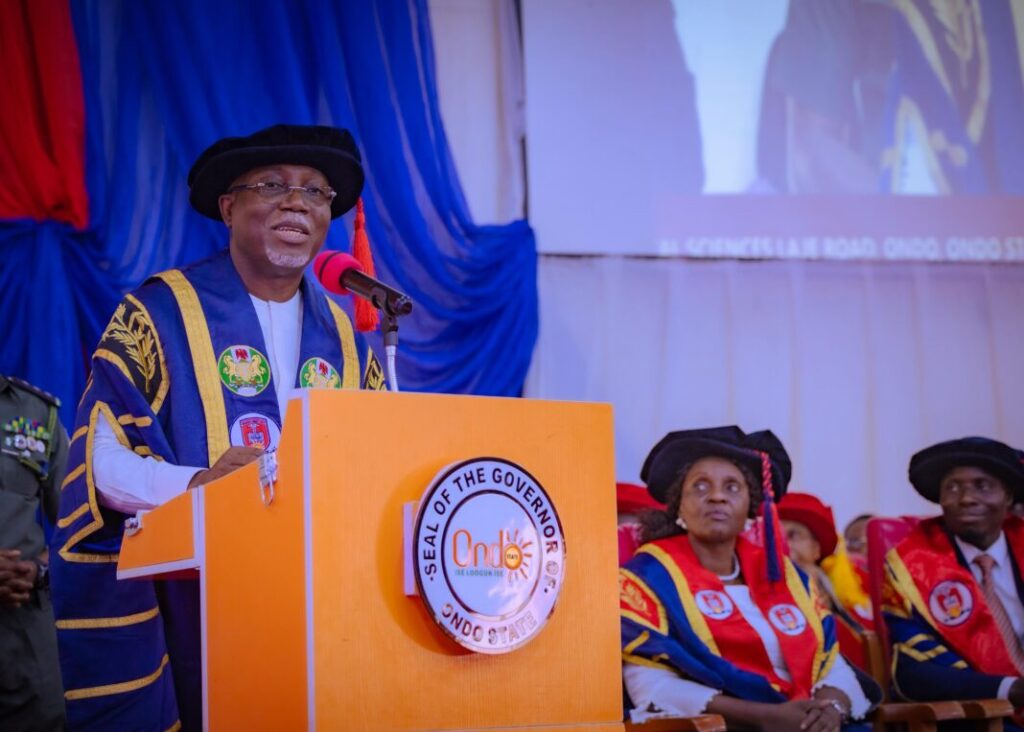
He mentioned that the construction of the Senate Building had commenced, a borehole had been sunk for the university while he offered to construct a 50-kilometre access road within the main site.
To the graduands, he said: “Your certificates are not just credentials. They are calls to service. Society will place immense trust in you. Uphold the ethics of your profession and let compassion guide your practice.”
Friends of UNIMED Fund
Both the Chancellor and the Vice Chancellor invited members of the public to join the Friends of UNIMED Fund, which seeks financial and material support for the university.
Membership, they said, requires a minimum monthly contribution of N10,000, with donors acknowledged in the university’s Book of Benefactors and granted access to university information and events.

