



Sixteen years after it was first conceived, the Nigerian National Petroleum Company Limited (NNPC), Shell Nigeria Exploration and Production Company Limited (SNEPCo), and the Nigerian Content Development and Monitoring Board (NCDMB) have formally handed over a state-of-the-art Geosciences Centre of Excellence to the University of Lagos (UNILAG), marking the completion of a strategic investment in Nigeria’s research capacity.
The facility, commissioned on Friday, is the product of a collaboration involving Shell Nigeria Exploration and Production Company Limited (SNEPCo), the Nigerian Content Development and Monitoring Board (NCDMB), and other co-venture partners. It is expected to reduce Nigeria’s reliance on foreign laboratories for geoscience training, testing and research.
The project’s co-venture partners are Nigerian Agip Exploration Limited and Esso Exploration and Production Nigeria (Deepwater) Limited, with 225MM Nigeria Limited as the main contractor.
Originally proposed in 2010, the centre has evolved into a five-storey complex equipped with modern laboratories, lecture rooms, a seismic interpretation suite, a digital museum, and a 250-seat auditorium.
Speakers at the commissioning described the centre as the first of its kind in Nigeria, positioning it as a critical response to the country’s long-standing dependence on overseas facilities for specialised geoscience work.
The structure houses geoscience and instrumentation laboratories, including facilities for hydrogeology, mineralogy, environmental geology, and sedimentary and palaeoenvironmental studies. It also features a rock preparation workshop, a seismic interpretation room, lecture and seminar rooms, a research library, a digital museum, collaborative spaces, a conference room, an auditorium, and administrative and departmental offices.
A project across four administrations
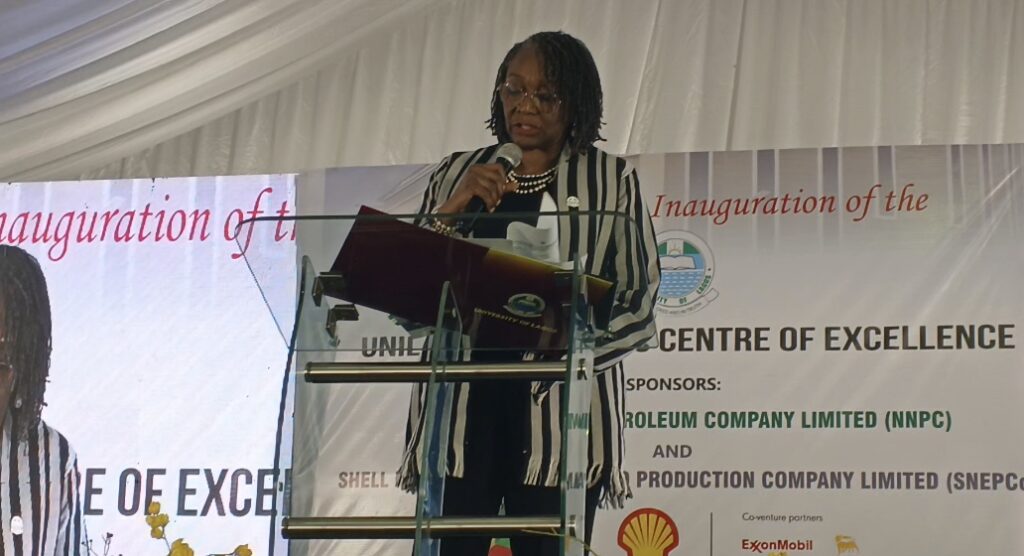
The Vice-Chancellor of UNILAG, Folasade Ogunsola, a professor, said the project was originally conceived in 2010 under the administration of the late Babatunde Sofoluwe. A subsequent vice chancellor, Rahman Bello, repositioned it as an industry–university linkage centre, while Oluwatoyin Ogundipe oversaw a value-engineering process covering cost, scope, and schedule to improve its feasibility and alignment with the university’s priorities.
Mrs Ogunsola, the fourth VC to handle the project, ultimately oversaw its completion.
“This is the seed time, so we must knuckle down and continue to push knowledge boundaries,” Mrs Ogunsola said, acknowledging the long journey from concept to commissioning.
She added that the university has put in place a sustainability framework for the centre, including long-term institutional funding, strategic industry partnerships, technology upgrade cycles, and structured maintenance provisions.
Cutting dependence on foreign facilities
The Chief Upstream Investment Officer at NNPC Upstream Investment Management Services, Richard Igandan, said the centre’s advanced equipment would enable critical geoscience studies and analyses to be conducted within Nigeria, eliminating the need to send samples or researchers abroad.
“This systems-strengthening approach ensures that students, researchers, and industry professionals now have access to facilities that meet global standards, right here in Nigeria,” he said.
The Executive Secretary of the NCDMB, Felix Ogbe, described the commissioning as a step towards reducing Nigeria’s reliance on foreign facilities for training, testing, and research in subsurface geophysical and seismic studies.
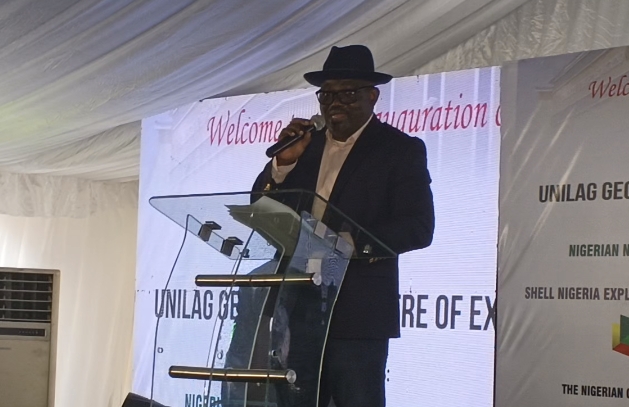
Mr Ogbe said the centre aligns with the board’s human capital development framework and carries clear performance expectations.
“The success of this centre will not be measured by its structure, but by its impact – the number of skilled graduates it produces, the quality of research it generates, and the solutions it provides to industry challenges,” he stated.
He added that the project achieved a cumulative 87 per cent Nigerian content in staffing and materials procurement, with interns accounting for 69 per cent of the workforce. The remaining 13 per cent, he explained, resulted from unavoidable foreign procurement and the need for specialised skills not yet available locally.
Students trained on the project
One striking feature of the project was the deliberate involvement of students during construction.
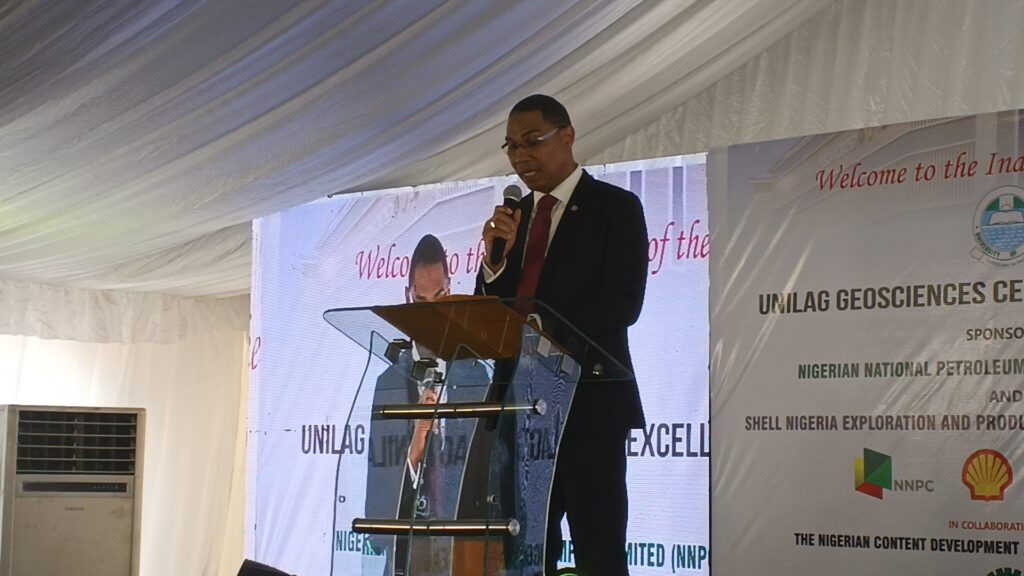
The Managing Director of SNEPCo, Ronald Adams, said students from UNILAG’s Civil Engineering, Architecture, and Project Management departments participated through industrial training, gaining hands-on experience in real-world project execution.
Mrs Ogunsola, added that students from UNILAG, Obafemi Awolowo University (OAU), University of Ilorin (UNILORIN), and Yaba College of Technology undertook internships during the project, with some later employed as full-time staff.
She further noted that students from the Geosciences Department were also exposed to technical processes such as piling, providing hands-on learning opportunities. “It is safe to say that the journey has just begun,” She stressed.
Addressing illegal mining and local challenges
Beyond infrastructure, Mrs Ogunsola raised concerns about Nigeria’s widespread illegal mining activities, noting that about 80 per cent of artisanal mining remains unregulated.
She said the centre would help address the issue by training small-scale artisanal miners and reducing the environmental damage associated with their operations.
She also urged the centre to position Nigeria to harness advanced science in accessing hard-to-reach energy resources, while producing research tailored to Africa’s realities rather than relying on imported solutions.
“Africa has for a long time been stereotyped as poor and needing aid to solve its peculiar challenges. We must break that stereotype and own our narrative,” she said.
Lagos State backs capacity development
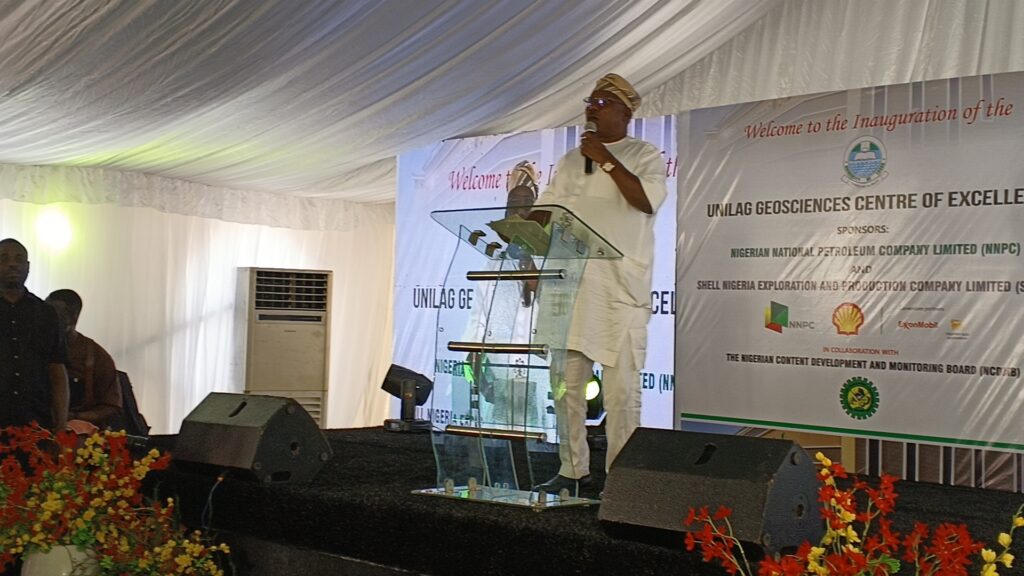
The Governor of Lagos State, Babajide Sanwo-Olu, represented by the Commissioner for Higher Education, Tolani Sule, described the centre as an investment in people and in the State’s position as a hub for knowledge and industry.
“Nigeria cannot continue to rely heavily on external expertise in critical sectors. We must build our own capacity. We must train our own professionals. We must develop our own solutions.”
The governor assured that Lagos State Government would continue to support initiatives that expand opportunities and strengthen human capital.
A call to industry
Mr Adams stressed that the centre is a national asset, not a Shell facility, and called on industry players to support research, student development and innovation.
“The dividends will be measured in innovation, capability and national progress,” he said.
Mr Ogbe also urged strong governance and sustained collaboration between academia and industry to maximise the centre’s impact.
