


As the 2026 Unified Tertiary Matriculation Examination (UTME) begins on Thursday, 16 April, the Joint Admissions and Matriculation Board (JAMB) has introduced key adjustments and issued guidelines for candidates.
The examination, which will run until 25 April, comes amid recent concerns over early arrival times and the overall conduct of the exercise, prompting the Board to review its schedule.
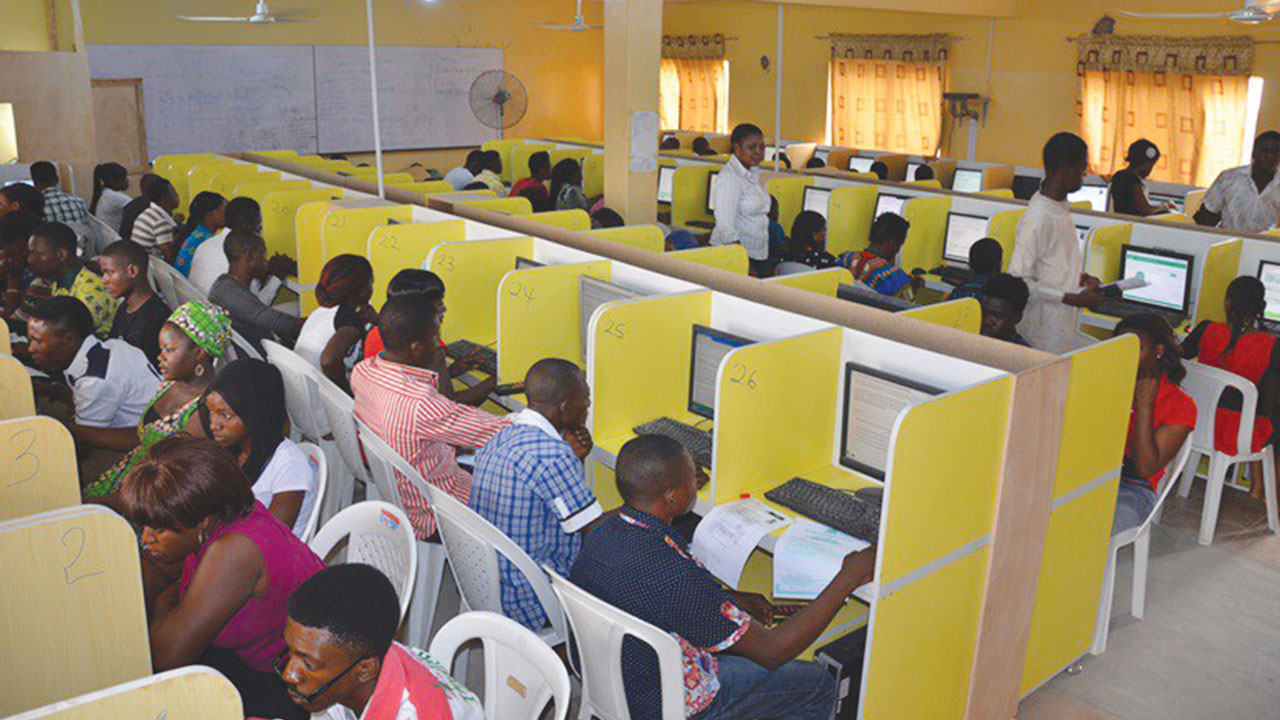
No fewer than 2.24 million candidates are expected to sit the examination across 966 approved CBT centres nationwide. Although 23 centres have been delisted over poor performance during the mock UTME.
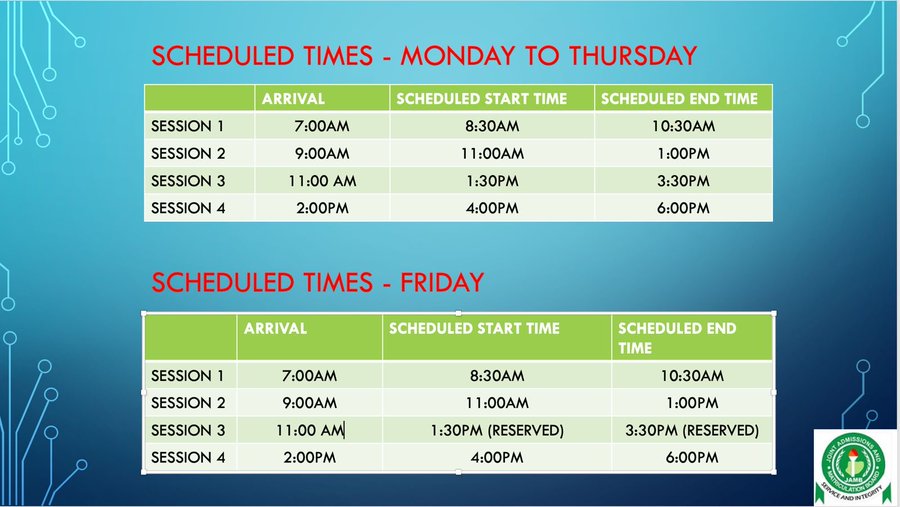
In an update posted on its X handle on Monday, JAMB announced that candidates for the first session are now expected to arrive by 7:00 a.m., instead of the earlier 6:30 a.m., while the examination will commence at 8:30 a.m.
The post reads: “Attention 2026 UTME Candidates: This is to notify you of a slight adjustment to the arrival scheduled time, particularly for the first session, which is now 7:00am as against the earlier published 6:30am, while the scheduled start time for the session is now 8:30 am and end time.”
Beyond the timing adjustment, the Board has also reiterated strict compliance with examination rules, warning that failure to adhere to its guidelines could prevent candidates from sitting the exam.
Candidates are required to study the instructions on their UTME examination slip carefully, as it contains vital details such as the examination date, time, and centre.
Similarly, the Board has outlined key requirements for Computer-Based Test (CBT) centres to ensure the seamless conduct of the examination.
Early arrival
The UTME operates a strict schedule, and candidates are expected to arrive well before the time stated on their examination slip.
Late arrival remains one of the leading reasons candidates are denied entry into examination halls. Even minimal delays may result in missing the examination.
JAMB has restated the importance of punctuality, emphasising that arriving late for biometric capturing or the examination proper increases the risk of missing the examination.
Candidates are therefore advised to plan their movement in advance, taking into account traffic and distance to the centre.
No slip, no examination
Candidates must present their UTME registration slip at the examination centre, as it serves as proof of registration and contains essential details required for entry.
Failure to provide the slip or proper identification may result in denial of access to the examination hall, JAMB warned.
Candidates are encouraged to print and keep their documents safely ahead of the examination day.
Fingerprint
Biometric verification is a mandatory step in the examination process. Candidates must have their thumbprints successfully captured before they can be admitted into the hall.
This measure is designed to prevent impersonation and other forms of malpractice.
Candidates whose fingerprints cannot be verified risk being denied access. It is therefore important to ensure that fingers are clean and free from substances that may affect scanning.
Electronic devices and phones are prohibited
JAMB has maintained a strict ban on electronic devices within examination halls. Items such as mobile phones, smartwatches, pens, keyholders, ATM cards, jewellery and other gadgets are not permitted.
Any candidate found with prohibited items risks disqualification and possible sanctions. Candidates are advised to leave such items at home or with a trusted person before arriving at the centre.
Avoid errors in examination details
Mistakes such as going to the wrong centre or misunderstanding examination schedules have prevented some candidates from sitting for the UTME in the past.
Candidates are advised to carefully review all information on their examination slip before the examination day. Visiting the centre in advance may help reduce confusion.
On the day of the examination, candidates should follow all instructions given by invigilators.
Support from parents and guardians matters
Parents and guardians are expected to support candidates by ensuring proper preparation for the examination.
This includes arranging transportation, confirming examination details, and ensuring candidates are well-rested.
A calm and supportive environment can help candidates remain focused and perform better during the examination.
Prepare, focus, and follow instructions
Adequate preparation and composure are essential for success in the UTME.
Candidates are advised to rest well, eat properly, and arrive early at their centres. Remaining calm during the examination and following all instructions can significantly improve performance.
Attention to detail is as important as academic readiness.
Zero tolerance for examination malpractice

JAMB has reiterated its warning against examination malpractice, stressing that offenders risk prosecution.
The Registrar, Ishaq Oloyede, a professor, earlier urged candidates to work diligently and avoid dishonest practices. He noted that some candidates from the 2025 UTME have already been convicted for offences such as impersonation and result falsification.
He revealed that the Board has deployed advanced technology capable of detecting malpractice in real time and will not entertain appeals for leniency.
Candidates are therefore advised to focus on their studies and comply with all examination guidelines to avoid jeopardising their future.
Requirements for CBT centres
JAMB has outlined strict requirements for accredited CBT centres to ensure a conducive examination environment.
A statement published on the Board’s website on Sunday, 12 April, outlined key requirements for CBT centres. Each centre is expected to have at least 250 functional laptops, with additional backup systems, all connected to a central server capable of supporting simultaneous usage.
The systems must operate on a cable-based Local Area Network, as wireless connections are not permitted.
Centres must provide individual cubicles, adequate seating, uninterrupted power supply, backup generators, and functional UPS systems.
Security personnel and technical staff, including a network engineer, must be available throughout the examination.
Other requirements include internal toilets, proper fencing, reception or holding areas, and adequate lighting and air conditioning. Centres must not be located within shared premises such as markets or shopping malls.
All systems are required to run on updated operating systems with functional antivirus protection, while the installation of CCTV cameras is compulsory for monitoring activities.
Compliance and monitoring of centres
JAMB has directed all accredited centres to ensure that their surveillance systems are fully accessible from its control room.
According to the Board, any centre that cannot be monitored in real time risks having its activities declared invalid and may also forfeit payment. The directive is aimed at strengthening transparency and oversight.
The Board disclosed that over 150 centres were previously not visible during monitoring, leading to sanctions. Although cancellation of affected registrations was considered, additional monitoring measures were introduced instead.
JAMB stated that live monitoring remains ongoing across all centres to detect and prevent malpractice.