



Nigeria has launched the first Artificial Intelligence (AI) UniPod at the University of Lagos (UNILAG), marking the start of a national rollout of innovation hubs aimed at strengthening research, entrepreneurship, and technology development in tertiary institutions.
The initiative, a collaboration between the Federal Government, the United Nations Development Programme (UNDP), and UNILAG, is the first of seven hubs to be established across Nigeria under the UNDP’s Timbuktoo project, which seeks to catalyse innovation across Africa and translate it into tangible, homegrown solutions capable of driving sustainable development, economic growth, and job creation.
Shift to innovation-led development
Speaking at the launch, Nigeria’s Vice President, Kashim Shettima, described the initiative as the beginning of a new era of university-led innovation.
Represented by the Deputy Chief of Staff to the President, Ibrahim Hadejia, he emphasised that the UniPod is not merely a platform for dialogue but a strategic platform for enterprise and national development.
According to him, the transformative capacity of AI to augment human intelligence and expand possibilities makes it imperative for Nigeria to actively participate in shaping the global AI landscape.
UNILAG positions for AI-driven academic transformation

In her opening remarks, the Vice Chancellor of UNILAG, Folashade Ogunsola, a professor, described the launch as the start of a transformative journey that will redefine scholarship and contribute to national progress. She noted that AI is rapidly reshaping the world, with the potential to enhance human capabilities, accelerate scientific discovery, and address complex global challenges.
She explained that the AI UniPod would serve as a hub for interdisciplinary collaboration, enabling scholars to explore new frontiers of knowledge while equipping students with critical skills for an AI-driven future. Beyond academia, she added, the initiative holds strong potential as a catalyst for national development by nurturing a generation of innovators capable of driving economic competitiveness and addressing societal needs.
“On a national scale, this initiative has immense potential to be a catalyst for development. The applications of AI are boundless and we aim to cultivate a generation of leaders who can drive technological advancement, enhance our economic competitiveness, and address critical societal needs,” she said.
On the rationale for selecting UNILAG, she noted that the UNDP aligned institutions based on their strengths and potential. She reiterated the university’s commitment to embedding AI across all disciplines, emphasising its role as a fundamental problem-solving tool that enhances efficiency, reduces costs, and delivers timely solutions across sectors.
Stakeholders emphasise research, partnerships, and impact
The Minister of Communications, Innovation and Digital Economy, Bosun Tijani, urged the academic community to move beyond theoretical discussions and focus on leveraging AI to accelerate scientific research.
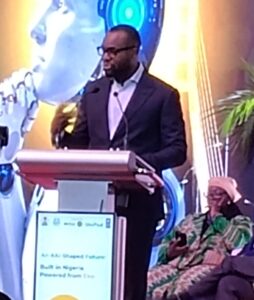
He highlighted the growing importance of “AI for science,” noting its potential to transform research across disciplines such as biology, physics, chemistry, robotics, and climate science.
“In an academic gathering, the conversation is not just about another generative AI tools, but what can AI do to help us accelerate the studies that are coming up? We have to work with a large body of data. How well are we leveraging that efficient data?
“I think the biggest challenge I would like to leave with the university community today is not just to support this initiative as one that is focused on exciting, innovative, new ideas across the academia, but also one that gives the opportunity to local researchers to be able to do groundbreaking researches by leveraging new ideas and AI to stand out,” he said, reiterating the need to involve the researchers.
Similarly, the UNDP Country Representative, Elsie Attafuah, described the initiative as a new development model, government-led, government-financed, and enabled through strategic partnerships.

She noted that it creates a coordinated system linking talent, research, industry, and investment, ensuring that education translates directly into innovation, enterprise, and job creation.
“What is particularly significant about this moment is that it reflects a new development model. One that is government-led, government-financed and partnership enabled. Nigeria is not simply articulating ambition, but delivering a scale where institutions align across policy, planning, programming, and investment to drive sustained national transformation.
“It is the foundation of a national system designed to connect talents, research, industry, and investment into a single, coordinated platform capable of generating a sustained economic value. At its core, the system creates a continuous pathway from learning to innovation, to enterprise, and ultimately to jobs, ensuring that education is directly linked to productivity and national development,” she said.
TETFund pushes shift from certificates to innovation

Also speaking, the Executive Secretary of the Tertiary Education Trust Fund (TETFund), Sonny Echono, and Architect, described the launch as a defining moment for Nigeria’s tertiary education system.
He noted that, in partnership with UNDP, the Fund is driving a transition from a “certificate-based” system to an “innovation-driven” reality through the National Innovation and Digital Transformation Partnership Programme (NIDTPP).
He stressed that globally, the commercialisation of research has become the backbone of industrial growth, making it essential for Nigeria to prioritise human capital development and invest in sustainable research infrastructure.
According to him, the partnership framework is designed to accelerate Nigeria’s shift to a knowledge-based economy by strengthening innovation systems, advancing research commercialisation, and developing digital talent.
Mr Echono further disclosed that the initiative will see the rollout of seven UniPods and one Polytechnic Pod, alongside 12 TETFund Innovation Hubs nationwide, bringing the total to 20 within the year. He described the hubs as “collision spaces” where ideas evolve into practical solutions through collaboration between academia, industry, and innovators.
Lagos reinforces commitment to innovation ecosystem
On his part, Lagos State Governor, Babajide Sanwo-Olu, represented by the Commissioner for Innovation, Science and Technology, Olatunbosun Alake, said the launch reflects a broader movement already underway in the state.

He noted that Lagos has moved beyond rhetoric to institutionalising innovation through strategic investments in research, talent development, and policy frameworks while emphasising that the AI UniPod arrives at a critical moment when the state is transitioning from merely consuming technology to actively building and funding innovation.
However, he cautioned that beyond launching such initiatives, sustained commitment to maintenance, improvement, and funding remains essential.
The governor encouraged students to take full advantage of the facility, urging them to collaborate across disciplines, ask critical questions, and develop practical solutions, stressing that innovation must be driven by action. “You see a problem, solve it,” he said.
Other dignitaries at the launch included the Minister of Education, Tunji Alausa, who was represented by the Minister of State for Education, Suwaiba Ahmad, a professor; and the Head of the Civil Service of the Federation, Didi Walson-Jack. The event also attracted university leaders, members of the diplomatic corps, industry partners, and students, among others.
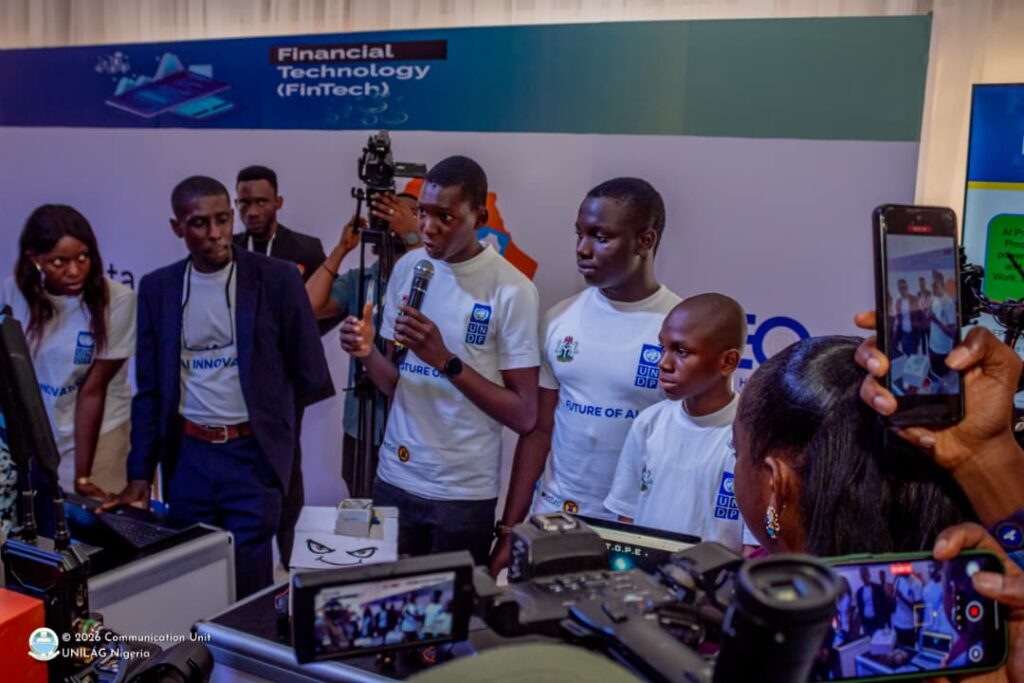
At the market place section of the event, exhibitors showcased their products, including Smile Superheroes, Nigernius, Accesstech Academy, Beebahtics, CocoaNexus Limited, Tomato Plant Disease Detection System, Homefort Energy, NEPAWatch, Doorcas Africa, Esusu Africa, and HealthPadi, among others.
About AI UniPod
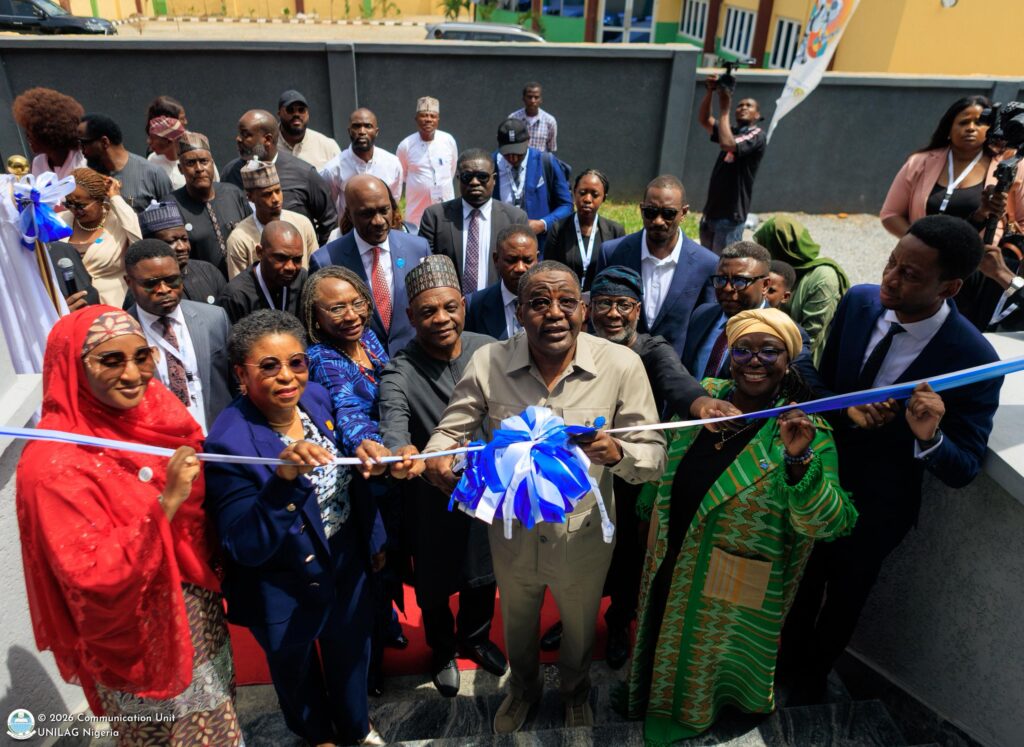
Nigeria is among the first countries to implement the UniPod model at scale. Eight universities were selected in the first cohort, each tailored to the unique economic endowments and development challenges of its region, including AI UniPod, Green and Blue Tech Lab, Manu-Tech and Trade Lab, Mine-Tech Lab, Agro-Tech Lab, Resilience -Tech Lab, Industrial-&- Govt Tech.
Participating institutions include the University of Lagos, University of Uyo, Michael Okpara University, Nasarawa State University (NSU), Benue State University (BSU), University of Maiduguri (UNIMAID), and Ahmadu Bello University (ABU).
The UniPod is equipped with a range of specialised facilities designed to support innovation. These include a design studio fitted with high-performance systems for design, editing, and visualisation, as well as a virtual reality (VR) space where users can explore concepts in 3D using VR headsets and motion-tracking tools, allowing them to experience ideas before they are physically created.
There is also a pitch garage, a dedicated space where students can present and pitch their ideas or solutions to the community, industry stakeholders, and potential investors.
Within the AI and robotics lab, students are able to develop, build, and train AI models and algorithms using high-performance computing systems that support advanced processing, training, and scalability. The lab also features a robotics section where users can build hardware solutions, utilise printed circuit board (PCB) and electronic tools, integrate internet of things (IoT) and embedded systems into AI-driven innovations.
Once an AI-driven solution is ready, it can be transformed into a tangible product within the market space lab. Here, innovators are able to develop prototypes and fabricate usable products using state-of-the-art tools such as 3D and resin printers, laser-cutting systems, and high-performance design computers.
The UniPod also functions as an ecosystem space, enabling the eight universities to connect, collaborate, and engage with international labs and AI hubs globally. The AI Fundamentals Lab further supports this ecosystem by providing a space for experimentation, continuous learning, and the application of AI across disciplines. In addition, the collaboration space is designed to host demonstrations, product showcases, hackathons, and idea funding opportunities, offering innovators visibility, access to partners and investors, and pathways for scaling their solutions.
At the end of the innovation pipeline, ideas evolve into AI solutions, solutions are developed into products, and these products are taken to market with the potential to create global impact.