



Nigeria’s journalism industry is facing a silent but deepening crisis as poor remuneration, ownership pressure and unethical funding continue to undermine editorial independence, a communication and media scholar, Ismail Ibraheem, has warned.
Mr Ibraheem, a professor of journalism and communication studies, said the future of credible journalism in the country depends on the ability of newsrooms to embrace development-centred reporting while resisting financial influence from wealthy individuals and institutions whose support often comes at the cost of independence.
Speaking on Saturday at a gathering organised by DevReporting, a development-focused media platform, Mr Ibraheem said, “Sustainable journalism must prioritise public interest, social justice and accountability, not patronage-driven coverage.”
He described development journalism as a viable response to the industry’s growing integrity crisis despite its high cost of operation.
Ownership capture, ethical decline

Mr Ibraheem, who doubles as the director of Uptake at the African Cities Research Consortium (ACRC), warned that reliance on wealthy benefactors frequently results in the quiet capture of media organisations, gradually stripping them of editorial freedom.
According to him, several Nigerian media platforms with strong potential collapsed after succumbing to ownership interference fuelled by poor funding structures and weak ethical safeguards.
“In some mainstream media organisations where I have students, the payment structure is deplorable. It offers no future for journalism if it continues.”
He said many reporters are compelled to depend on payments from sponsors to write stories, a practice he described as dangerous to public-interest journalism.
“That was what destroyed Newswatch. A money bag steps in, offers support, and then claims ownership. At a point, the platform is then rested,” he said.
The scholar urged DevReporting and similar outlets to resist “brown envelopism” and reject individuals or institutions whose interests could compromise their credibility.
He pointed to organisations such as The Guardian UK, which openly appeal to audiences for support, as models for sustaining independent journalism. “We are up against billionaire owners and disinformation actors but we still have the public.”
Development journalism as counter-narrative

Mr Ibraheem said development journalism helps redirect attention to citizens whose voices are often drowned out by elite narratives, particularly in policy debates.
“That is why we need platforms like DevReporting to bridge the gap and amplify the voices of the voiceless,” he said.
He cited forced evictions in communities such as Oworonshoki, Lagos, where official narratives often portray residents as illegal occupants.
“To the people living there, that is their land. But the government controls the narrative,” he said, noting that alternative media platforms provide perspectives often missing from mainstream coverage.
He urged readers, institutions and stakeholders to view support for credible journalism as an investment in national development.
“Our world is better when we have free media. If we truly want to uphold truth, we must support platforms committed to public-interest journalism. Promoting truth in an age of contested narratives is not cheap,” Mr Ibraheem stressed.
Unpaid salaries, weak welfare
Beyond ownership control, Mr Ibraheem identified unpaid salaries and weak welfare systems as major drivers of ethical breaches in Nigerian newsrooms.
“Some journalists have not been paid since early 2025. Where they are paid, it is sometimes less than ₦100,000. They have families. So what happens? They sell the platform.”
He warned that without sustainable funding, independent media organisations remain vulnerable.
“Responsible journalism costs money. Without support, platforms like DevReporting cannot survive,” he said.
Workplace temperament and productivity

Also speaking at the event, a personality expert and managing director of AL-OLUT Consulting, Olutayo Akande, examined workplace behaviour through the lens of temperament.
He said how people think, react and perform at work is often shaped by inherent personality traits rather than competence alone, noting that many organisational conflicts stem from a failure to understand these differences.
According to him, recognising temperament enables organisations to assign roles more strategically, improve productivity and foster healthier workplace relationships.
“When people are placed in roles aligned with how they naturally function, organisations are better positioned to achieve shared goals,” Mr Akande said.
DevReporting’s first-year milestones

Earlier, DevReporting’s Team Lead and Editor-in-Chief, Mojeed Alabi, said the platform recorded notable progress in its first year despite early challenges.
He said the outlet published over 310 development-focused stories, conducted five in-depth interviews with key actors and implemented a reporting project supported by Education As a Vaccine (EVA) and the Malala Fund.
Mr Alabi thanked readers, partners and supporters for sustaining the platform through its formative year.
Recognising contributions
The gathering also featured the recognition of team members for outstanding contributions.
The Head of Creatives and Social Media, Adeola Ajibola, was commended for strengthening the organisation’s digital presence during seven months of voluntary service.
A reporter, Sodiq Mojibola, was named ‘Employee of the Year’ for his professional growth and reporting contributions. He received a cash prize of ₦50,000.
The Managing Editor, Christiana Alabi-Akande, said the recognition was meant to motivate staff and highlight the role of committed teams in sustaining public-interest journalism.
The event coincided with the birthday of the wife of DevReporting’s Team Lead, Atinuke Akinrinade. Speakers described her as a stabilising force whose support has strengthened the platform.
Mr Alabi said their 15-year journey had endured because of her support and belief in his work. “Without her confidence in me and this vision, I would not have achieved as much,” he said.
The celebrant thanked guests and expressed appreciation to all those supporting DevReporting’s growth.
Stakeholders in attendance
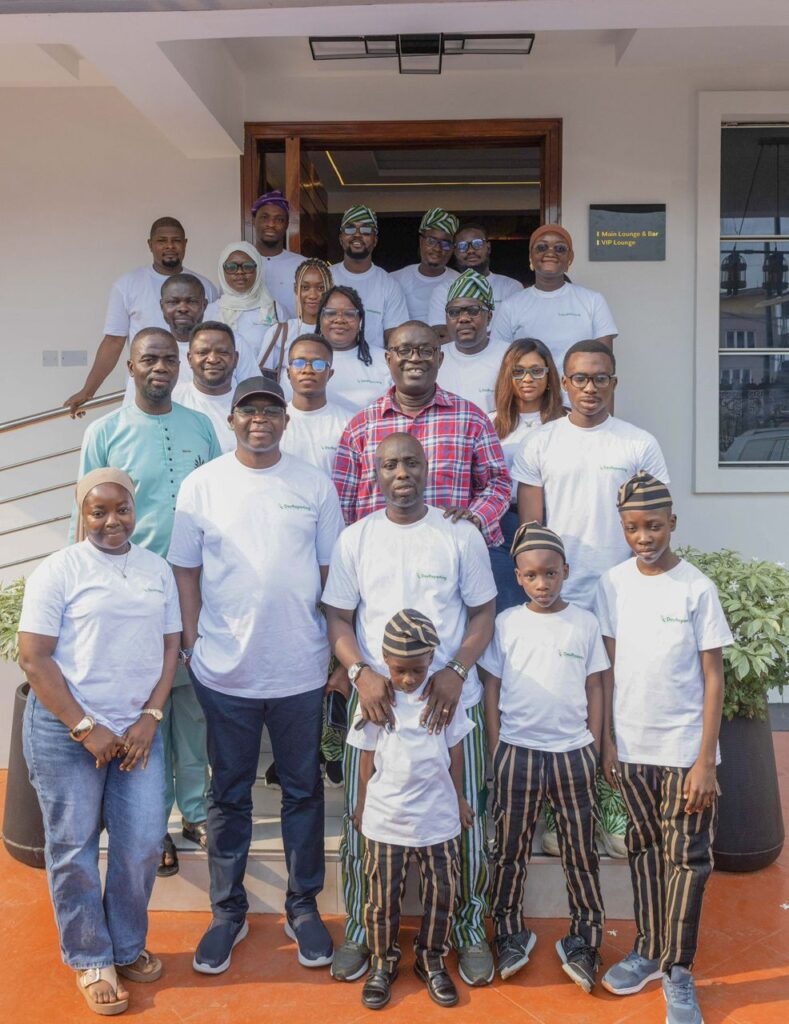 The event was attended by friends, families and stakeholders supporting DevReporting’s work, including the Head, Media and External Relations at UBA Plc, Ramon Nasir, and his wife, Folasade Nasir; Managing Director/CEO of Integrated Indigo Limited, Bolaji Abimbola, and an obstetrician and gynaecologist operating in the diaspora, Oluwole Alabi.
Other guests had included a public health consultant and Deputy Managing Director at a Lagos General Hospital, Morufat Omotayo, and her husband, also a medical doctor and lecturer at the Lagos State University College of Medicine (LASUCOM), Ikeja, Hammed Omotayo; former Business Development Manager at New Telegraph Newspaper, Taiwo Ahmed, and his wife, who is the Principal Partner at Blue Diamond Law Firm, Blessing Ahmed; and a lecturer at the Computer Science Department, Lagos State University (LASU), Taofeek Ajagbe, among others.