



Stakeholders in the Agboyi-Ketu Local Council Development Area of Lagos State have urged immediate policy action to forestall future climate incidents, warning that delays in strengthening local infrastructure could expose residents to deeper environmental and economic losses as climate pressures intensify.
The call followed the presentation of a climate resilience study by researchers under the African Cities Research Consortium (ACRC), who found that existing infrastructure in the council area is inadequate to withstand projected future climate conditions, raising concerns over the community’s unpreparedness for extreme weather events.
The findings were revealed during a high-level stakeholder engagement forum convened by the Centre for Housing and Sustainable Development (CHSD) of the University of Lagos in partnership with the University of Manchester under the Action Research for Climate Resilience project.
Researchers, policymakers, traditional leaders, traders, planners, and residents gathered at the LCDA secretariat to examine the Climate Hazard and Vulnerability Assessment for Ajegunle–Ikorodu and deliberate on practical steps for implementation.
Flood risk widening
Presenting the report, Research Lead, Peter Elias, a professor, said climate change is intensifying rainfall patterns and flood events across Lagos, particularly in low-lying coastal and riverine settlements.
“Climate change is making floods more frequent and more severe in Lagos. Increasing rainfall, rising sea levels and rapid urban growth mean that many homes, businesses, and roads are now at higher risk. When poor drainage and waste disposal are added to this, the situation becomes critical,” he said.
According to the study, over 44,000 residents and more than 6,000 buildings in Ajegunle–Ikorodu are currently exposed to flood risks. The lowest-lying areas face the deepest and most prolonged inundation.
The research found that many drainage systems in the community were designed for five to 10-year storm events, standards that no longer reflect present or future rainfall realities.
“Local drainage systems designed for five to 10-year storms should be upgraded to handle 25-year storms under moderate climate scenarios and up to 50-year storms under high-emission scenarios,” Elias said.
He added that major channels must be expanded from 25-year to 50–100-year capacity, roads and culverts require additional elevation, while schools and markets should be raised above projected flood levels to avoid repeated public losses.
Urban expansion deepens vulnerability
The study further showed that rapid urbanisation has significantly altered Ajegunle–Ikorodu’s landscape, noting that the surface cover has increased by more than 500 per cent in less than three decades, reducing natural flood storage and accelerating surface runoff.
Encroachment on floodplains and drainage corridors, combined with inadequate solid waste management, has further constrained water flow. As a result, the community now experiences chronic flooding that disrupts schooling, trading activities, and transport networks, while also generating cumulative economic losses.
The Head of the Department of Geography at the University of Lagos, Olusegun Adeaga, a professor, warned that ignoring climate projections in infrastructure planning would deepen future damage.
“Earlier structures have to fail if they are not designed for present realities. Nature will always respond to the way we treat the environment. If we build without considering climate data, we will pay for it repeatedly,” he said.
Stakeholders demand action implementation
During a panel session moderated by an Assistant Director of Lagos State Physical and Urban Development, Olubunmi Alugbin, stakeholders urged the LCDA and the Lagos State Government to formally adopt the report and translate it into policy and budgetary action.
A former council chairman, Sesan Daini, described the research as a timely intervention.
“The beauty of this forum is that both the executive chairman and members of the legislative arm are present. This report should be taken to lawmakers and worked upon. It is a well-researched document presented to the LCDA on a platter of gold. That opportunity should not be wasted,” he said.
A town planner, Olutunde Babawale, stressed the role of evidence in governance, noting that “without data, it will be difficult to achieve meaningful development.”
“If this report is properly utilised, it will guide policies that truly reflect the needs of the people,” he asserted, commending the participatory approach adopted by the researchers.
Representatives of the Lagos State Ministry of the Environment and Water Resources emphasised the need to combine engineering solutions with nature-based approaches.
In the same vein, Bolanle Magbagbeola from the office of Drainage and Water Resources in the Lagos State Ministry of the Environment and Water Resources, added that flood control has on focused heavily on concrete infrastructure like engineering over the years, while ecological solutions such as wetland restoration and improved natural drainage systems remain underutilised.
“Nature-based solutions are critical. Engineering alone cannot solve every climate problem,” she said.
President of a Community network, Nigerian Federation of Slums and Informal Settlement, Bimbo Osobe said sensitisation campaigns are ongoing in Ajegunle–Ikorodu and neighbouring communities to promote environmental sanitation and preparedness.
“Our communities are not waiting, but scaling these efforts requires institutional support and deliberate government backing,” she said.
From assessment to action
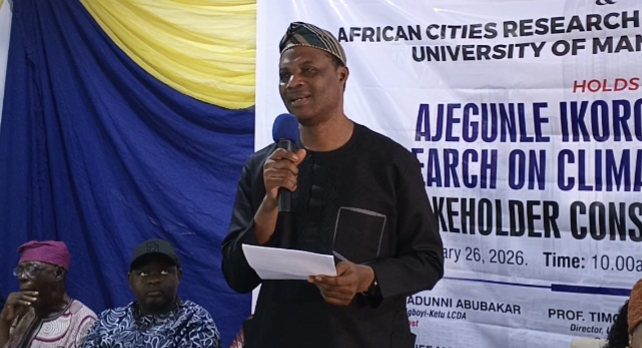
Convener of the forum, Timothy Nubi, a professor and Director of the Centre for Housing and Sustainable Development at UNILAG, said while climate adaptation plans exist in Lagos, they are rarely grounded at community level.
“The objective of this project is to produce a truly community-level Climate Hazard and Vulnerability Assessment that leads to a practical resilience action plan. We cannot solve community problems without involving the people, and community efforts cannot be sustained without institutional support,” he said.
He added that the forum aimed to validate findings, identify action entry points and establish pathways to scale interventions beyond Ajegunle–Ikorodu to other vulnerable neighbourhoods.
Residents describe lived impact
Residents who participated in the research described how flooding affected their daily life between September and November.
A resident of Ajegunle, Oluwakemi Awobona, said the participatory research approach helped residents to articulate their experiences and identify practical responses.
“Flooding affects our homes and businesses every year. Through this project, we were able to say clearly how it affects us and what can be done. We now understand our environment better and what steps we can take ourselves,” she said.
A teacher in the community, Oyeneye Olawale, said the community often rallies around traditional leadership during flood periods rather than relocating.
“When flooding comes, we meet with our Baale to discuss what can be done, we do not run away. We look for solutions together.”
The Baale of Ajegunle-Ikorodu, Moyosola Oladunjoye, said the project has improved the community’s visibility in planning discussions.
“Before now, Ajegunle was hardly recognised. This research has brought our community to the limelight,” he said, noting that the action plan was co-designed with residents from the start.
LCDA chairman pledges action
In her remarks, the Chairman of Agboyi-Ketu LCDA, Adetola Abubakar, pledged to take all necessary steps to ensure that the research work does not stop there.
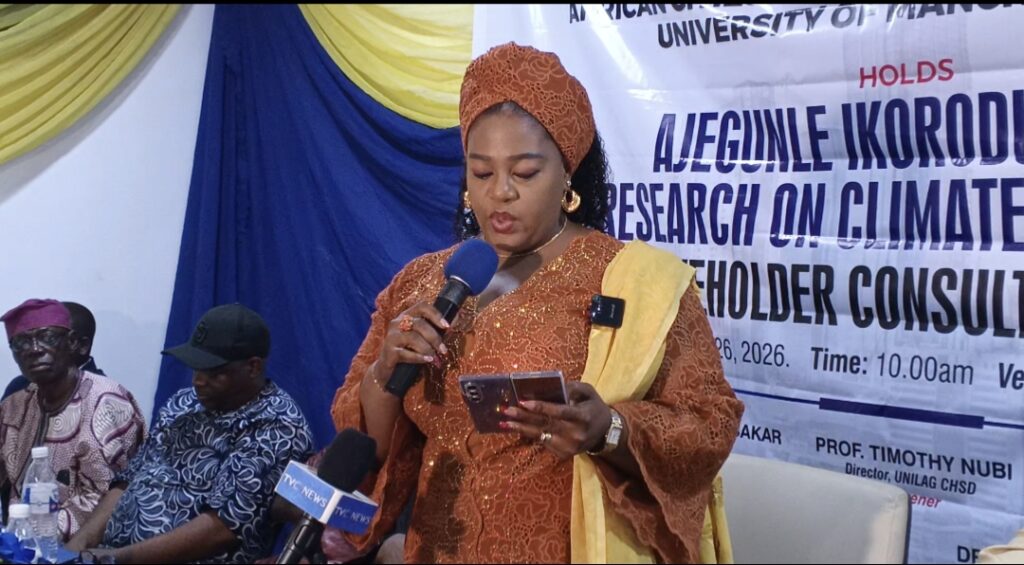
Appreciating the efforts of the researchers and their consideration to co-design the climate solution with residents who have lived experience, she acknowledged that research is indeed the basis of scientific and social knowledge and solutions.
“You have already set things rolling, and all other necessary things will be put in place. We are going to do our due diligence to ensure that what needs to be done is done. What we need to communicate to the state government will be communicated,” she stated.
She acknowledged Ajegunle-Ikorodu’s riverine vulnerability and the broader ecological diversity of the LCDA, describing climate-sensitive planning as essential to safeguarding residents.
In her opening remarks, she noted that Ajegunle is one of the most important communities in the LCDA. According to her, Agboyi-Ketu is perhaps the most unique LCDA / LGA in Lagos State in terms of climate and ecological diversities.
“We have communities in the upland such as Ketu, Kosofe and Alapere. Our Agboyi (I, II and III) communities are Islands that are nature’s wonder adorning the Lagos Lagoon. And then, Ajegunle is a community on the Creeks of Agboyi, having unique climatic conditions.
Additionally, she stated that “Ajegunle-Ikorodu due to its riverine nature is very prone to flood,” expressing hope that the LCDA will get some respite in this regard for the benefit of our people.