


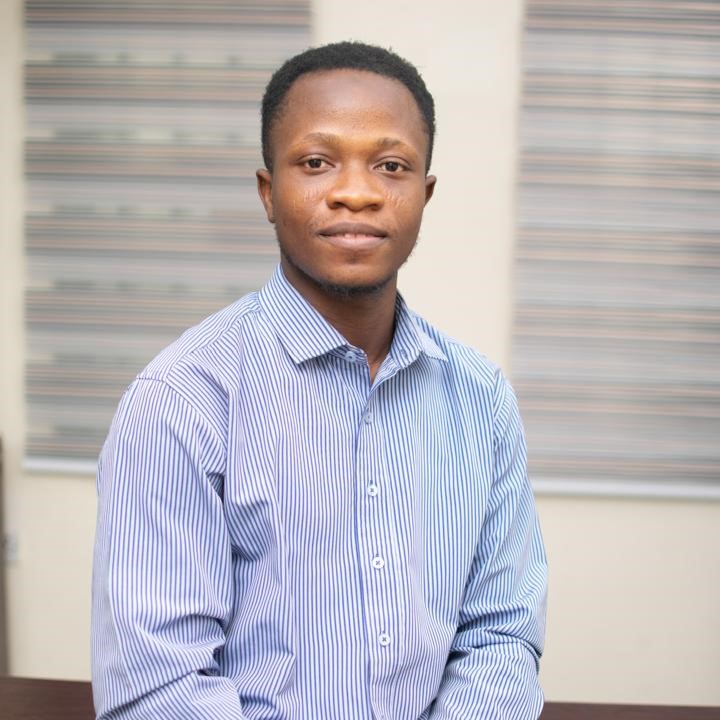

A Lagos State University (LASU) 300-level Mass Communication student, Fajana Mary, has won top prize at a fiercely contested environmental debate after arguing that Lagos State should not wait for the federal intervention to tackle its pollution challenges.
Mary emphasised that Lagos state possesses both the authority and capacity to tackle transboundary pollution.
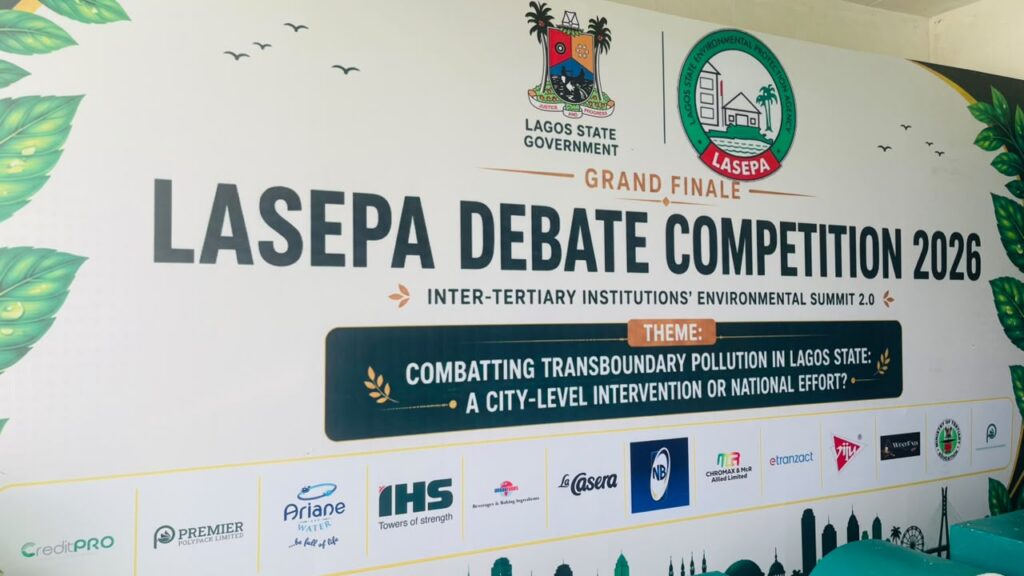
The debate formed part of the Lagos State Environmental Protection Agency’s (LASEPA) 2026 Inter-Tertiary Institutions Environmental Summit 2.0, which brought together six finalists from universities across the state to examine whether tackling transboundary pollution requires city-level action or national intervention.
The motion before the students was: “Combating Transboundary Pollution in Lagos State: A City-Level Intervention or National Effort.” Transboundary pollution refers to contamination that originates in one location but spreads across geographical boundaries, affecting other communities or states.
The event was attended by the Commissioner for Tertiary Education, Tolani Sule, represented by the Permanent Secretary, Ministry of Tertiary Education, Adeniran Kasali. Also present were the Special Adviser to the Lagos State Governor on Environment, Olalekan Rotimi-Akodu, alongside representatives of various government ministries, departments and agencies (MDAs).
In a remark delivered on behalf of the commissioner, Mr Kasali described the debate topic as timely and significant, noting that environmental challenges require collaboration across local, state and national levels.
“Let this experience inspire you to become champions of sustainable development and advocate for a cleaner, healthier and more resilient society,” he said.
Selection process and finalists
The finalists were selected from more than 400 essay submissions by students from 14 tertiary institutions in Lagos State. The entries were anonymised and assessed by a panel of academics, after which the top 20 candidates advanced to a preliminary debate round. Six students eventually qualified for the grand finale.
Five of the six finalists were drawn from the University of Lagos (UNILAG), while Mary represented LASU as the only finalist from her institution.
The competition featured arguments sharply divided along two lines: those who believed only the federal government has the legal and institutional authority to address cross-border pollution, and those who insisted Lagos already has the capacity and enforcement power to act independently.
Arguments for national intervention
The first speaker on the national intervention side, Esther Aderinto, a 400-level Chemical Engineering student at the University of Lagos (UNILAG), argued that Lagos state lacks the legal authority to regulate pollution that originates outside its jurisdiction.
She said, “City-level intervention cannot regulate pollution that originates in other states. Lagos jurisdiction ends at the Lagos border.”
She referenced a 2023 study published in Environmental Science and Pollution Research, which found that city-level environmental controls are often ineffective in addressing transboundary pollution unless supported by higher-level intergovernmental agreements.
Esther also cited the Federal Executive Council’s June 2024 nationwide ban on single-use plastics, as well as Nigeria’s commitment under the Paris Agreement to reduce greenhouse gas emissions by 20 per cent unconditionally by 2030, as examples of actions that only federal authority can effectively enforce.
Another debater on the national side, Igbinosa Delight, also of UNILAG, supported this position using the example of the Omu River, which spans approximately 23,000 square kilometres across Oyo, Ogun and Lagos states. He noted that Lagos accounts for only about 3,000 square kilometres of the basin, leaving the majority of pollution sources outside the state’s control.
He further referenced the 1988 Koko toxic waste incident, arguing that Nigeria’s response to the crisis was only possible through federal intervention under the Harmful Waste Decree of 1988, rather than state-level action.
Arguments for city-level intervention
Countering the national position, Mary of LASU argued that waiting for federal intervention would only worsen Lagos’ environmental challenges.
“Waiting for the federal government to fix Lagos’ land, air and water is like waiting for a deer to cross in front of a railway station,” she said. “That is an act of environmental suicide.”
She structured her argument around three frameworks: authority, capacity and treaty.
On authority, she cited LASEPA compliance data indicating that over 90 per cent of industries in Lagos operate without adequate waste treatment facilities, describing this as an enforcement gap that falls within the state’s jurisdiction to correct.
On capacity, she pointed to LASEPA’s 2024 enforcement record, which included 352 operations and the sealing of 609 facilities without any directive from the federal government. She also referenced a joint enforcement exercise between LASEPA and the Ogun State Environmental Protection Agency (OSEPA) along the Lagos-Ibadan Expressway, initiated at the state level.
On treaties and cooperation, she argued that Lagos could leverage regional platforms such as the Development Agenda for Western Nigeria (DAWN) Commission to establish cross-border environmental agreements with neighbouring states.
She argued that Lagos must impose penalties on the 90 per cent of industries operating without adequate facilities, citing the United Kingdom, where industrial compliance reportedly increased from 61 per cent to 89 per cent within four years following stricter regulatory enforcement.
Mary also referenced Rwanda’s 2009 ban on plastic bags, which achieved 94 per cent compliance within 18 months without federal legislation, as evidence that strong subnational action can be effective.
Also speaking for the city-level side, Nduka Onyinyechi of UNILAG highlighted Lagos State’s financial capacity, citing its first-quarter 2025 internally generated revenue of $771 million.
She proposed environmental solutions such as phytoremediation, the use of plants to absorb toxins from water bodies and large-scale tree planting along border communities.
Judges’ assessment
The panel of judges included veteran broadcaster, Babajide Kolade-Otitoju; former Vice Chancellor of LASU, Olanrewaju Fagbohun, a professor of environmental law; climate change advocate Olamide Idowu, and Senior researcher at Trinity University, Yaba, Ibrahim Oyewole.
Mr Fagbohun, who served as chief judge, said the debate underscored the importance of structured academic engagement in addressing policy questions.
“The two must work together. The state cannot run without the federal government, and the federal government cannot run without the state,” he said.
He commended the students for their depth of analysis and described the discussions as “robust and rigorous,” adding that the exercise helped clarify the distinct responsibilities of each tier of government. “A lot of kudos to LASEPA for today’s event,” he added.
LASEPA’s strategy and vision
The General Manager of LASEPA, Babatunde Ajayi, said the debate was deliberately designed to reflect current environmental realities.
“A debate is only valid when the topics are contemporary issues,” he said, noting concerns such as cross-border pollution and the growing challenge of electronic waste.
He explained that the competition is part of LASEPA’s wider advocacy strategy to engage tertiary institution students as environmental ambassadors.
According to him, both state and federal governments have critical but distinct roles in addressing pollution.
“Responsibility is best taken by whoever is closest to the pollution.. So it could be the state government. But the federal government also has a role, particularly in policy areas such as electronic waste, which fall under its jurisdiction.”
Mr Ajayi added that LASEPA also runs a separate environmental awareness programme for secondary school students, which will continue alongside the inter-tertiary initiative.
Winner speaks
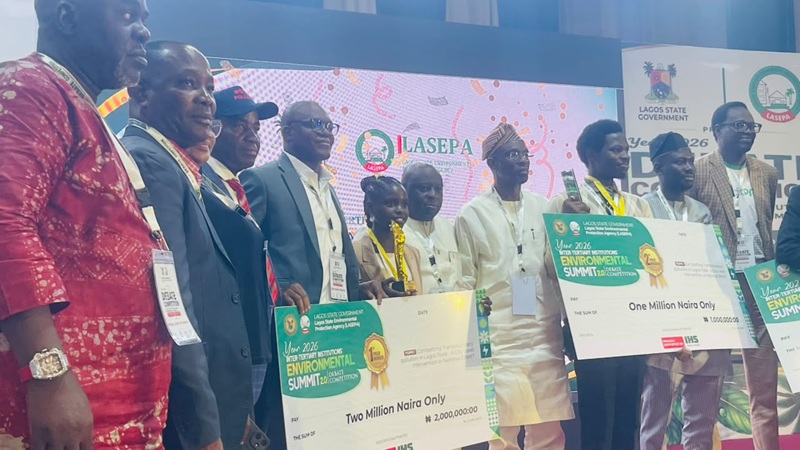
At the end of the competition, Mary of LASU emerged winner, receiving a cash prize of N2 million, while Igbinosa Nosa and Daniel Akinkuowo of UNILAG came second and third respectively, winning N1 million and N500,000.
Reacting to her victory, Mary said her argument was strengthened by the cooperation among environmental agencies within Lagos State.
“LASEPA is not the only agency operating in Lagos State. We have the Lagos State Waste Management Authority (LAWMA), and the Lagos State Waste Management Office. If they work together with LASEPA, we can create a cleaner Lagos and a healthier environment for Lagosians,” she said.

