



By Aminat Miskilu
Lagos State is yet to meet the blood supply required for its annual healthcare needs despite sustained awareness campaigns and repeated calls for voluntary blood donation, the Commissioner for Health, Akin Abayomi, has said.
Mr Abayomi said Lagos, with an estimated population of about 30 million people, requires between 200,000 and 250,000 units of blood annually but recorded only about 141,000 units in the last donation cycle, roughly 70 per cent of its target.
He warned that the shortfall leaves hospitals vulnerable, particularly during medical emergencies that require immediate blood transfusions.
The commissioner spoke at a voluntary blood donation awareness and one-to-one sensitisation campaign organised by the Lagos State Blood Transfusion Service (LSBTS) and themed “Voluntary Donors, Sustainable Blood: Securing Lagos State’s Blood Supply.”
He commended Lagosians who voluntarily donated blood and saved lives in times of medical emergencies.
The health commissioner described blood as a “liquid organ,” and emphasised that blood transfusion is comparable to organ transplantation that must follow strict scientific protocols, including rigorous screening and precise donor-recipient matching, to prevent complications and transfusion-related infections.
He clarified that blood donation poses no health risk to eligible, healthy donors; urging young people to make blood donation a regular habit. “Every pint donated translates directly into lives saved across the state’s health facilities,” he said.
The campaign formed part of activities marking LSBTS Blood Awareness month, and highlighted the state’s long-term strategy to institutionalise voluntary, non-remunerated blood donation among residents.
Blood demand cuts across daily medical emergencies
The Special Adviser to the Governor on Health, Kemi Ogunyemi, said blood demand remains constant, cutting across childbirth complications, road traffic accidents, surgeries and other daily medical emergencies.

Ms Ogunyemi said Governor Babajide Sanwo-Olu’s administration has modernised blood transfusion services in Lagos through digitisation, improved tracking systems and strengthened safety protocols to ensure that only screened and safe blood is supplied to patients.
She explained that not all prospective donors are eligible to donate, noting that robust screening processes are in place to protect both donors and recipients, while continuous training of laboratory and transfusion personnel helps ensure adherence to global best practices.
Ms Ogunyemi urged residents to overcome fears and myths surrounding blood donation, stressing that public confidence is central to sustaining the state’s blood supply.
Lagos urges sustained blood donation
In her remarks, the Permanent Secretary of the Lagos State Ministry of Health, Dayo Lajide, commended the LSBTS and voluntary donors for their commitment, describing blood as life and a critical resource for effective healthcare delivery.
Mr Lajide noted that demand for blood often rises during festive periods due to increased mobility and accidents, but stressed that the need exists year-round, making sustained donation campaigns vital to health system resilience.
Earlier, the Executive Secretary of LSBTS, Bodunrin Osikomaiya, lamented the persistent myths and misconceptions that discourage blood donation in Nigeria, even as medical emergencies, childbirth complications and accidents continue daily.
Ms Osikomaiya explained that the campaign was designed to take advocacy directly to communities, beginning with government offices, ministries, departments and agencies (MDAs), and public spaces, in a bid to lead by example and encourage broader public participation.

The Senior Special Assistant to the Governor on Health, Oluwatoni Adeyemi, expressed that blood donation should be a continuous civic duty rather than a one-off activity tied to specific campaigns.
Donors share personal experiences
Voluntary donors at the event highlighted the human impact of blood donation.
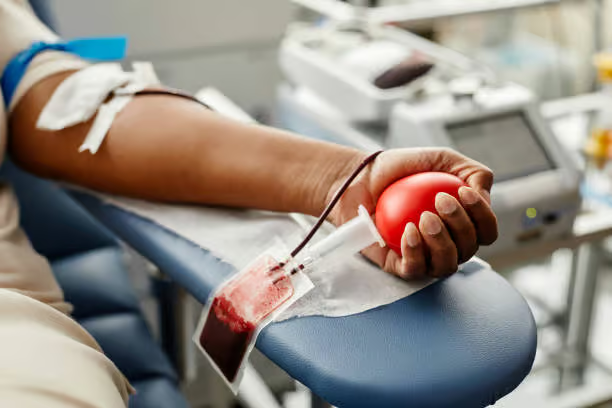
Mohammed Asalejo, who has been donating blood since 2022, said the experience has improved his sense of well-being and inspired him to encourage others to donate.
Another donor, Oladele Asalejo, who has donated blood for over 15 years, described blood donation as beneficial both medically and socially, urging residents not to be deterred by fear or misinformation.

