



By Mohammed Taoheed
At a Sallah gathering in Abuja, the Nation of Justice (NOJ) used the occasion to shift attention from food to growing concerns about accountability in Nigeria’s justice system.
Addressing a crowd of worshippers shortly after prayers at the National Mosque, the founder of the NOJ, Jyde Adelakun, used the occasion to raise concerns about impartiality in the judiciary, urging Nigerians to become more aware of their rights and demand transparency from those who wield judicial power.
Mr Adelakun who is also the Director of TOF Energy Corporation, explained that his advocacy is rooted in personal experience. He recounted how what he described as repeated instances of bias against Nigerians abroad prompted him to begin writing petitions to international bodies, including the United Nations, from 2022.
“Those countries pride themselves as united, yet are not united in how they treat others,” he said. “I made complaints on behalf of Nigerians, highlighting how they are often stigmatised when travelling to parts of Europe and beyond.”
According to him, those experiences reinforced the need to push for stronger accountability systems both within and outside Nigeria, particularly in institutions where decisions directly affect citizens’ lives.
But beyond personal grievances, his message centred on a broader concern, that weak accountability mechanisms within the justice system continue to leave citizens vulnerable, particularly when those entrusted with judicial authority are not effectively checked.
“Impartiality is something that should be upheld in judicial houses, but it often is not,” he said. “If a judge’s decision is influenced by bias, who then pays the price?”
He argued that while democratic structures exist, loopholes within the system often allow for abuse of power, making it difficult for citizens to seek redress even when injustice occurs.
Civic education for accountability
To drive the message beyond rhetoric, Mr Adelakun said the organisation has adopted civic education as its primary tool, deploying volunteers to schools, religious centres and communities to sensitise citizens on their constitutional rights and responsibilities.
According to him, the goal is to close the knowledge gap that often leaves citizens unable to challenge abuse of power or demand accountability from public institutions.
“People need to understand the law and their place in society,” he said, noting that informed citizens are better positioned to question injustice and participate meaningfully in governance.
Judicial accountability concerns
Mr Adelakun argued that one of the most critical gaps in Nigeria’s democracy lies in the limited mechanisms available to hold judicial officers accountable.
While avenues for complaints exist, he said, they are often ineffective, as the same system accused of wrongdoing is sometimes responsible for addressing those complaints.
“If it is truly a democracy, then people should be able to hold judicial powers accountable. The Nation of Justice was founded to push for this, and to make this happen,” he said.
Food distribution
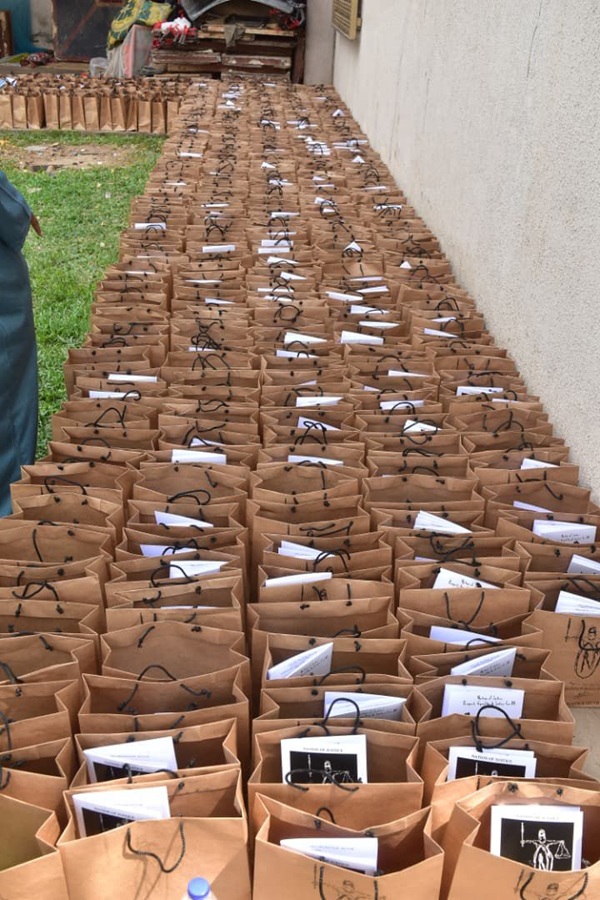
Following the discussions, the organisation distributed food packages to more than 2,000 vulnerable persons, especially women and children.
However, beyond the humanitarian gesture, the outreach served as a platform for civic engagement, with beneficiaries receiving simplified materials explaining their rights and the importance of demanding accountability.
Beneficiaries speak
For some attendees, the combination of material support and civic education left a lasting impression.
Ishaq Danladi, a medicine store worker, said the outreach changed how he viewed his role as a citizen.
“I am happy to be part of this discussion. The advice the founder gave us on why it is important to demand what is just and right made me start thinking deeply. Before now, I didn’t know the contents of the Nigerian Constitution, but the organisation explained it in a simple way.”
Another beneficiary, Aisha Mohammed, a mother of seven said the food support would provide immediate relief for her family, while the messages shared during the programme offered something more enduring.
The organisation said it plans to expand its intervention beyond periodic outreach, with proposed initiatives including scholarship programmes and skills acquisition schemes aimed at supporting vulnerable students across the country.
According to Mr Adelakun, the long-term objective remains clear – building a citizenry that is not only supported in times of need but also equipped to demand transparency and accountability from institutions meant to serve them.

