



Samson Ademola
The Bishop of the Catholic Diocese of Sokoto, Matthew Kukah, has urged young Nigerians to ground their ambitions in history and dialogue across generations, warning that a nation without memory risks losing its direction.
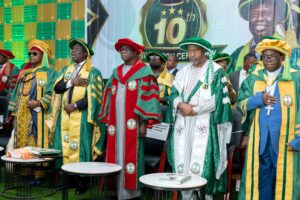
Mr Kukah made the call on Saturday, 7 February, while delivering a lecture at the 10th convocation ceremony of the Federal University Oye-Ekiti (FUOYE), where 7,684 students were awarded degrees, certificates and diplomas.
Framing his lecture around what he described as “intergenerational dialogue”, Mr Kukah argued that greatness is not achieved by abandoning the past, but by understanding it critically and building upon it.
“History is not linear. The younger generation would need to learn from Nigeria’s founding founders to build a great nation. America is great because it made its founding fathers its reference point. A country without a memory bank is like an aircraft flying without a black box,” he said.
Democracy in Nigeria and broken expectations
Reflecting on Nigeria’s democratic experience, Mr Kukah said both leaders and citizens still struggle to understand the core principles that define a functioning democracy. According to him, democracy must guarantee security, participation, inclusion, accountability and transparency, among other indicators, which he said Nigeria continues to fall short of.
“We have layers and layers of exclusion: ethnic, religious and so on. Inclusion does not mean everyone must sit at the table, but people must have a sense of fairness that if they work hard, result is assured,” he said, speaking on inclusion.
A call across generations
Mr Kukah challenged both elders and young people to rethink how they relate to one another. He urged the older generation to stop intimidating young people with early-life success stories, while encouraging youths to adopt the discipline and resilience that defined earlier generations, despite today’s distractions with phones and other technologies.
“The leaders of yesterday became leaders at very early ages, but many of them had only secondary school education or NCE. Today, we have highly educated, energetic youths using knowledge creatively. If they don’t take you to the table, build your own,” he said.
He advised the new graduates to read widely about Nigeria’s founding fathers, study their biographies and internalise the values that shaped their leadership.
“Read history. Read about the founding fathers of Nigeria. Read their proverbs. There is more to learn from them than you imagine,” he stated.
Addressing the graduating class directly, Mr Kukah added: “This is the Nigeria of your heritage. Learn from history. Look at the possibilities ahead of you. Don’t measure your life against the children of senators or look for shoulders to lean on.”
Convocation figures and honours
In his address, the Vice-Chancellor, Abayomi Fasina, a professor, said the university graduated 7,684 students, including 131 first-class degree holders, 2,519 second class upper, 3,777 second class lower, 966 third class, and three with pass degrees.
Mr Fasina, a professor of soil science, thanked the university’s governing council, management members, staff, and especially students, for their support throughout his five-year tenure, noting that the ceremony would mark his last in office.
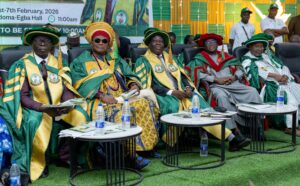
He once again reeled out his achievements while in office, urging his successor-elect, Joshua Ogunwole, also a professor of soil science, to build on the legacy being bequeathed to him.
Meanwhile, the Pro-Chancellor and Chairman of the Governing Council, Victor Ndoma-Egba, a Senior Advocate of Nigeria (SAN), also announced the conferment of honorary degrees on several distinguished Nigerians, including the Sultan of Sokoto, Muhammad Sa’ad Abubakar III; the Ooni of Ife, Adeyeye Ogunwusi; the Oloye of Oye-Ekiti, Oluwole Ademolaju Adugbole III; Matthew Kukah; and former Chief Justice of Nigeria, Walter Onnoghen.
According to the Pro-Chancellor, the honours recognise “tremendous contributions to Nigeria and humanity” and are intended to inspire service, leadership and public responsibility.
The ceremony also marked FUOYE’s 15 years of academic activity, drawing senior government officials, traditional rulers, academics and members of the university community, including the Executive Secretary of the National Universities Commission (NUC), Abdullahi Ribadu; Vice-Chancellor of the Olabisi Onabanjo University (OOU), Ago-Iwoye, Ogun State, Ayodeji Agboola, a professor, among others.

