



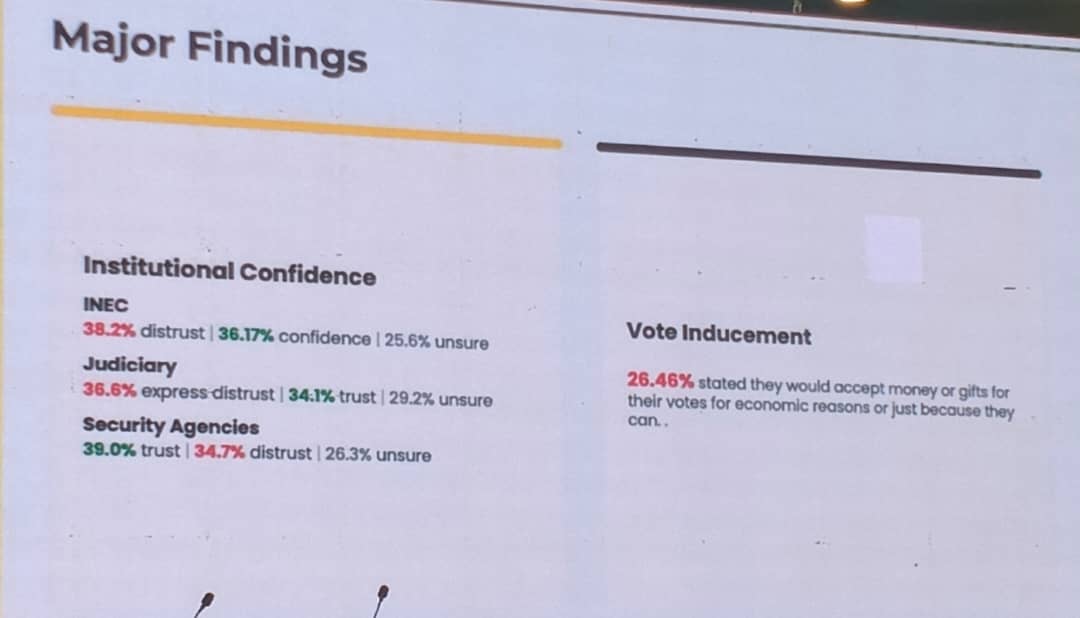
At least one in four Nigerians (26.46 per cent) would be willing to sell their votes in the 2027 general elections, according to a preliminary national perception survey by the Centre for Journalism Innovation and Development (CJID), raising concerns about the persistence of vote buying and its implications for the credibility of the forthcoming polls.
The survey also found that 38.2 per cent of respondents distrust the Independent National Electoral Commission (INEC), while 57.87 per cent believe Nigeria’s democracy has failed to deliver on its promises.
The findings, contained in a report titled Nigeria 2027: What Citizens Think, were presented by Amina Miango, Lead of CJID’s Media in National Elections Programme, at the Election Risk and Readiness Summit 2026 convened by the Centre on Wednesday.
According to Ms Miango, the survey covered all 36 states and the Federal Capital Territory (FCT), with responses from 19,519 Nigerians.
She said the research sought to determine whether concerns surrounding the conduct and outcomes of the 2023 general elections, particularly the trust deficit associated with INEC, persisted and how they might shape citizens’ participation in the 2027 elections.
Despite widespread dissatisfaction with democratic governance and concerns about electoral institutions, the findings suggest that a majority of respondents still intend to vote.
The survey found that 57.46 per cent of respondents were certain they would participate in the 2027 elections, while 15.51 per cent were undecided. Another 17 per cent said they did not intend to vote.
On confidence in INEC, 36.17 per cent expressed confidence in the electoral commission, compared with 38.2 per cent who said they distrusted it. Another 25.6 per cent were unsure about their level of confidence in the institution.
Ms Miango said the undecided respondents represented an opportunity for INEC to rebuild public confidence and strengthen trust in the electoral process.
The judiciary and security agencies also recorded considerable levels of distrust, with 36.6 per cent of respondents expressing a lack of confidence in the judiciary and 34.7 per cent distrusting security agencies.
Vote buying remains a concern
The survey identified vote buying and electoral inducement as significant concerns ahead of the 2027 elections, with 26.46 per cent of respondents saying they were willing to exchange their votes for money or other benefits.
Ms Miango said respondents’ willingness to accept electoral inducements could be influenced by economic circumstances or personal preferences.
However, the findings revealed regional differences in attitudes towards vote buying.
In the North-west, 72 per cent of respondents said they would not sell their votes, while in the FCT, 70 per cent said they would reject vote buying. In the South-east, the presentation reported that 45 per cent of respondents would reject gifts and money in exchange for their votes.
Security, economy top voters’ concerns
Beyond electoral integrity, insecurity and economic hardship emerged as the leading issues likely to influence voters’ decisions in 2027.
The survey found that 80.51 per cent of respondents identified security as a major priority, while 69.47 per cent cited the economy.
It also found that 32.6 per cent of respondents did not feel safe in their communities, highlighting the extent to which insecurity could shape electoral choices.
On the performance of democratic institutions, the presidency emerged as the most disappointing institution, identified by 50.27 per cent of respondents. INEC and the National Assembly followed.
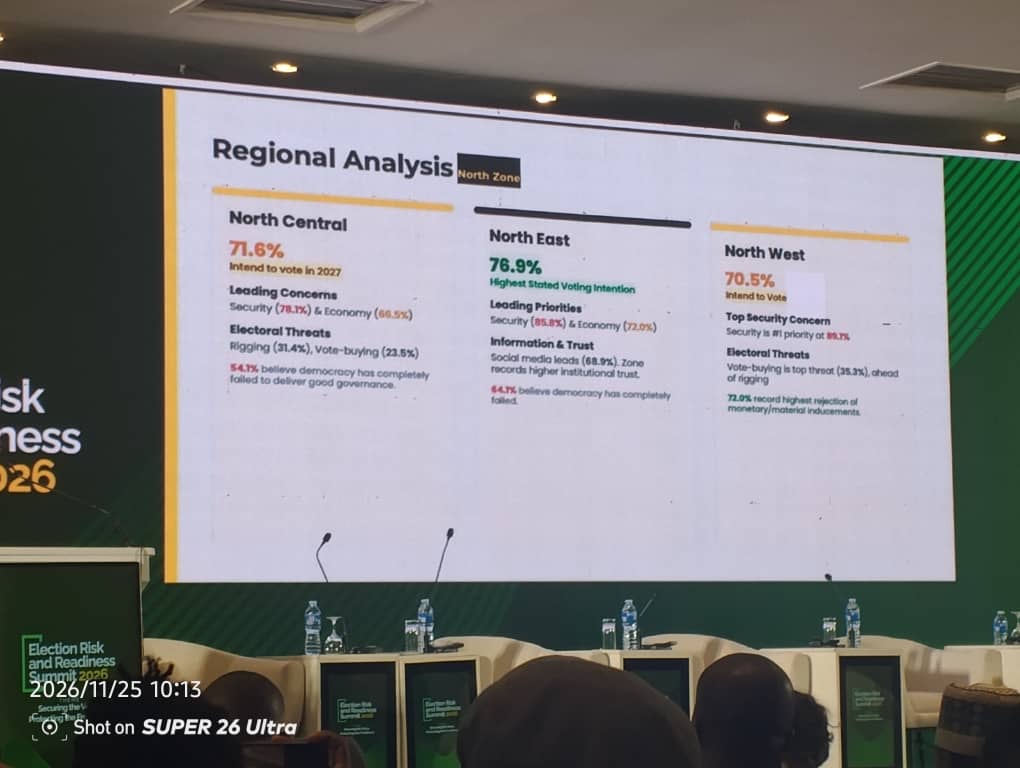
The regional findings also revealed differences in voting intentions, perceptions of democracy and institutional trust.
In the North-central, 71.6 per cent of respondents said they intended to vote in 2027, while 54.1 per cent believed democracy had failed to deliver on its promises.
The North-east recorded a voting intention of 76.9 per cent, with security emerging as the leading concern. The survey also found that 64.1 per cent of respondents in the region believed democracy had completely failed.
In the South-east, 22.1 per cent of respondents said they did not intend to vote. The region also recorded considerable dissatisfaction with democratic governance, with 67.5 per cent saying democracy had completely failed. Additionally, 58.9 per cent expressed distrust in INEC, while 37.6 per cent reported high levels of perceived insecurity.
In the South-south, 54.2 per cent of respondents expressed distrust in INEC, while 66.1 per cent said democracy had completely failed.
The South-west recorded the lowest voting intention among the regions, at 56.9 per cent. However, it also recorded the lowest level of perceived insecurity, at 25.4 per cent.
In the FCT, 66.8 per cent of respondents intended to vote in 2027, while 77.3 per cent identified the economy as a major factor influencing their voting decisions. Perceived electoral rigging was also identified as a major threat, with 41 per cent of respondents expressing concern.
CJID outlines recommendations
The survey proposed six areas of intervention to strengthen Nigeria’s electoral process and democratic governance.
These include rebuilding public confidence in electoral institutions through greater transparency, addressing voter apathy and encouraging participation, and tackling vote buying and other forms of electoral inducement.
It also recommended stronger measures to improve electoral security and protect citizens, alongside efforts to promote information integrity and tackle the spread of unreliable information during elections.
The final recommendation called for more inclusive governance and issue-based politics, urging political actors to prioritise accountability and citizens’ interests.
The findings come as political stakeholders and electoral institutions prepare for the 2027 general elections, with questions around electoral credibility, public trust, insecurity and economic conditions expected to shape the political landscape.