


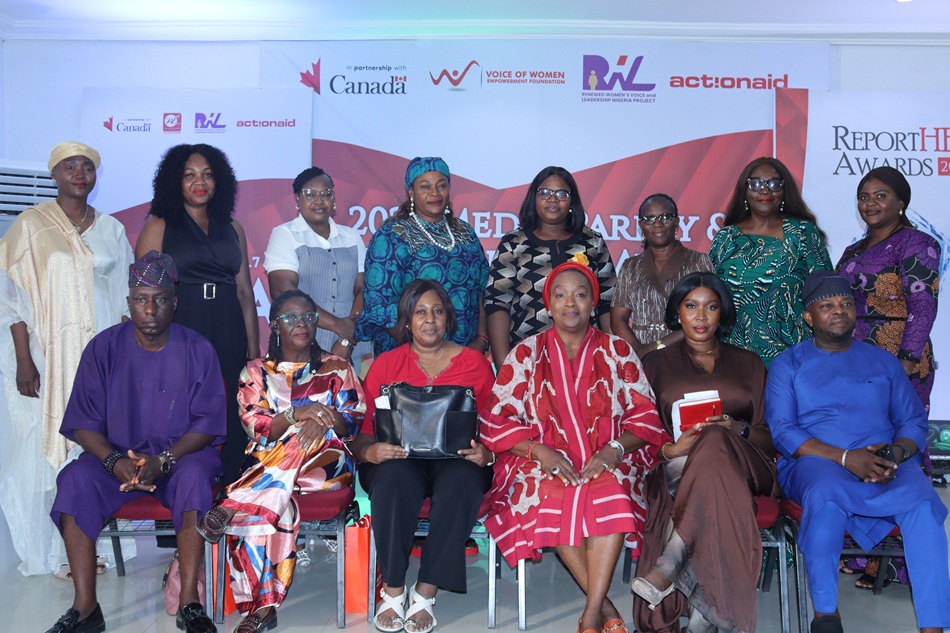
A gender-focused radio station in Nigeria, Women Radio WFM91.7, has appealed to editors, publishers and media organisations across the country to amplify women’s voices, give greater visibility to their contributions, leadership and experiences across different sectors, and ensure that issues affecting them receive sustained media attention.
The organisation made the call at a media parley organised in collaboration with the Voice of Women Empowerment Foundation (VOWEF) under the Renewed Women’s Voice and Leadership Nigeria (RWVL-N) Project, implemented by ActionAid Nigeria with funding from Global Affairs Canada.
Speaking at the engagement, themed ‘Advancing Women’s Representation Through Gender-Responsive Journalism’, the Chairman, Board of Directors, Women Radio WFM91.7 and Executive Director of VOWEF, Toun Okewale-Sonaiya, commended media leaders for helping to bring issues affecting women and girls into public discussions.
At the media parley, editors, publishers, media executives and women’s rights advocates explored ways to strengthen collaboration towards more sustained and balanced coverage of women’s contributions, challenges and aspirations.
However, Mrs Okewale-Sonaiya urged media leaders to move beyond simply giving women visibility to ensuring they are fairly represented in spaces where decisions are made.
She called for more women to feature in news reports, set editorial agendas, shape public conversations and occupy positions of influence.
Mrs Okewale-Sonaiya also challenged media organisations to move beyond portraying women mainly as victims, wives or beneficiaries of interventions, and tell more stories about their roles as decision-makers, innovators, entrepreneurs, political leaders and agents of change.
Ahead of the 2027 general elections, she highlighted the low representation of women, saying that only 1,481 of the 14,674 candidates contesting the five major elective offices – president, governor, Senate, House of Representatives and state Houses of Assembly were women, representing 10.1 per cent, compared with 89.9 per cent men.
Among the women seeking elective positions she highlighted were Nkeiruka Onyejeocha, seeking a return to the House of Representatives in Abia State; Adijat Adeleye, contesting for the House of Representatives in Ifo/Ewekoro, Ogun State; Rukayat Shittu, seeking a second term in the Kwara State House of Assembly; Jennifer Agbaji, contesting for the Senate in Kaduna North; and Bolanle Sarumi-Aliyu, seeking to represent Oyo South in the Senate.
She noted that the call was not for political endorsement or preferential treatment but for fair visibility, balanced reporting and equal opportunities for women and men to be heard. “Research the Nigerian woman, follow her and profile her. Be intentional and deliberate, keep reporting the woman until something happens,” Mrs Okewale-Sonaiya said.
Delivering remarks on behalf of the Chief Executive Officer of News Central, Kayode Akintemi, the media organisation’s Director of Programmes, Tolulope Adeleru-Balogun, challenged editors to examine how newsroom decisions influence the representation of women in public conversations.
She said women remained underrepresented in reporting on politics, the economy, security and governance, citing the 2025 Global Media Monitoring Project, which found that women accounted for only 26 per cent of people appearing in global print and broadcast news.
Mrs Adeleru-Balogun said gender-responsive journalism was not about giving women preferential treatment or compromising editorial standards, but ensuring they had fair opportunities to be heard, recognised as experts and represented across different subject areas.
She also urged journalists to pay closer attention to language, headlines and story framing, particularly when reporting gender-based violence, calling for accurate, sensitive and responsible coverage that informs audiences without causing unnecessary harm.
RWVL-N targets 188 women’s rights organisations
Providing an overview of the Renewed Women’s Voice and Leadership Nigeria Project, Emmanuel Olonade, a communications specialist, described it as an intervention aimed at strengthening women’s rights organisations, advancing gender equality and creating opportunities for women and girls to influence decisions, policies and institutions that affect their lives.
He said the five-year project, running from April 2025 to March 2030 builds on the achievements of the first Women’s Voice and Leadership Nigeria Project and seeks to strengthen organisations and movements working to advance women’s rights across the country.
According to Mr Olonade, the project targets 188 women’s rights organisations across eight states: Bauchi, Benue, Cross River, Enugu, Imo, Kebbi, Kwara and Lagos.
It aims to reach more than 375,000 direct participants, including 260,000 women and girls and 18,750 persons with disabilities, as well as over 2.2 million indirect beneficiaries.
He identified the project’s key areas of intervention as women’s leadership and political participation, prevention of gender-based violence, economic justice, community mobilisation and advocacy, and institutional sustainability.
The project according to him, supports women’s rights organisations to address barriers affecting women and girls, including economic exclusion, discrimination, violence, limited political representation and unequal access to opportunities.
Commenting on economic justice, he highlighted support for Village Savings and Loan Association (VSLA) groups, which enable women to save collectively, access loans and strengthen their economic activities. He also stressed the importance of women’s participation in agriculture, entrepreneurship and access to markets.
Speaking on gender-based violence, Mr Olonade said the project supported awareness creation, advocacy and improved access to protection and justice for survivors, while encouraging stronger community responses to violence against women and girls.
He added that the initiative also focused on strengthening the institutional capacity, sustainability, communications and visibility of women’s rights organisations, noting that strong organisations and movements were essential to achieving lasting change.
While providing an update on the project’s implementation, he disclosed that between April and July 2026, it reached 22,634 direct beneficiaries through 102 activities conducted by 14 partner organisations across 52 Local Government Areas and 96 communities.
The beneficiaries included 17,394 women aged 18 and above and 1,324 persons with disabilities, he said.
He added that 36 women’s rights organisations had participated in a multi-phase institutional development programme designed to improve their organisational structures, governance, sustainability, programme delivery, communications and visibility.
Mr Olonade also disclosed that the project supported 346 VSLA groups across 11 states, with a combined membership of 7,842 people, approximately 90 per cent of whom were women.
He highlighted the policy achievements of the previous Women’s Voice and Leadership Nigeria Project, saying partner organisations influenced 47 gender-related laws and policies between 2019 and 2024.
These included advocacy around the Violence Against Persons (Prohibition) Act and state VAPP laws, the Child Rights Act, the 35 per cent Affirmative Action target, university gender policies and disability rights policies.
Media urged to report grassroots women’s experiences
Mr Olonade urged journalists and media executives to broaden their coverage of women’s issues beyond political participation.
He called for more reports highlighting women farmers, entrepreneurs, women with disabilities, community advocates, survivors seeking justice, women in leadership and grassroots organisations driving social change.
He further urged media organisations to investigate the implementation of gender-related laws and policies, examine barriers to women’s economic and political participation, promote ethical reporting on gender-based violence and document the impact of grassroots interventions.
According to him, women’s rights organisations across Nigeria’s six geopolitical zones have stories, experiences and interventions that deserve national attention.
He said stronger partnerships with the media would help bring these grassroots efforts into wider public conversations and encourage greater accountability.

